Reasons for choosing our testing services
ZHONGXI Testing has obtained inspection qualification certifications from multiple countries and regions worldwide. We possess a senior testing team and advanced testing methods, providing independent, impartial, and professional third-party verification services for global carbon projects.

Internationally recognized authority
Certified by multiple international standards such as CNAS, VCS, and GS, with reports universally applicable worldwide.

Global service capability
Covering 140+ countries and regions, it supports on-site detection and remote verification in multiple languages.

Professional experimental methods
Adopt standard experimental methods to ensure accurate and reliable data.
Comprehensive Guide to Building Material Testing: Ensuring Structural Safety and Compliance
Building materials form the physical foundation of all construction projects—from residential homes and commercial buildings to bridges, dams, and highways. The quality, durability, and performance of materials such as concrete, steel, aggregates, bricks, timber, asphalt, and mortar directly determine the safety, longevity, and cost-effectiveness of a structure. Building material testing is therefore an essential quality control process that verifies material properties against national and international standards, prevents premature failures, and ensures regulatory compliance. This article provides a systematic overview of the introduction, testing scope, key test items, and common testing methods for building materials.
1. Introduction
Building material testing involves the application of physical, mechanical, chemical, and non-destructive techniques to evaluate the properties of raw materials, semi-finished products, and finished construction components. The primary objectives are: verify conformity with standards (e.g., ASTM, EN, ISO, GB, BS); assess strength, durability, and workability under expected service conditions; detect defects or impurities that could compromise structural integrity; provide quality assurance data for design, procurement, and acceptance. Testing is performed at various stages: incoming material inspection, during construction, and for existing structure assessment (retrofitting or forensic analysis).
2. Testing Scope
The scope of building material testing is broad, covering most materials used in construction. Major categories include:
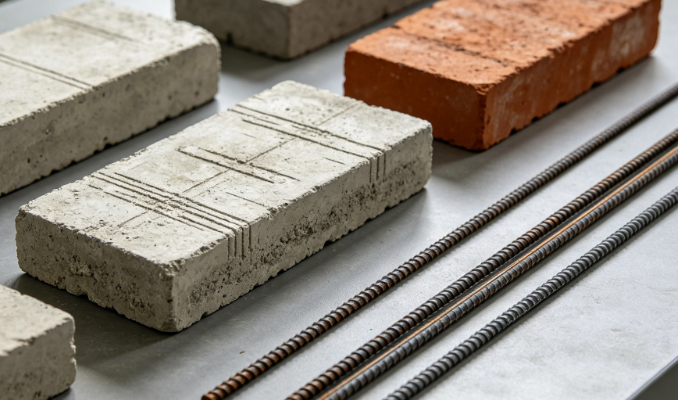
concrete and cementitious materials: Portland cement, blended cements, aggregates (coarse and fine), fresh concrete, hardened concrete, grout, mortar, admixtures.
Metals and steel products: Reinforcing steel bars (rebar), structural steel sections, steel plates, steel wires, fasteners, bolts, welded connections.
Aggregates and soils: Crushed stone, gravel, sand, recycled aggregates, subgrade soil, fill material.
Masonry units: Clay bricks, concrete blocks, aerated autoclaved concrete (AAC) blocks, stone masonry.
Timber and wood products: Structural lumber, plywood, laminated veneer lumber (LVL), glulam, wood-based panels.
Bituminous materials: Asphalt binder, hot mix asphalt (HMA), asphalt emulsions, bitumen for waterproofing.
Other materials: Geosynthetics, insulation materials, sealants, adhesives, pipes, tiles, and protective coatings.
3. Testing Items
Building material testing items are grouped by material type and performance parameter. Common testing items across categories include:
3.1 concrete and cement Testing
Workability: Slump test, Vebe time, compaction factor.
Strength: compressive strength (cube, cylinder), flexural strength, tensile splitting strength.
Durability: Water permeability, chloride ion penetration, resistance to freeze-thaw cycles, sulfate attack, alkali-silica reaction (ASR).
Setting time: Initial and final setting time of cement paste.
Consistency: Normal consistency of cement.
3.2 Steel and Reinforcement Testing
Tensile properties: yield strength, ultimate tensile strength, percentage elongation, reduction of area.
Bend and rebend tests: Ductility and ability to withstand bending without cracking.
Hardness: Rockwell or brinell hardness.
Chemical composition: Carbon equivalent, sulfur, phosphorus, manganese, etc.
Mass per unit length and geometric dimensions.
3.3 Aggregate Testing
Grading (sieve analysis): Particle size distribution.
Specific gravity and water absorption.
Bulk density and voids.
Shape indices: Flakiness and elongation index.
Soundness: Resistance to weathering (sodium or magnesium sulfate).
Abrasion resistance: Los Angeles abrasion value.
Crushing value and impact value.
3.4 Soil and Subgrade Testing
Moisture content.
Atterberg limits: Liquid limit, plastic limit, shrinkage limit.
Particle size analysis (sieve and hydrometer).
Proctor compaction test: Maximum dry density and optimum moisture content.
California Bearing Ratio (CBR).
Direct shear and triaxial shear strength.
Consolidation test (settlement characteristics).
3.5 Masonry (Bricks & Blocks) Testing
compressive strength of brick/block.
Water absorption and efflorescence.
Dimensional tolerance and warpage.
Modulus of rupture.
Thermal conductivity (for insulating blocks).
3.6 Timber Testing
Moisture content.
Static bending strength (modulus of rupture and modulus of elasticity).
Compression parallel and perpendicular to grain.
Tension parallel to grain.
shear strength.
Hardness (Janka test).
Nail and screw holding capacity.
3.7 Asphalt and Bitumen Testing
Penetration (consistency).
Softening point (Ring & Ball).
Ductility.
Flash point and fire point.
Specific gravity.
Loss on heating.
Marshall stability and flow for asphalt mixtures.
4. List of Testing Methods
The following are standard test methods used for building materials, organized by technique and applicable standard bodies (ASTM, EN, ISO, BS, GB).
4.1 concrete and cement Test Methods
Slump test: ASTM C143, EN 12350-2, BS 1881-102.
compressive strength of concrete cubes/cylinders: ASTM C39, EN 12390-3, ISO 4012, GB/T 50081.
Flexural strength of concrete: ASTM C78, EN 12390-5.
Splitting tensile strength: ASTM C496, EN 12390-6.
Water permeability: DIN 1048, BS EN 12390-8.
Setting time of cement (Vicat apparatus): ASTM C191, EN 196-3.
compressive strength of cement mortar: ASTM C109, EN 196-1.
4.2 Steel Reinforcement Test Methods
Tensile test of steel rebar: ASTM A615, ISO 6892-1, BS 4449, GB/T 228.1.
Bend and rebend test: ASTM E290, ISO 7438, GB/T 232.
Weight and dimensions: ASTM A615, BS 4449.
Chemical analysis (spectrometry): ASTM E415, ISO 14284.
Hardness test: ASTM E10 (Brinell), ASTM E18 (Rockwell).
4.3 Aggregate Test Methods
Sieve analysis: ASTM C136, EN 933-1, ISO 3310, GB/T 14685.
Specific gravity and water absorption: ASTM C127 (coarse) / C128 (fine), EN 1097-6.
Los Angeles abrasion: ASTM C131, EN 1097-2, GB/T 14685.
Flakiness & elongation index: BS 812-105, EN 933-3.
Soundness: ASTM C88, EN 1367-2.
Aggregate crushing value (ACV): BS 812-110.
Aggregate impact value (AIV): BS 812-112.
4.4 Soil Test Methods
Moisture content (oven-dry method): ASTM D2216, BS 1377-2, ISO 17892-1.
Atterberg limits: ASTM D4318, BS 1377-2, ISO 17892-12.
Standard Proctor compaction: ASTM D698, BS 1377-4, ISO 17892-2.
Modified Proctor: ASTM D1557.
CBR (California Bearing Ratio): ASTM D1883, BS 1377-9.
Direct shear test: ASTM D3080, BS 1377-7, ISO 17892-10.
Particle size distribution (sieve & hydrometer): ASTM D6913, ASTM D7928.
4.5 Masonry Unit Test Methods
compressive strength of bricks: ASTM C67, EN 772-1, GB/T 2542.
Water absorption: ASTM C67, EN 772-21.
Efflorescence test: ASTM C67, GB/T 2542.
Dimensional measurement: EN 772-16.
4.6 Timber Test Methods
Moisture content (meter or oven-dry): ASTM D4442, EN 13183.
Static bending (MOR & MOE): ASTM D143, EN 408, ISO 3133.
Compression parallel to grain: ASTM D143, EN 408, ISO 3787.
Janka hardness: ASTM D143, ISO 3350.
Nail withdrawal resistance: ASTM D1761.
4.7 Asphalt and Bitumen Test Methods
Penetration test: ASTM D5, EN 1426, ISO 4945.
Softening point (Ring & Ball): ASTM D36, EN 1427, ISO 4625.
Ductility test: ASTM D113, EN 13358.
Flash point (Cleveland open cup): ASTM D92, EN 22592.
Loss on heating: ASTM D6, EN 13303.
Marshall stability test (for asphalt mixtures): ASTM D6927, EN 12697-34.
4.8 Non-Destructive Testing (NDT) for Construction Materials
Rebound hammer (Schmidt hammer): ASTM C805, EN 12504-2 – estimates in-place concrete strength.
Ultrasonic pulse velocity (UPV): ASTM C597, EN 12504-4 – assesses uniformity, cracks, and elastic modulus.
Half-cell potential measurement: ASTM C876 – detects corrosion risk of reinforcing steel.
Covermeter (reinforcement cover & bar location): BS 1881-204, EN 12504-3.
Impact echo: ASTM C1383 – detects voids and delaminations in concrete slabs.
Ground penetrating radar (GPR): for subsurface imaging and rebar mapping.
Building material testing is a systematic discipline that ensures construction projects are safe, durable, and cost-effective. From the compressive strength of concrete to the ductility of steel and the compaction of soil, each test provides critical data that guides material selection, quality control, and structural design. Adherence to internationally recognized standards (ASTM, EN, ISO, BS, GB) is essential for consistency and legal acceptance. As the construction industry evolves toward sustainable materials, recycled aggregates, and high-performance composites, testing methods are also advancing with digital data logging, artificial intelligence for defect detection, and portable field testing devices. Whether for a new skyscraper, a bridge, or a residential foundation, rigorous building material testing is the backbone of engineering reliability and public safety. It is strongly recommended to use accredited laboratories (CMA/CNAS/UKAS/A2LA) and certified inspection personnel to ensure test results are accurate, traceable, and defensible.
(This article is based on common international practices; for specific testing standards, always refer to the latest applicable version of the relevant code.)