Reasons for choosing our testing services
ZHONGXI Testing has obtained inspection qualification certifications from multiple countries and regions worldwide. We possess a senior testing team and advanced testing methods, providing independent, impartial, and professional third-party verification services for global carbon projects.

Internationally recognized authority
Certified by multiple international standards such as CNAS, VCS, and GS, with reports universally applicable worldwide.

Global service capability
Covering 140+ countries and regions, it supports on-site detection and remote verification in multiple languages.

Professional experimental methods
Adopt standard experimental methods to ensure accurate and reliable data.
Comprehensive Guide to Ceramic Material Testing: From Traditional Pottery to Advanced Technical Ceramics
Ceramic materials are among the oldest and most versatile engineering materials. They range from traditional products like bricks, tiles, and sanitaryware to advanced technical ceramics such as alumina (Al₂O₃), zirconia (ZrO₂), silicon carbide (SiC), silicon nitride (Si₃N₄), and ceramic matrix composites (CMCs). Ceramics are valued for their high hardness, wear resistance, high-temperature stability, chemical inertness, and unique electrical properties. However, they are also inherently brittle, making rigorous quality testing essential. Ceramic material testing ensures that these materials meet required specifications for structural, thermal, electrical, and biomedical applications. This article provides a systematic overview of the introduction, testing scope, key test items, and common test methods for ceramic materials.
1. Introduction
Ceramic material testing involves the application of mechanical, thermal, electrical, chemical, and microstructural characterization techniques to evaluate raw materials (clays, powders, glazes) as well as fired or sintered products. The primary objectives are: verify conformity with international standards (ASTM, ISO, EN, JIS, GB); assess mechanical strength and fracture toughness – critical for brittle materials; determine thermal and electrical performance for functional ceramics; evaluate chemical durability and phase composition; provide quality assurance for industries ranging from construction to aerospace and medical implants.
2. Testing Scope
The scope of ceramic material testing is broad, covering various ceramic families and product forms:
By material type: Traditional ceramics (earthenware, stoneware, porcelain, wall and floor tiles, bricks, roof tiles, sanitaryware); Advanced/technical ceramics (alumina, zirconia, silicon nitride, silicon carbide, cordierite, mullite, steatite, ferrites, piezoelectric ceramics, bioceramics); Refractories (fireclay, high-alumina, silica, magnesia, castables, insulating firebricks); Glass-ceramics; Ceramic coatings; Cermets; Ceramic matrix composites (CMC).
By application industry: Construction (tiles, bricks, pipes); Aerospace (turbine blades, thermal protection); Automotive (sensors, spark plugs, brake discs); Electronics (substrates, insulators, capacitors, varistors, piezoelectrics); Medical (dental ceramics, hip replacements); Energy (solid oxide fuel cells, nuclear fuel pellets); Chemical processing (corrosion-resistant linings, membranes).
3. Testing Items
Ceramic material testing items can be grouped into six major categories:
3.1 Mechanical Properties
Flexural strength (modulus of rupture – MOR): Most common strength measurement for ceramics (3-point or 4-point bending).
compressive strength: Important for bricks, refractories, and structural ceramics.
Fracture toughness (KIC): Resistance to crack propagation – critical for brittle materials.
Hardness: Vickers, Knoop, or rockwell hardness for sintered ceramics.
Weibull modulus: Statistical measure of strength reliability and flaw distribution.
tensile strength: Less common due to gripping difficulties; often derived indirectly.
Impact strength (Charpy/Izod): For some high-toughness ceramics.
Wear resistance (abrasion, erosion): Essential for tiles and grinding media.
Modulus of elasticity (Young’s modulus): Determined via resonant frequency or ultrasonic methods.
3.2 Thermal Properties
Thermal expansion coefficient (CTE): Important for thermal shock resistance and joining with metals.
Thermal conductivity (k): For heat sinks, insulators, or furnace linings.
Thermal diffusivity and specific heat capacity.
Thermal shock resistance: Ability to withstand rapid temperature changes (quenching test or R-parameter).
Refractoriness (pyrometric cone equivalent – PCE): For refractory ceramics.
Melting point or softening point.
3.3 Electrical Properties
Dielectric strength (Breakdown Voltage).
Dielectric constant (permittivity) and dissipation factor (tan δ).
Volume and surface resistivity (Insulation Resistance).
Piezoelectric coefficients (d33, d31): For piezoceramics.
Ferroelectric hysteresis (P-E loop).
Curie temperature (TC).
3.4 Microstructure and Composition
Phase analysis (XRD – X-ray diffraction): Identify crystalline phases (e.g., α-alumina vs. γ-alumina, tetragonal vs. monoclinic zirconia).
Chemical composition (XRF, ICP, EDS).
Grain size and distribution (SEM, intercept method).
Porosity, bulk density, and apparent density (Archimedes method).
Water absorption (for tiles, bricks).
Surface roughness and topography (profilometer, AFM).
Presence of glassy phases or microcracks.
3.5 Chemical and Environmental Durability
Chemical resistance (acid, alkali, salt spray).
Corrosion resistance in aggressive environments (molten metals, slags).
Hydrothermal stability (for bioceramics and SOFC materials).
Leaching of heavy metals (for food-contact ceramics like glazes).
Frost resistance (freeze-thaw cycles) for outdoor ceramics.
3.6 Surface and Appearance Properties (for Traditional Ceramics)
Modulus of rupture of glazed tiles.
Glaze hardness and scratch resistance.
Color, gloss, and surface flatness.
Stain resistance and cleanability.
Crazing resistance (cracking of glaze).
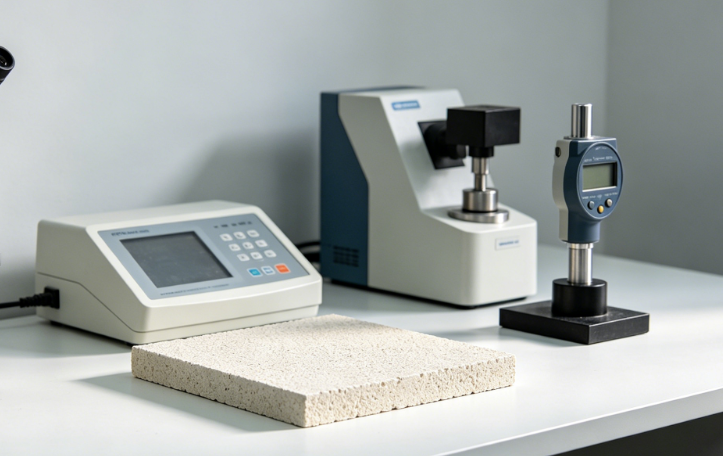
4. List of Testing Methods
The following are standard test methods used for ceramic materials, organized by property and referencing major international standards (ASTM, ISO, EN, JIS, GB).
4.1 Mechanical Testing Methods
Flexural strength (3-point or 4-point bending): ASTM C1161 (advanced ceramics), ISO 14704, EN 843-1, ASTM C674 (traditional ceramics).
compressive strength: ASTM C773, ISO 14705, EN 993-5 (refractories).
Fracture toughness (KIC): ASTM C1421 (chevron notch, single-edge precracked beam, surface crack in flexure).
vickers hardness: ASTM C1327, ISO 14705, EN 843-4.
knoop hardness: ASTM C1326.
Weibull modulus estimation: ASTM C1239, ISO 20501.
Impact testing (Charpy): ISO 179-1 (adapted for ceramics).
Wear resistance (abrasion): ASTM C704 (sandblasting), ISO 4645 (glazed tiles).
Young’s modulus by resonant frequency: ASTM C1198, ISO 12680-1.
Ultrasonic velocity method: ASTM E494.
4.2 Thermal Testing Methods
Linear thermal expansion (dilatometry): ASTM E228, ISO 17562, EN 10309.
Thermal conductivity (steady-state guarded hot plate or laser flash method): ASTM C177, ASTM E1461 (laser flash), ISO 18755, ISO 22007-4.
Thermal diffusivity (laser flash): ASTM E1461, ISO 13826.
Thermal shock resistance (quenching test): ASTM C1525, ISO 2747 (glazed tiles).
Refractoriness under load (RUL): ASTM C16, ISO 1893 (refractories).
Pyrometric cone equivalent (PCE): ASTM C24, ISO 4525.
Differential thermal analysis (DTA) / Differential scanning calorimetry (DSC): ASTM E794, ISO 11357.
4.3 Electrical Testing Methods
Dielectric strength: ASTM D149, IEC 60243-1.
Dielectric constant and dissipation factor: ASTM D150, IEC 61167.
Volume/surface resistivity: ASTM D257, IEC 60093.
Piezoelectric d33 coefficient (quasi-static method): IEEE 176, IEC 60483.
Ferroelectric hysteresis measurement (Sawyer-Tower circuit): ASTM E1853.
Curie temperature measurement: Using permittivity vs. temperature or DSC.
4.4 Microstructure and Density Testing
X-ray diffraction (XRD) phase analysis: ASTM E975, E1426.
Scanning electron microscopy (SEM) with EDS: ASTM E1508, E2809.
Apparent porosity, bulk density, and water absorption (Archimedes method): ASTM C20, ISO 10545-3 (tiles), EN 993-1 (refractories).
True density (gas pycnometry): ASTM D5550, ISO 12154.
Grain size measurement (linear intercept method): ASTM E112, E1382.
Particle size distribution of ceramic powders (laser diffraction): ASTM C1070, ISO 13320.
BET specific surface area (nitrogen adsorption): ASTM D3663, ISO 9277.
4.5 Chemical Resistance and Durability
Acid/alkali resistance (static immersion or boiling method): ASTM C1895, ISO 10545-13 (tiles), ISO 1771 (chemical porcelain).
Resistance to salt spray: ASTM B117 (for coated or glazed ceramics).
Leaching of lead and cadmium (glazed ceramics): ISO 6486, EN 1388, GB 4806.4.
Frost resistance (freeze-thaw): ASTM C1026 (tiles), ISO 10545-12.
4.6 Special Methods for Advanced Ceramics
R-curve testing (rising fracture resistance): ASTM C1421.
Edge chip resistance: ASTM C1624 (sharp edge contact).
Ball-on-three-balls (B3B) test for biaxial strength: ISO 22082.
Cyclic fatigue testing (for ceramic matrix composites): ASTM C1360.
High-temperature flexural strength (hot bending): ASTM C1341, ISO 17565.
4.7 Traditional Ceramic and Tile Testing Methods
Water absorption for tiles: ISO 10545-3, ASTM C373.
Breaking strength and modulus of rupture for tiles: ISO 10545-4, ASTM C648.
Deep abrasion resistance (glazed tiles): ISO 10545-6, ASTM C1027.
Resistance to staining (glazed tiles): ISO 10545-14, ASTM C1378.
Crazing resistance (autoclave test): ISO 10545-11.
Linear thermal expansion of tiles: ISO 10545-8.
Determination of flatness and squareness: ISO 10545-2.
Ceramic material testing is a multidisciplinary field that bridges traditional craftsmanship and high-technology applications. From the simple water absorption test on a floor tile to the sophisticated fracture toughness measurement of a zirconia femoral head, each test method plays a critical role in ensuring material performance, safety, and longevity. With the growing use of advanced ceramics in extreme environments (aerospace, biomedical implants, solid oxide fuel cells), test methods continue to evolve – incorporating in-situ characterization, digital image correlation (DIC) for strain mapping, and high-temperature mechanical testing. Whether you are a manufacturer of porcelain tiles, a supplier of refractory bricks, or a developer of ceramic matrix composites, adhering to internationally recognized standards (ASTM, ISO, EN, JIS, GB) and using accredited laboratories (CMA/CNAS/UKAS/A2LA) is essential for product acceptance, liability reduction, and market access. A robust testing protocol ensures that even the most brittle material can be trusted to perform reliably under demanding conditions.
(This article is based on common international practices; for specific testing standards, always refer to the latest applicable version of the relevant standard.)