Reasons for choosing our testing services
ZHONGXI Testing has obtained inspection qualification certifications from multiple countries and regions worldwide. We possess a senior testing team and advanced testing methods, providing independent, impartial, and professional third-party verification services for global carbon projects.

Internationally recognized authority
Certified by multiple international standards such as CNAS, VCS, and GS, with reports universally applicable worldwide.

Global service capability
Covering 140+ countries and regions, it supports on-site detection and remote verification in multiple languages.

Professional experimental methods
Adopt standard experimental methods to ensure accurate and reliable data.
Advanced Analytical Testing for Lithium‑Nickel Compounds (Li‑Ni‑O / LiNiO₂ / NCA / NMC Precursors)
If you are searching for lithium‑nickel compound testing, you are likely working with high‑energy‑density cathode materials such as LiNiO₂ (lithium nickel oxide), LiNiₓCoᵧAl₁₋ₓ₋ᵧO₂ (NCA), LiNiₓMnᵧCo₁₋ₓ₋ᵧO₂ (NMC), or lithiated nickel‑containing precursors. These materials are central to advanced lithium‑ion batteries for electric vehicles and portable electronics. Even small deviations in Li/Ni stoichiometry, nickel oxidation state, or trace impurities can cause capacity loss, thermal runaway, or cycle life degradation. We understand that your need for testing is driven by synthesis optimization, production QC, incoming material verification, or failure analysis. Our laboratory offers the most comprehensive, high‑depth analytical suite for lithium‑nickel compounds – from bulk composition to atomic‑level electronic structure and safety‑critical parameters.
What We Can Do for Your Lithium‑Nickel Compound Samples
We provide a complete testing program tailored to all lithium‑nickel‑based materials, including LiNiO₂, Ni‑rich NMC (e.g., NMC811, NMC955), NCA, and lithiated nickel hydroxide/oxide precursors. Our core capabilities include:
- Elemental stoichiometry (Li, Ni, Co, Mn, Al, O, and dopants) by inductively coupled plasma optical emission spectrometry (ICP‑OES) and ICP‑MS. Specialized lithium quantification using flame atomic emission spectrometry (FAES) with matrix‑matched calibration – accuracy ±0.3% relative.
- Ni²⁺ / Ni³⁺ / Ni⁴⁺ oxidation state analysis via redox titration (iodometric or cerimetric method) and X‑ray photoelectron spectroscopy (XPS) with peak deconvolution. Average nickel valence is directly correlated to reversible capacity.
- Trace metal impurities (Na, Ca, Fe, Cu, Zn, Al, Pb, Cd, Cr, etc.) by high‑resolution ICP‑MS (detection limits down to 0.01 ppm). Special attention to magnetic metal particles (Fe, Ni, Co in elemental form) using magnetic extraction and ICP‑MS – detection limit 0.1 ppm, critical for preventing internal short circuits.
- Crystalline phase identification & quantitative Rietveld refinement by X‑ray diffraction (XRD). Detect Li/Ni cation mixing (a major defect in LiNiO₂) as low as 0.5%, and quantify secondary phases such as Li₂CO₃, NiO, or LiOH.
- Lithium‑nickel disorder (cation mixing) determination via Rietveld refinement of XRD data and confirmed by ⁷Li solid‑state NMR (distinguishes Li in Ni sites).
- Surface carbonate & hydroxide contamination by XPS depth profiling and TGA‑MS (evolved CO₂ and H₂O from 100–500 °C).
- Particle morphology & size distribution by high‑resolution SEM (with EDS mapping) and laser diffraction (0.01–2000 µm).
- Specific surface area (BET, N₂ adsorption) and tap density – key for electrode slurry formulation.
- Moisture & adsorbed species quantification by Karl Fischer oven method (solid sample heating to 250 °C).
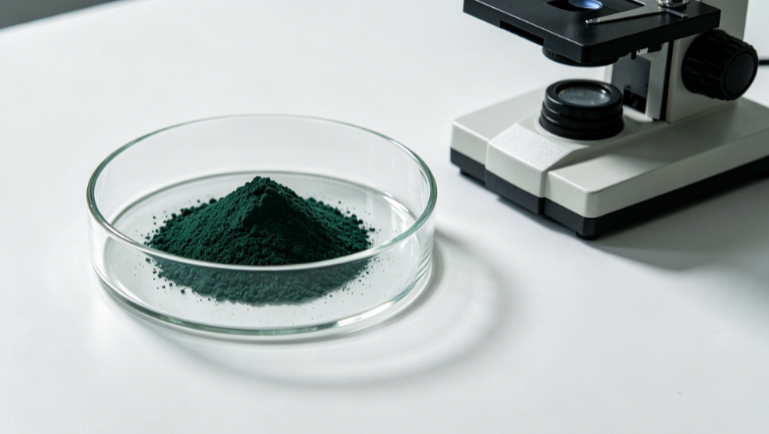
How Deep Our Characterization Goes
We go far beyond routine “elemental + XRD” packages. Our advanced methods are specifically designed to address the unique challenges of nickel‑rich lithium compounds – including air sensitivity, cation mixing, and oxidation state instability. Examples of our technical depth:
- Simultaneous TGA‑DSC‑FTIR‑MS from 30 °C to 1100 °C in inert or oxidizing atmospheres: quantify lattice oxygen release, decomposition of residual Li₂CO₃/LiOH, and phase transitions (layered → spinel → rock‑salt). Detection of evolved gases (CO₂, H₂O, O₂) with mass resolution 1 amu.
- High‑temperature XRD (HT‑XRD) from room temperature to 900 °C in air or vacuum – directly observe structural degradation, thermal expansion, and onset of cation mixing.
- Electrochemical performance screening (optional add‑on): Prepare half‑cells (Li metal counter electrode) or full coin cells using your powder. Measure first cycle coulombic efficiency, discharge capacity (0.1C to 5C), and capacity retention over 100 cycles. Directly correlate chemical test results with battery performance.
- Cross‑sectional FIB‑SEM/TEM on secondary particles: image microcracks, intra‑granular pores, and lithium distribution via electron energy loss spectroscopy (EELS).
- Trace chlorine, sulfur, and phosphorus by ion chromatography after alkaline fusion – sub‑ppm detection limits. These impurities accelerate electrolyte decomposition.
- Residual magnetic particle analysis using an automated magnetic extraction station (magnetic field ≥0.8 T) combined with ICP‑MS – quantifies Fe, Ni, Co metal particles ≥1 µm to as low as 0.1 ppm by weight. Essential for safety‑critical battery applications.
- Lithium diffusion coefficient (DLi) estimation from galvanostatic intermittent titration technique (GITT) on button cells – optional but available for R&D samples.
Why Our Laboratory Is the Premier Choice for Lithium‑Nickel Compound Testing
General‑purpose labs often lack the specialized equipment and handling protocols required for air‑sensitive, highly reactive nickel‑rich compounds. Our advantages are built on dedicated battery materials expertise, ISO/IEC 17025 accreditation, and strict inert‑atmosphere sample handling:
➤ Argon‑glovebox sample preparation for all air‑sensitive steps – Lithium‑nickel compounds (especially Ni‑rich NMC) rapidly form Li₂CO₃/LiOH layers and undergo surface Ni reduction when exposed to ambient air. We perform all sample splitting, grinding, and loading for XRD, XPS, and TGA inside a high‑purity argon glovebox (H₂O <0.1 ppm, O₂ <0.1 ppm), ensuring results represent the true material state.
➤ Matrix‑optimized digestion for complete decomposition – Nickel‑rich layered oxides resist conventional acid digestion. We use sealed microwave digestion with HCl/HNO₃/HF followed by fuming with H₂SO₄ or HClO₄, achieving 100% recovery of Ni, Co, Mn, and trace elements – validated with certified reference materials.
➤ Quantitative cation mixing analysis – Using high‑resolution XRD (step size 0.005°, 2θ range 10–140°) and Rietveld refinement with site occupation constraints, we report the degree of Li/Ni disorder as a percentage (e.g., “% of Ni in Li layers”) with uncertainty <0.2% absolute. This parameter is directly correlated with first‑cycle irreversible capacity.
➤ Comprehensive “Battery‑Grade Certification” package – Combines stoichiometry, cation mixing, impurity profile, magnetic particles, surface carbonate, particle size, and BET into a single certificate. Includes a “Ni‑Rich Stability Index” that predicts thermal and cycling stability based on combined metrics.
➤ Rapid turnaround and transparent reporting – Standard full characterization (elements, XRD, cation mixing, BET, particle size, moisture, magnetic particles) completed within 5‑7 business days. Expedited 48‑hour service available. You receive raw data, fitting models, uncertainty budgets, and representative micrographs.
➤ Global logistics for dangerous goods – Many lithium‑nickel compounds are classified as UN 3288 (toxic solids) or UN 3290 (corrosive). We provide compliant packaging, safety data sheets, and assistance with international shipping documentation.
➤ Direct technical support from battery materials experts – Our chemists and electrochemists help you interpret results, trace batch failures to specific parameters (e.g., cation mixing, surface carbonate, or trace Cu impurity), and advise on calcination temperature adjustments or washing procedures.
Ready to Get Your Lithium‑Nickel Compound Tested?
Whether you are developing Ni‑rich NMC for next‑gen EV batteries, qualifying a supplier of LiNiO₂, or troubleshooting capacity fade in production, our lab delivers the deepest, most actionable characterization available for lithium‑nickel compounds. Contact our battery materials analysis team with your nominal composition, target nickel valence, and critical impurity limits – we will return a custom test plan and competitive quote within 24 hours.