Reasons for choosing our testing services
ZHONGXI Testing has obtained inspection qualification certifications from multiple countries and regions worldwide. We possess a senior testing team and advanced testing methods, providing independent, impartial, and professional third-party verification services for global carbon projects.

Internationally recognized authority
Certified by multiple international standards such as CNAS, VCS, and GS, with reports universally applicable worldwide.

Global service capability
Covering 140+ countries and regions, it supports on-site detection and remote verification in multiple languages.

Professional experimental methods
Adopt standard experimental methods to ensure accurate and reliable data.
Lithium Battery Endurance Performance Testing Services: Validating Range, Energy Retention & Operational Lifetime
As an independent third-party testing service provider, we offer comprehensive endurance performance testing for lithium batteries used in electric vehicles (EVs), energy storage systems (ESS), consumer electronics, drones, power tools, and micro‑mobility applications. Endurance performance directly determines a battery’s real‑world range, usable energy over time, and service life. Our accredited laboratory conducts rigorous tests according to international standards (ISO, IEC, GB/T, SAE, UL, USABC) to evaluate capacity, energy efficiency, rate capability, low/high temperature operation, cycle life, calendar life, and state‑of‑health (SOH) evolution. This article outlines our lithium battery endurance testing capabilities – including scope, key test items, and standard test methods – to help manufacturers, integrators, and end users validate battery performance under realistic usage profiles.
1. Our Testing Scope for Lithium Battery Endurance
We cover all common lithium battery chemistries, form factors, and application levels:
By battery chemistry: LFP (lithium iron phosphate); NMC (nickel manganese cobalt); NCA (nickel cobalt aluminium); LCO (lithium cobalt oxide); LMO (lithium manganese oxide); Li‑titanate (LTO); Silicon‑anode cells; High‑voltage spinel; Solid‑state lithium batteries (by arrangement).
By test level: Cell (single battery – cylindrical, prismatic, pouch); Module (multiple cells assembled with busbars and sensors); Pack (complete battery pack with BMS and thermal management); System (multiple packs for stationary storage).
By application: EV traction batteries (passenger car, commercial vehicle, two‑wheeler); Stationary ESS (grid, residential, industrial); Consumer electronics (smartphones, laptops); UAV/drones; Power tools; Marine and golf cart batteries.
2. Key Test Items We Perform
Our endurance performance testing services are grouped into seven categories, simulating real‑world mission profiles and degradation mechanisms.
2.1 Capacity & Energy Measurement
Rated (nominal) capacity – manufacturer‑declared capacity at specified current and temperature (typically 0.2C, 25°C).
Actual (delivered) capacity – measured under customer‑defined conditions.
Energy content (Wh) – integral of voltage × current vs. time (more relevant than Ah for range).
Power capability (kW) – maximum continuous and peak power.
State of charge (SOC) vs. open circuit voltage (OCV) characterisation.
Coulombic efficiency (CE = discharge capacity / charge capacity) – indicator of reversible lithium inventory.
2.2 Rate Capability & High‑Rate Discharge
Discharge rate capability – capacity retention at various C‑rates (e.g., 0.2C, 0.5C, 1C, 2C, 3C, 5C, 10C, 15C).
High‑power pulse capability (HPPC – Hybrid Pulse Power Characterisation) – DC resistance, power fade.
Peak power vs. SOC and temperature – for EV acceleration and regenerative braking.
Voltage sag and IR rise under high current.
2.3 Temperature‑Dependent Endurance
Low temperature performance (as low as -40°C) – capacity retention, energy efficiency, and DCIR at sub‑zero temperatures (critical for cold climates).
high temperature performance (up to +85°C) – capacity, power, and thermal stability.
Temperature effect on available energy – range reduction in cold or hot weather.
Self‑heating behaviour during high‑rate discharge (temperature rise measurement).
2.4 Cycle Life (Endurance Cycling)
Standard cycle life – repeated charge‑discharge at specified C‑rates (e.g., 1C/1C) at 25°C until SOH reaches 80% (or 70% end‑of‑life).
Drive cycle simulation – dynamic load profiles (UDDS, WLTP, NEDC, US06) for EV battery validation.
Mission profile cycling – for specific applications (e.g., daily solar charge/discharge for ESS).
Fast‑charge cycle life – aggressive charging (e.g., 2C, 3C, 4C) followed by standard discharge.
Depth of discharge (DOD) effect – cycle life at 100% DOD, 80% DOD, 50% DOD.
Performance degradation tracking – capacity fade, resistance increase, and rate capability fade vs. cycle number.
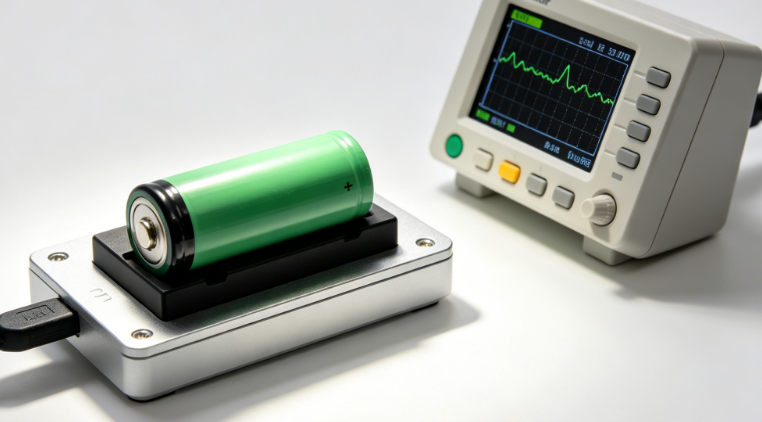
2.5 Calendar Life (Storage Endurance)
Storage at elevated temperature (accelerated calendar life) – e.g., 45°C, 55°C, 65°C at specific SOC (usually 50% or 100%). Periodic check‑up of capacity and resistance.
Arrhenius extrapolation – to predict room‑temperature calendar life (years).
Calendar life vs. SOC – higher SOC accelerates degradation (e.g., 100% vs. 50% SOC).
Recoverable capacity after prolonged storage.
2.6 State of Health (SOH) & Degradation Analysis
Capacity‑based SOH = Ccurrent / Cnominal × 100%.
Resistance‑based SOH – DCIR increase from fresh state.
Incremental capacity analysis (ICA) and differential voltage analysis (DVA) – identifies loss of lithium inventory (LLI), loss of active material (LAM), and resistance growth.
Post‑test tear‑down (electrode analysis, SEM, XRD) – for root cause of endurance failure.
2.7 Energy Efficiency & Round‑Trip Efficiency
Energy efficiency (%) = (discharge energy / charge energy) × 100 – at various C‑rates and temperatures.
Charge retention (self‑discharge) – capacity loss after open‑circuit storage at defined conditions (e.g., 28 days at 25°C, 7 days at 45°C).
Charge acceptance – ability to absorb energy under different charging protocols.
3. Standard Test Methods We Apply
All tests are performed according to internationally recognised standards. Our laboratory is ISO/IEC 17025 accredited and equipped with multi‑channel battery cyclers (up to 1200 A, 1000 V), environmental chambers (-50°C to +150°C), and high‑precision temperature sensors.
3.1 Capacity & Energy Standards
Cell capacity (EV/ESS): IEC 62660-1, GB/T 31486, USABC Manual.
Module/Pack capacity: ISO 12405-1, SAE J1798, GB/T 31467.
Energy content determination: IEC 61960, IEC 62133-2.
3.2 Rate Capability & HPPC Standards
Rate performance: IEC 62660-1, ISO 12405-1, USABC.
HPPC (Hybrid Pulse Power Characterisation): USABC Manual (FreedomCAR), IEC 62660-1 (Annex B).
Peak power vs. SOC: SAE J2288, GB/T 31467.
3.3 Temperature Performance Standards
Low temperature discharge: IEC 62660-1, GB/T 31486, SAE J1798.
high temperature discharge: IEC 62660-1, GB/T 31486.
Temperature rise measurement: GB/T 31467 (clause 7.3).
3.4 Cycle Life Standards
General cycle life (EV cells): IEC 62660-2, GB/T 31484, SAE J2288, ISO 12405-3.
Drive cycle simulation (UDDS, WLTP): FreedomCAR manual, GB/T 31484 (dynamic stress test).
Fast‑charge cycle life: GB/T 31484 (fast‑charge protocol), IEC 62660-2 optional.
ESS cycle life (stationary): IEC 61427-1 (PV‑storage), GB/T 36276.
3.5 Calendar Life Standards
Calendar life test (accelerated): IEC 62660-2 (clause 5.3), USABC, GB/T 31484 (calendar life).
Arrhenius modelling: No single standard, but data is collected per above standards and extrapolated using industry‑accepted practice.
3.6 Self‑Discharge & Charge Retention Standards
Self‑discharge (capacity loss): IEC 62660-1, GB/T 31486, USABC.
Charge retention: IEC 61960 (for portable batteries).
3.7 Efficiency & Degradation Analysis Standards
Energy efficiency: GB/T 31467, ISO 12405-1 (optional).
Incremental capacity analysis (ICA) / DVA: No specific standard – performed as research service using recorded charge/discharge data.
Post‑test characterisation (SEM, XRD, ICP): ISO 16700, ASTM E1508, etc.
4. Why Choose Our Third‑Party Lithium Battery Endurance Testing Services?
As an independent laboratory with dedicated energy storage testing facilities, we provide unbiased, accurate, and actionable endurance data. Our advantages include:
ISO/IEC 17025 accreditation – CNAS/CMA certified, accepted by global certification bodies and automotive OEMs.
High‑channel cyclers – up to 96 independent channels for cells, 8 channels for modules/packs, enabling parallel testing and fast turnaround.
Environmental chambers – multiple walk‑in and benchtop chambers with precise temperature control (±1°C).
Realistic drive cycles – we program WLTP, UDDS, NEDC, US06, and customer‑defined profiles.
Long‑term testing – calendar life (over 1 year) and cycle life (up to 5000+ cycles) with automated data logging.
Detailed reporting – capacity fade curves, resistance evolution, ICA/DVA plots, efficiency tables, and SOH projections.
Confidentiality – full protection of your cell chemistry, BMS logic, and product specifications.
Consultative approach – we help select the most relevant test standards, define end‑of‑life criteria, and interpret degradation mechanisms.
Whether you need to validate a new EV battery pack for range declaration, qualify batteries for extreme‑temperature environments, or predict the remaining useful life of an ESS, our endurance testing experts are ready to support your product development and certification.
Get Started with Your Lithium Battery Endurance Testing Project
Contact our team with your battery type (LFP, NMC, LTO), test level (cell/module/pack), target standards, and specific endurance requirements (target cycles, operating temperature, test duration). We will provide a detailed quotation, sample submission guidelines (including safe SOC for transport), and a testing schedule. Let us help you accurately measure and improve the real‑world range and lifetime of your lithium batteries.
This article provides an overview of our lithium battery endurance performance testing capabilities. For specific test methods, sample quantity, and pricing, please request a tailored service proposal.