Reasons for choosing our testing services
ZHONGXI Testing has obtained inspection qualification certifications from multiple countries and regions worldwide. We possess a senior testing team and advanced testing methods, providing independent, impartial, and professional third-party verification services for global carbon projects.

Internationally recognized authority
Certified by multiple international standards such as CNAS, VCS, and GS, with reports universally applicable worldwide.

Global service capability
Covering 140+ countries and regions, it supports on-site detection and remote verification in multiple languages.

Professional experimental methods
Adopt standard experimental methods to ensure accurate and reliable data.
Environmental Adaptability Testing Services: Ensuring Material Performance Under Real-World Conditions
As an independent third-party testing service provider, we offer comprehensive environmental adaptability testing for materials, components, and finished products. Environmental factors such as temperature, humidity, salt spray, mould, sand & dust, solar radiation, low pressure, and weathering can significantly degrade the performance, appearance, and safety of materials and assemblies. Whether you are a manufacturer of automotive parts, electronics, aerospace components, construction materials, or consumer goods, our accredited laboratory simulates real‑world and extreme environmental conditions according to international standards (ISO, ASTM, IEC, GB/T, MIL‑STD, RTCA DO‑160). This article outlines our environmental adaptability testing capabilities – including scope, key test items, and standard test methods – to help you validate material durability and product reliability.
1. Our Testing Scope for Environmental Adaptability
We cover a wide range of materials, products, and environmental stressors:
By material/product type: Metals (steel, aluminium, copper, coatings); Polymers (plastics, rubber, seals, adhesives); Composites (CFRP, GFRP); Electronics (PCBs, connectors, enclosures); Automotive components (interior, exterior, under‑hood); Aerospace parts; Military equipment; Construction materials (paints, sealants, roofing); Medical devices; Consumer electronics; Packaging materials.
By environmental stressor: Temperature (high, low, thermal shock, thermal cycling); Humidity (steady state, cyclic, condensation); Salt spray / salt fog (neutral, acetic, copper‑accelerated); Mould and fungi resistance; Sand and dust (blowing, settling); Solar radiation (UV, xenon arc, carbon arc); Low pressure (altitude simulation); Rain and water ingress (IPX, driving rain); Corrosive gases (SO₂, H₂S, NO₂, Cl₂); Mixed flowing gas (MFG); Ozone (for rubber); Weathering (natural or accelerated).
2. Key Test Items We Perform
Our environmental adaptability testing services are grouped into nine categories. Each category simulates specific service or transport conditions.
2.1 Temperature & Humidity Testing
high temperature storage/operation – e.g., +85°C, +125°C, +150°C for electronics, materials.
Low temperature storage/operation – as low as -70°C (cold start, cold flexibility).
Damp heat (steady state) – constant temperature + humidity (e.g., 40°C / 93% RH).
Damp heat (cyclic) – e.g., IEC 60068-2-30: 12h + 12h cycles with condensation.
Thermal cycling – rapid transitions between temperature extremes (e.g., -40°C to +85°C, 5°C/min).
Thermal shock – two‑zone or three‑zone (e.g., -55°C to +125°C with <1 min transfer).
Temperature / humidity combined with electrical or mechanical load.
2.2 Salt Spray & Corrosion Testing
Neutral salt spray (NSS) – 5% NaCl, pH 6.5-7.2, 35°C (ASTM B117, ISO 9227).
Acetic acid salt spray (AASS) – accelerated test for decorative coatings.
Copper‑accelerated acetic acid salt spray (CASS) – for anodised aluminium, electroplated parts.
Cyclic corrosion test (CCT) – salt spray + dry + humid (e.g., SAE J2334, ISO 11997, Volvo VCS 1027).
Kesternich test (SO₂ / condensation) – for industrial atmospheres (DIN 50018).
Corrosion creep / filiform corrosion (for coated panels).
2.3 Mould & Fungus Resistance
Mould growth test – inoculation with specified fungi (Aspergillus niger, Penicillium, etc.), 28 days at 28-30°C / 85-95% RH (ISO 846, ASTM G21, IEC 60068-2-10).
Resistance to biodeterioration – for electronics, textiles, packaging, sealants.
Assessment of mould growth rating (0 = no growth, 4 = heavy growth).
2.4 Sand & Dust (Particulate) Testing
Blowing dust (dust resistance) – non‑abrasive dust, vertical or horizontal flow (MIL-STD-810, ISO 20653).
Blowing sand (abrasive) – sharp sand particles (MIL‑STD‑810).
Settling dust – fine dust deposited on surfaces (IEC 60529 IP5X / IP6X).
Sealing effectiveness (IP5X, IP6X) – dust‑tight enclosure testing.
Abrasion by dust‑laden airflow (for coatings and surfaces).
2.5 Solar Radiation (Light & UV) Testing
Xenon arc weathering – full‑spectrum sunlight simulation (ISO 4892-2, ASTM G155, SAE J2527).
Fluorescent UV (UVA‑340, UVB‑313) – for polymer degradation, colour change, gloss loss (ASTM G154, ISO 4892-3).
Carbon arc (older standard – fading test) – ASTM G152.
Combined UV + moisture (condensation, spray).
Colour fastness (Blue Wool scale, Grey scale).
Mechanical property retention after light exposure (tensile, impact).
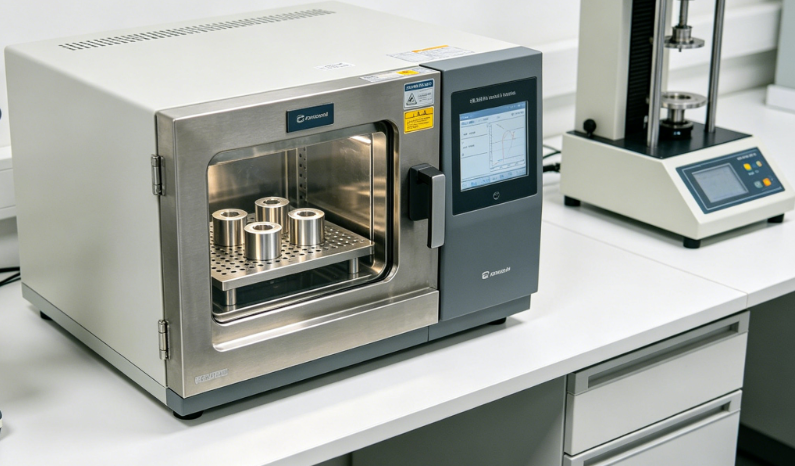
2.6 Low Pressure (Altitude) Testing
Altitude simulation (low air pressure) – up to 15,000 m (e.g., 57 kPa, 30 kPa, 11 kPa).
Low pressure with temperature (combined) – e.g., -55°C at 15,000 m (RTCA DO‑160 Section 4).
Rapid decompression / explosive decompression – for aircraft components.
Electrical performance at altitude (dielectric breakdown, corona).
2.7 Water Ingress & Rain Testing
IP protection rating (IEC 60529) – IPX1 to IPX9K (dripping, spraying, jetting, immersion).
Driving rain (wind‑driven rain) – for building façades, enclosures (ASTM E331).
Water spray (pressurised) – for automotive and outdoor electronics.
Immersion (temporary or continuous) – up to 1 m or deeper.
Hydrostatic pressure resistance (for seals, underwater housings).
2.8 Corrosive Gases & Mixed Flowing Gas (MFG)
SO₂ (sulphur dioxide) exposure – for industrial / marine environments (IEC 60068-2-42, DIN 50018).
H₂S (hydrogen sulphide) – for tarnish testing of silver, copper (IEC 60068-2-43).
NO₂ / Cl₂ (nitrogen dioxide / chlorine) – for specific chemical plants.
Mixed flowing gas (MFG) – low concentrations of Cl₂, H₂S, NO₂, SO₂ (IEC 60068-2-60, Telcordia GR‑63).
Porosity and corrosion of contacts / connectors.
2.9 Ozone & Fluid Exposure
Ozone resistance (for rubber, elastomers) – static or dynamic strain (ISO 1431, ASTM D1149, D518).
Fluid resistance (fuels, oils, coolants, solvents) – immersion or spray (ASTM D471, ISO 1817).
Hydraulic fluid / de‑icing fluid resistance.
3. Standard Test Methods We Apply
All tests are performed according to internationally recognised standards. Our laboratory is ISO/IEC 17025 accredited and equipped with environmental chambers (‑70°C to +180°C, humidity 10-98% RH), salt spray chambers, dust chambers, xenon/UV weathering testers, low‑pressure chambers, and MFG systems.
3.1 Temperature & Humidity Standards
Damp heat (steady state): IEC 60068-2-78, GB/T 2423.3, ASTM D2247.
Damp heat (cyclic): IEC 60068-2-30, GB/T 2423.4.
Thermal cycling (fast change): IEC 60068-2-14, GB/T 2423.22.
Thermal shock (two‑zone / liquid‑to‑liquid): MIL-STD-810 Method 503.7, IEC 60068-2-14.
High / low temperature storage & operation: IEC 60068-2-1 (cold), IEC 60068-2-2 (dry heat), GB/T 2423.1/.2.
Combined temperature / humidity / vibration (by arrangement).
3.2 Salt Spray & Corrosion Standards
Neutral salt spray: ASTM B117, ISO 9227, GB/T 10125, JIS Z 2371.
Acetic acid salt spray: ASTM G85 Annex A1, ISO 9227.
CASS test: ASTM B368, ISO 9227.
Cyclic corrosion: SAE J2334, ISO 11997-1, ASTM G85 Annex A5 (Prohesion), Volvo VCS 1027,149.
Kesternich (SO₂): DIN 50018, ISO 6988, ASTM G87.
3.3 Mould & Fungus Standards
Mould growth test: ISO 846 (plastics), ASTM G21 (synthetic polymeric materials), IEC 60068-2-10 (electronic components).
MIL‑STD‑810 Method 508.8 (fungus).
3.4 Sand & Dust Standards
Blowing dust and sand: MIL-STD-810 Method 510.7, ISO 20653 (Road vehicles – degrees of protection).
IP5X / IP6X (dust‑tight): IEC 60529, GB/T 4208.
Def Stan 00-35 (UK defence standard).
3.5 Solar Radiation (UV / Xenon) Standards
Xenon arc weathering: ISO 4892-2, ASTM G155, SAE J2527 (automotive exterior), SAE J2412 (interior).
Fluorescent UV (UVA / UVB): ASTM G154, ISO 4892-3, SAE J2020.
Carbon arc (historical): ASTM G152 (withdrawn but still referenced).
Colour fastness (textiles / plastics): ISO 105‑B02, AATCC 16.
3.6 Low Pressure (Altitude) Standards
Altitude simulation: RTCA DO‑160 Section 4, MIL-STD-810 Method 500.7, IEC 60068-2-13.
Temperature‑altitude combination: RTCA DO‑160 Section 4.6, MIL-STD-810 Method 501.7/502.7.
3.7 Water Ingress & Rain Standards
IP Code (IEC 60529): IPX1 – IPX9K, GB/T 4208.
Driving rain (building components): ASTM E331, AAMA 501.1.
Water spray (pressurised): ISO 20653 (IPX9K for high‑pressure jet).
Immersion: IEC 60529 (IPX7, IPX8), MIL-STD-810 Method 512.7.
3.8 Corrosive Gases (MFG) Standards
SO₂ exposure: IEC 60068-2-42, DIN 50018.
H₂S exposure: IEC 60068-2-43.
Mixed flowing gas (MFG): IEC 60068-2-60 (4 gas mixture), Telcordia GR-63-CORE (NEBS).
ASTM B827 (MFG test methodology).
3.9 Ozone & Fluid Resistance Standards
Ozone resistance (static & dynamic): ISO 1431 (rubber), ASTM D1149, ASTM D518, GB/T 13642.
Fluid immersion (oils, fuels, etc.): ASTM D471, ISO 1817, GB/T 1690.
4. Why Choose Our Third-Party Environmental Adaptability Testing Services?
As an independent laboratory with extensive experience in environmental simulation, we provide unbiased, accurate, and legally defensible results. Our advantages include:
ISO/IEC 17025 accreditation – CNAS/CMA certified, accepted by global industries and certification bodies (CE, UL, E‑mark, etc.).
Comprehensive chamber fleet – walk‑in chambers, benchtop chambers, thermal shock (air‑to‑air and liquid), altitude chambers, and specialty corrosion rigs.
Fast turnaround – standard salt spray (96‑500 h) and thermal cycling (10‑100 cycles) with efficient scheduling.
Detailed reporting – photographic evidence, corrosion rating (e.g., ASTM D610 / D1654), measured properties before/after, and compliance statements.
Custom test plans – we design test sequences that match your product’s specific life‑cycle (transport, storage, operation in desert / maritime / arctic / tropical climates).
Confidentiality – full protection of your materials, formulations, and intellectual property.
Consultative support – we help you select the right severity levels, test durations, and pass/fail criteria based on product application.
Whether you need to qualify a new material for outdoor use, validate a coating system, meet automotive OEM specifications (e.g., PV1200, GMW14872), or simulate storage conditions for electronics, our environmental testing experts are ready to assist.
Get Started with Your Environmental Adaptability Testing Project
Contact our team with your material / product type, target environment (e.g., marine, desert, alpine, tropical), relevant standards, and specific test parameters (temperature range, humidity, duration). We will provide a detailed quotation, sample submission guidelines, and a testing schedule. Let us help you ensure that your materials and products withstand the toughest real‑world conditions – reliably, safely, and for the required service life.
This article provides an overview of our environmental adaptability testing capabilities. For specific test methods, sample size, and pricing, please request a tailored service proposal.