Reasons for choosing our testing services
ZHONGXI Testing has obtained inspection qualification certifications from multiple countries and regions worldwide. We possess a senior testing team and advanced testing methods, providing independent, impartial, and professional third-party verification services for global carbon projects.

Internationally recognized authority
Certified by multiple international standards such as CNAS, VCS, and GS, with reports universally applicable worldwide.

Global service capability
Covering 140+ countries and regions, it supports on-site detection and remote verification in multiple languages.

Professional experimental methods
Adopt standard experimental methods to ensure accurate and reliable data.
Comprehensive Characterization of Zeolite Molecular Sieves – Advanced Analytical Services for Structural Integrity, Compositional Purity, and Adsorptive Performance
You are searching for zeolite molecular sieve detection because these crystalline aluminosilicates are essential for petrochemical catalysis, gas separation, drying agents, environmental remediation, and specialty adsorption applications. Unlike routine chemical assays, zeolite performance depends critically on framework type (e.g., FAU, MFI, BEA, LTA), Si/Al ratio, cation exchange capacity, crystallinity, porosity, and acid site distribution. Standard bulk elemental analysis (e.g., XRF for Si, Al) cannot reveal whether the material possesses the correct structure, adequate thermal stability, or the desired pore architecture. You require a laboratory that delivers multi‑technique, structure‑sensitive characterization covering phase identification, crystallinity, Si/Al ratio, textural properties (BET, micropore volume), cation composition, acid site strength, and thermal stability. Our facility provides exactly that: an integrated analytical platform for zeolite molecular sieves, compliant with ISO, ASTM, and IUPAC guidelines, and validated for both powder and formed products (beads, extrudates).
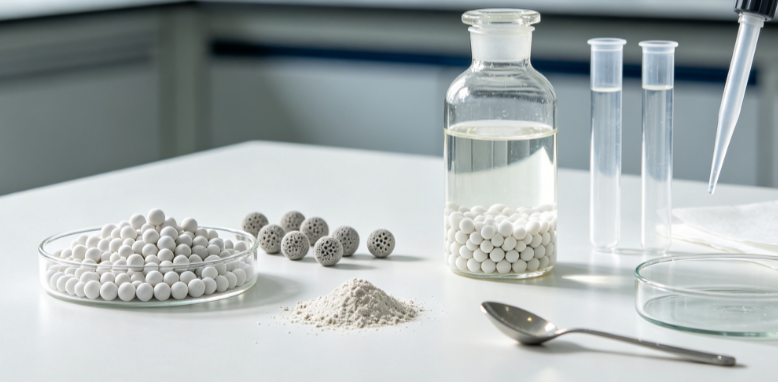
Analytical Framework – From Bulk Composition to Framework Structure and Adsorptive Performance
We offer a tiered analytical strategy tailored to your quality control, process optimization, or R&D needs. Our platform includes:
• Framework type and crystallinity – X‑ray diffraction (XRD) with Rietveld and whole pattern analysis. Using a PANalytical X’Pert Pro MPD (Cu Kα), we collect diffraction patterns over 5–50° 2θ. We identify the zeolite framework type (FAU, MFI, BEA, LTA, MOR, etc.) by comparison with ICDD/IZA databases. We quantify relative crystallinity (%) by comparing the integrated intensity of characteristic peaks against a certified reference zeolite – with precision ±1% absolute. For detailed structural analysis, we perform Rietveld refinement to obtain unit cell parameters (a, b, c, angles) and estimate phase purity (detection of amorphous content or competing phases). This service is essential to confirm that your zeolite matches the claimed structural type and has not undergone framework collapse.
• Si/Al ratio – X‑ray fluorescence (XRF) and wet chemical digestion with ICP‑OES. The Si/Al ratio directly affects acidity, hydrophobicity, and ion‑exchange capacity. We quantify SiO₂ and Al₂O₃ (and Na₂O, K₂O, CaO, MgO, etc.) using fused bead XRF (PANalytical Zetium) with a typical precision of ±0.05–0.1% absolute for major oxides. For low‑level cation determination, we use ICP‑OES (Agilent 5110) after acid digestion, achieving LOQs of 0.01% for Na, K, Ca, Mg, Fe, Ti. We then calculate SiO₂/Al₂O₃ molar ratio (SAR) – a critical quality parameter – with expanded uncertainty (Ulab, k=2) < 2% relative.
• Textural properties – Nitrogen physisorption (BET, t‑plot, BJH) and mercury porosimetry. We use a Micromeritics ASAP 2460 for N₂ adsorption at 77 K after degassing (300°C, 6 h, under vacuum). We report specific surface area (BET, 5‑point method) with precision ±1 m²/g, micropore volume (by t‑plot or Dubinin‑Radushkevich), external surface area, and mesopore size distribution (BJH from desorption branch). For macroporosity in extrudates or beads, we use mercury intrusion porosimetry (Micromeritics AutoPore IV) to determine total pore volume, median pore diameter, and bulk/skeletal density. These data are essential for verifying that the zeolite has the expected adsorption capacity and diffusion characteristics.
• Cation composition and exchange capacity – Atomic absorption (AAS) or ICP‑OES, plus ammonium exchange capacity. The type and amount of charge‑balancing cations (Na⁺, K⁺, Ca²⁺, Mg²⁺, etc.) control ionic selectivity and catalytic activity. We first determine the cation composition in the as‑received sample by ICP‑OES after complete dissolution. Then we measure the maximum ion‑exchange capacity by saturating the sample with NH₄⁺ (using 1 M NH₄Cl, repeated washes), followed by determination of exchanged Na⁺ and K⁺ released. We also report the degree of exchange for any specific cation (e.g., %Na exchanged by Ca).
• Acidity and acid site strength – Temperature‑programmed desorption of ammonia (NH₃‑TPD) and pyridine‑adsorbed FTIR. Using a Micromeritics AutoChem II with a thermal conductivity detector (TCD) and online mass spectrometer, we saturate the zeolite with NH₃ at 100°C, then desorb up to 800°C at 10°C/min. We quantify total acid site density (mmol NH₃/g) and resolve weak, medium, and strong acid sites by deconvolution of desorption peaks. For Bronsted/Lewis acid ratio, we perform pyridine adsorption FTIR (Nicolet iS50) after evacuation at 150°C and 350°C, recording spectra from 1400–1650 cm⁻¹; we report the relative concentrations of Bronsted (1545 cm⁻¹) and Lewis (1450 cm⁻¹) acid sites. This is indispensable for catalysis and adsorption process design.
• Thermal stability – Differential thermal analysis (DTA/TG) coupled with evolved gas analysis (EGA). We use a Netzsch STA 449 F3 with a quadrupole mass spectrometer to heat samples (RT to 1000°C, 10°C/min in air or inert gas). We obtain mass loss steps (dehydration, deammoniation, framework decomposition) and identify the onset temperature of structural collapse – critical for applications involving high‑temperature regeneration or catalysis.
• Morphology and particle size – Scanning electron microscopy (SEM) with EDS, and laser diffraction. We capture high‑resolution images (Tescan MIRA3) to assess crystal habit, size, and agglomeration. EDS analysis provides semi‑quantitative local Si/Al and cation distribution to check homogeneity. For bulk powder, we measure particle size distribution by laser diffraction (Malvern Mastersizer 3000) with dry or wet dispersion, reporting D10, D50, D90.
No other service offers simultaneous integration of XRD, XRF, BET, NH₃‑TPD, pyridine‑FTIR, thermal analysis, and particle size under one ISO 17025‑accredited system for zeolite molecular sieves – providing a complete picture of structural, chemical, and performance‑linked properties.
Why Our Laboratory Is the Preferred Partner for Zeolite Molecular Sieve Testing
Our specialisation in catalysis and porous materials analysis has enabled us to overcome the unique challenges of zeolite testing: low crystallinity and amorphous contamination requiring careful XRD peak fitting, difficulty in accurate Si/Al determination due to sample heterogeneity, interference from exchangeable cations during BET measurements, and very low acid site density needing high‑sensitivity TPD. Our distinct advantages include:
1. Optimized sample preparation for reproducible physical and chemical results. For BET, we specify degassing temperature and time based on zeolite type (e.g., 350°C for high‑silica, 250°C for low‑silica to avoid framework damage). For XRF, we use fusion beads to minimize mineralogical effects. For NH₃‑TPD, we use a pretreated sample (calcined at 500°C) to remove template and moisture.
2. Multi‑method cross‑validation for Si/Al ratio. We compare XRF results with those obtained by ICP‑OES after complete dissolution – discrepancy > 0.2 (SAR units) triggers additional analysis (e.g., EDX mapping) to locate potential inhomogeneities.
3. Extensive reference material library and in‑house standards. We maintain certified reference zeolites (e.g., NIST SRM 8850 – mordenite, or our own in‑house standards) to calibrate XRD for crystallinity and BET for surface area. We participate in round‑robin tests (e.g., IZA inter‑laboratory comparisons) with results within ±2% of the consensus.
4. High sensitivity for acidic and thermal property measurements. Our NH₃‑TPD setup includes a mass spectrometer for real‑time identification of desorbed species, and a multidetector system to resolve overlapping desorption peaks. The pyridine‑FTIR method is validated to detect as low as 5 µmol/g acid sites with a signal‑to‑noise ratio > 100.
5. ISO 17025 accreditation and global industry acceptance. Our methods comply with ASTM D4365, D4652, D3906, and ISO 9277, 12133, 14317. Our test reports are accepted by oil refinery catalyst suppliers, petrochemical licensors, gas separation plant operators, and specialty chemical manufacturers worldwide.
Technical Depth – Beyond Basic Quality Indicators
While many laboratories report only SAR, BET, and crystallinity, we provide mechanistic and application‑oriented insights for advanced process control:
• Quantitative assessment of dealumination degree (framework Si/Al vs. extra‑framework Al). Through ²⁹Si and ²⁷Al solid‑state NMR (Bruker Avance III) – available upon request – we distinguish framework Al (tetrahedral, ~55 ppm) from extra‑framework Al (octahedral, ~0 ppm). This gives a true framework Si/Al ratio (not bulk), which controls hydrothermal stability and acidity. We report the fraction of extra‑framework Al (%).
• Location and strength of acid sites. Using pyridine‑FTIR with variable temperature desorption (150°C, 250°C, 350°C), we quantify the retained Bronsted and Lewis acid site concentration at each temperature. From this, we derive an acidity strength distribution map. This is directly linked to catalytic activity for cracking, isomerization, and alkylation reactions.
• Prediction of adsorption capacity for specific molecules. We offer single‑component adsorption isotherms (gravimetric or volumetric) for H₂O, CO₂, N₂, O₂, CH₄, or volatile organics at temperatures from 0 to 200°C. This allows us to calculate equilibrium adsorption capacity (mmol/g) and Henry’s constant – vital data for gas separation and drying process design.
• Hydrothermal stability assessment (steaming test). For applications such as FCC catalysts, we expose the zeolite to 100% steam at 800°C for up to 48 hours, then re‑measure crystallinity and BET surface area. We report the retained crystallinity (%) and surface area (m²/g) after steaming, predicting lifetime under severe industrial conditions.
Supporting Your Specific Zeolite Molecular Sieve Testing Objectives
Your search for zeolite detection likely aligns with one or more of these scenarios. We provide precisely tailored solutions:
• Raw material qualification for catalysts and adsorbents. We test each batch for phase type, crystallinity, SAR, BET, cation composition, and acid site density. Based on your specification, we issue a certificate of analysis (COA) with pass/fail assessment. Typical turnaround: 5‑7 working days.
• Process optimization for zeolite synthesis (hydrothermal, seeding, exchange). We analyse samples from different synthesis stages, providing feedback on crystallization progress, impurity formation, and final cation exchange efficiency. Our data can be used to adjust gel composition, aging time, or exchange solution concentration.
• Troubleshooting for sub‑performance catalysts. If your zeolite fails to achieve desired conversion or selectivity, we conduct a forensic investigation including XRD, NH₃‑TPD, and BET, and compare with your historical good batches. We identify the likely root cause – e.g., loss of crystallinity, dealumination, pore blockage, or cation migration.
• Regulatory and safety compliance. We provide data for REACH, TSCA, and China RoHS related to zeolite composition, including heavy metal analysis and hazard classification. We also perform respirable crystalline silica (RCS) determination by XRD per OSHA and NIOSH methods, essential for workplace safety.
• Research and method development. For academic or industrial R&D, we offer customized characterization – e.g., in‑situ XRD under controlled atmosphere, high‑pressure adsorption, or 3D‑TEM tomography. We also assist in method validation for novel zeolite compositions.
Partner with Us for Definitive Zeolite Molecular Sieve Characterisation
Choosing our laboratory gives you access to a dedicated porous materials characterization team with over 12 years of experience in zeolite science. We provide free sampling kits (sealed vials with desiccant), a detailed protocol for representative sampling (especially important for mixed or formed products), and direct consultation with our senior zeolite specialist for result interpretation. No project is too large or too small – from a single research sample to routine quality control of full production lots.
Contact our technical team with your zeolite analysis requirements. We will provide a customised project quotation and, for qualifying clients, a free preliminary screening (XRD for phase identification and BET for surface area) on up to two samples. Your search for authoritative, high‑depth zeolite molecular sieve characterisation ends here – because we deliver the structural, chemical, and performance‑linked insight that routine single‑parameter tests cannot provide.