Reasons for choosing our testing services
ZHONGXI Testing has obtained inspection qualification certifications from multiple countries and regions worldwide. We possess a senior testing team and advanced testing methods, providing independent, impartial, and professional third-party verification services for global carbon projects.

Internationally recognized authority
Certified by multiple international standards such as CNAS, VCS, and GS, with reports universally applicable worldwide.

Global service capability
Covering 140+ countries and regions, it supports on-site detection and remote verification in multiple languages.

Professional experimental methods
Adopt standard experimental methods to ensure accurate and reliable data.
Comprehensive Quality and Performance Characterization of Yellow Iron Oxide (Goethite) Pigments – Advanced Analytical Services for Composition, Crystal Structure, Colorimetry, and Application‑Specific Properties
You are searching for yellow iron oxide (FeOOH·H₂O, α‑FeOOH, Pigment Yellow 42/43/77492) detection because this high‑performance inorganic pigment is critical for coatings, construction materials, plastics, rubber, ceramics, and specialty inks. However, routine elemental analysis (e.g., total iron by titration) fails to capture the key attributes that determine pigment performance: crystal phase purity, goethite crystallinity, particle size and shape distribution, surface treatment uniformity, colorimetric consistency (L*, a*, b*), oil absorption, and volatile content. Moreover, the presence of secondary phases (e.g., hematite, magnetite, or amorphous iron hydroxides) or trace heavy metal impurities can drastically affect shade, heat stability, and regulatory compliance. You require a laboratory that delivers multi‑dimensional, application‑oriented characterization integrating chemical composition, phase identification, particle morphology, surface chemistry, colorimetry, and thermal stability. Our facility provides exactly that: an ISO 17025‑accredited, fully validated analytical platform for yellow iron oxide pigments, covering all critical parameters specified in ASTM D3022, ISO 1248, and Chinese GB/T 1863.
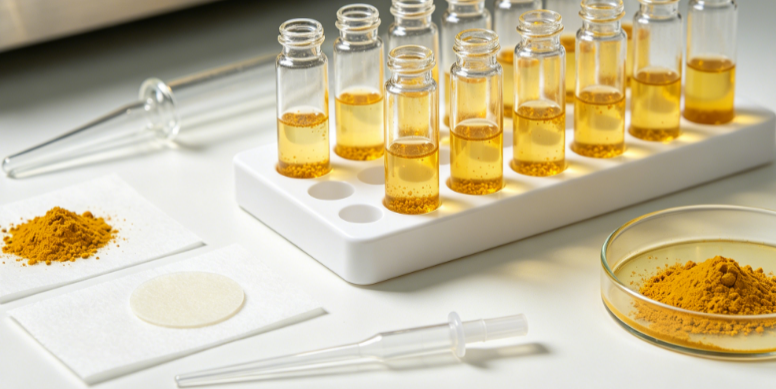
Analytical Framework – From Primary Composition to Crystal Structure, Colorimetric Performance, and Physical Properties
We offer a tiered analytical strategy tailored to your quality control, formulation development, or competitive benchmarking needs. Our platform includes:
• Total iron (Fe₂O₃) and major element composition – Redox titration and ICP‑OES/ICP‑MS. Our primary method is the standard dichromate titration after reduction with SnCl₂/HCl, achieving repeatability of ±0.15% absolute Fe₂O₃ – the reference method for trade arbitration. For high‑throughput screening, we use ICP‑OES (Agilent 5110) after microwave digestion, providing simultaneous quantification of Fe, Al, Si, Ca, Mg, Mn, Ti, and 15 other elements with LOQs of 0.01–0.05%. For ultra‑trace toxic elements (Pb, Cd, Cr, Hg, As), we employ ICP‑MS (Agilent 8900) with collision cell, achieving sub‑ppm detection limits compliant with EU RoHS and CONEG standards.
• Phase identification and crystallinity – X‑ray diffraction (XRD) with quantitative Rietveld analysis. Using a PANalytical X’Pert Pro MPD, we scan 10–80° 2θ and identify the goethite (α‑FeOOH) structure, detecting any hematite (α‑Fe₂O₃), magnetite (Fe₃O₄), or akaganeite (β‑FeOOH) as impurities. We quantify relative crystallinity (%) by comparing peak widths against a certified goethite reference; we also refine the unit cell parameters (a, b, c), which shift with Al substitution (solid solution). We can also perform quantitative phase analysis by Rietveld refinement with detection limits of 0.5% for secondary phases.
• Particle size and morphology – Laser diffraction (wet dispersion) and scanning electron microscopy (SEM) with image analysis. Using a Malvern Mastersizer 3000 with sodium hexametaphosphate dispersion, we obtain D10, D50, D90, and span with a size range of 0.02–2000 µm. For detailed shape analysis, we use Tescan MIRA3 SEM at 5,000–50,000× magnification to measure primary particle diameter, aspect ratio, and agglomerate structure by automated image analysis (over 1,000 particles per sample). This data is essential for predicting dispersion behavior, gloss, and rheology in coating formulations.
• Colorimetric parameters – Spectrophotometric CIELAB (L*, a*, b*) and tint strength. We use a HunterLab UltraScan VIS with D65 illuminant and 10° observer on pressed powder pellets or in‑film drawdowns (against a standard white tile). We report L* (lightness), a* (red/green), b* (yellow/blue), ΔE*, and tint strength (relative to a reference) with precision of ±0.1 units for L*, ±0.05 for a*/b*, and ±0.3 for ΔE*. This method complies with ISO 787‑25 and ASTM D2244. We also measure hiding power by contrast ratio on drawn films.
• Physical and surface properties – Oil absorption, pH, water‑soluble salts, and specific surface area (BET). Oil absorption (linseed oil, g/100 g pigment) is performed by the spatula rub‑out method (ISO 787‑5) with precision ±2 mL/100g. pH of an aqueous suspension (10% w/v) is measured with a calibrated glass electrode. Water‑soluble matter is determined by extraction with boiling water, evaporation, and gravimetry (< 0.1% detection). For surface area, we use nitrogen BET (Micromeritics TriStar II) after degassing at 120°C, reporting specific surface area (m²/g) and porosity (BJH) with ±1 m²/g precision.
• Thermal stability – Loss on ignition (LOI), TGA/DSC, and heat color change. We measure LOI at 1000°C to determine bound water and volatile organics. Using Netzsch STA 449 with simultaneous TGA‑DSC (RT–1000°C, 10°C/min, air), we identify dehydroxylation temperature (250–350°C) and transformation to hematite (~400–500°C). We also perform heat stability test by heating pigment at 200°C, 300°C, and 400°C for 2 h and measuring ΔE* to determine the maximum service temperature.
• Surface coating and treatment assessment – X‑ray photoelectron spectroscopy (XPS) and FTIR. For coated yellow iron oxide (e.g., silane, SiO₂, or organic treatments), we use Thermo Scientific K‑Alpha XPS to quantify surface atomic % of C, O, Si, Fe, and any organic species, with high‑resolution C1s and Fe2p spectra to identify chemical states. FTIR (Nicolet iS50) in ATR mode identifies organic binder residues or silane functionalities (Si‑O, C‑H).
No other service integrates redox titration, ICP‑MS, XRD with Rietveld, SEM image analysis, colorimetry, BET, TGA/DSC, and XPS surface analysis under one ISO 17025‑accredited system for yellow iron oxide – delivering a complete quality profile from bulk chemistry to surface chemistry.
Why Our Laboratory Is the Preferred Partner for Yellow Iron Oxide Analysis
Our specialization in inorganic pigment and advanced material characterization has enabled us to overcome the unique challenges of yellow iron oxide testing: complex interferences in redox titrations due to coexisting metals (e.g., Ti, Mn), very low crystallinity or nanoscale goethite requiring synchrotron‑like XRD resolution, difficulty in achieving stable colorimetric readings due to pigment agglomeration, and surface treatments that mask true particle properties. Our distinct advantages include:
1. Optimised sample preparation for consistent and reproducible results. For colorimetry, we use a standardised pressing force and backing (white tile) to eliminate surface roughness variations. For particle size, we use a validated dispersant and ultrasonication protocol to break agglomerates without fracturing primary particles. For XRD, we use zero‑background holders and internal standard (e.g., Si) to correct for peak shift.
2. Multi‑method cross‑validation for Fe₂O₃ content. We cross‑check titration results with ICP‑OES and, for high‑precision applications, with gravimetric determination as Fe₂O₃ after precipitation with NH₄OH. Discrepancy >0.2% triggers full re‑analysis and an investigation into possible sources (e.g., incomplete reduction).
3. Comprehensive reference database and proficiency testing. We have analysed over 1,000 yellow iron oxide samples from global producers and established typical ranges: Fe₂O₃ 84–88%, SiO₂ ≤ 2%, CaO ≤ 0.5%, LOI 10–12%, BET 12–20 m²/g, oil absorption 20–40 mL/100g, L* 70–80, b* 60–70. We participate in inter‑laboratory comparisons (e.g., ASTM PRA, DIN proficiency schemes) and consistently achieve |z|‑score < 0.5.
4. Ultra‑low detection for regulated heavy metals. Using ICP‑MS/MS, we routinely detect Pb, Cd, Cr, Hg, As at 0.1–0.5 ppm – well below EU limits (typically < 100 ppm). This is essential for pigments used in toys, food contact, or construction applications.
5. ISO 17025 accreditation and global acceptance. Our methods comply with ISO 1248, ASTM D3022, JIS K 5101, and GB/T 1863. Our test reports are accepted by pigment manufacturers, paint and coating suppliers, plastic compounders, and construction material producers worldwide.
Technical Depth – Beyond Basic Quality Parameters
While many laboratories report only Fe₂O₃% and color L*a*b*, we provide mechanistic and process‑relevant insight for advanced quality and application development:
• Aluminium substitution and crystal distortion. Goethite often contains Al substituting for Fe in the structure. Using XRD cell parameter refinement and ICP‑Al content, we calculate the degree of Al substitution (mol%) and correlate it with observed particle shape (acicular vs. lath‑like) and thermal stability. This is critical for predicting heat resistance and color shift.
• Particle surface charge and dispersion stability (zeta potential). We measure zeta potential vs. pH (Malvern Zetasizer) to identify the isoelectric point and optimal pH range for dispersion in aqueous or non‑aqueous media – directly relevant to paint grinding and stability.
• Identification of foreign phases (e.g., hematite, magnetite). Even a few percent of hematite can shift the shade from greenish‑yellow to reddish‑yellow. Our XRD with Rietveld quantification detects as little as 0.5% hematite, and we also use Mössbauer spectroscopy (available upon request) to confirm magnetic phases – a unique capability.
• Predictions for heat stability and color shift. By combining TGA/DSC with the heat stability test, we provide a maximum recommended processing temperature (MRPT) – e.g., 250°C for standard grade, 300°C for calcined grade – saving you from trial‑and‑error formulation.
Supporting Your Specific Yellow Iron Oxide Testing Objectives
Your search for yellow iron oxide detection likely aligns with one or more of these scenarios. We provide precisely tailored solutions:
• Raw material incoming inspection. We test each batch for Fe₂O₃, SiO₂, CaO, LOI, pH, oil absorption, particle size, and color (L*a*b*, ΔE*). Based on your specification, we issue a certificate of analysis (COA) with pass/fail decision. Typical turnaround: 3‑5 working days.
• Batch‑to‑batch color consistency monitoring. We provide comparative colorimetry against your reference standard and calculate tint strength and ΔE*. We also report any trend deviations to warn of potential shade drift before production begins.
• Process optimization for pigment synthesis and surface modification. For manufacturers, we analyse intermediate samples (precipitate, washed cake, dried, milled) for phase evolution, crystallinity, particle size, and surface chemistry – helping you control process variables to achieve target color and dispersion.
• Root cause analysis for product failures (e.g., dispersion issues, color change, increased oil absorption). We perform comparative full characterization between good and bad batches, identify the critical difference (e.g., increased clay content, change in coating agent, partial oxidation to hematite), and propose corrective actions.
• Regulatory compliance and product registration. We provide full heavy metal profiles, ROHS declarations, and REACH/IMDS data required by automotive and construction industries. We also test for free crystalline silica (by XRD) for workplace safety reporting.
Partner with Us for Definitive Yellow Iron Oxide Characterisation
Choosing our laboratory gives you access to a dedicated pigment and inorganic colorant analysis team with over 15 years of experience in iron oxide chemistry. We provide free sampling kits (opaque, moisture‑proof containers), a detailed protocol for representative sampling (especially important for micronised powders), and direct consultation with our senior pigment specialist for data interpretation. No project is too large or too small – from a single colour matching sample to a global quality audit covering hundreds of shipments.
Contact our technical team with your yellow iron oxide analysis requirements. We will provide a customised project quotation and, for qualifying clients, a free preliminary screening (Fe₂O₃ by titration, color L*a*b*, and oil absorption) on up to three samples. Your search for authoritative, high‑depth characterisation of yellow iron oxide ends here – because we deliver the structural, chemical, colorimetric, and physical insight that routine single‑parameter tests cannot provide.