Reasons for choosing our testing services
ZHONGXI Testing has obtained inspection qualification certifications from multiple countries and regions worldwide. We possess a senior testing team and advanced testing methods, providing independent, impartial, and professional third-party verification services for global carbon projects.

Internationally recognized authority
Certified by multiple international standards such as CNAS, VCS, and GS, with reports universally applicable worldwide.

Global service capability
Covering 140+ countries and regions, it supports on-site detection and remote verification in multiple languages.

Professional experimental methods
Adopt standard experimental methods to ensure accurate and reliable data.
Precision Analysis of Nickel Nitrate – Advanced Analytical Services for Compositional Purity, Hydrate Stoichiometry, and Trace Impurity Profiling
You are searching for nickel nitrate (Ni(NO₃)₂·xH₂O) detection because this important nickel salt is a key raw material for electroplating baths, catalyst preparation, battery cathode precursors (NMC, NCA), ceramic pigments, and specialty chemical synthesis. Quality specifications go far beyond a simple nickel content value; they require accurate determination of nickel (Ni) mass fraction, nitrate (NO₃⁻) content, water of crystallization, acidity/free acid, insoluble matter, and critical trace impurities (Co, Cu, Fe, Zn, Cr, Cd, Pb, etc.). Furthermore, nickel nitrate is hygroscopic and can exhibit variable hydration states (usually hexahydrate, Ni(NO₃)₂·6H₂O), making it essential to verify both the stoichiometric composition and the absence of unwanted hydration variants or decomposition products. Routine elemental techniques (e.g., simple AAS for Ni) cannot distinguish nitrate from other anions, nor assess the crystal water content or detect non‑nickel contaminants that impair application performance. You require a laboratory that provides comprehensive, multi‑parameter characterization using validated reference methods and state‑of‑the‑art instrumentation. Our facility delivers exactly that: an integrated analytical platform for nickel nitrate, compliant with ISO, ASTM, and Chinese GB/T specifications, and accredited under ISO 17025 for all critical quality attributes.
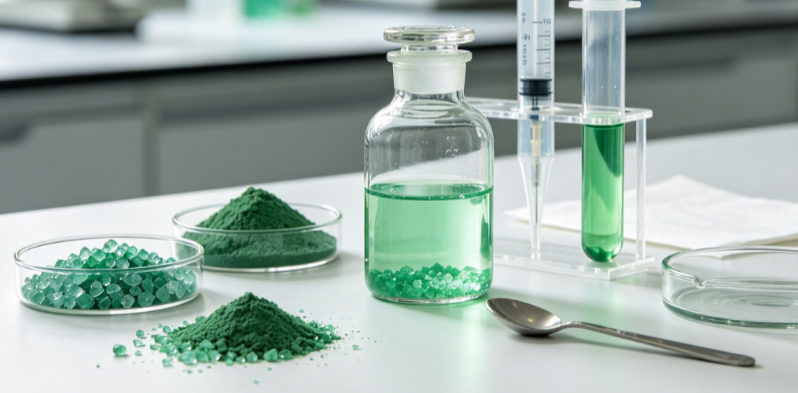
Analytical Framework – From Primary Assay to Hydrate Stoichiometry and Trace Contaminant Quantification
We offer a tiered analytical strategy tailored to your quality control, process optimization, or regulatory compliance needs. Our platform includes:
• Nickel content (as Ni or NiO) – complexometric EDTA titration and ICP‑OES/ICP‑MS. Our primary reference method is EDTA back‑titration with zinc sulfate at pH 10 (using murexide or PAN indicator) according to ISO 6351 and GB/T 23836. This method achieves repeatability of ±0.1% absolute Ni and is the accepted benchmark for trade arbitration. For high‑throughput or lower concentration ranges, we use ICP‑OES (Agilent 5110) after microwave digestion, providing simultaneous quantification of Ni and 20+ other metallic elements (Co, Cu, Fe, Mn, Zn, etc.) with LOQs of 0.005–0.02%. For ultra‑trace toxic metals (Cd, Pb, Cr, As, Hg), we employ ICP‑MS (Agilent 8900) with collision/reaction cell, achieving sub‑ppm detection limits (0.01–0.1 mg/kg) compliant with EU RoHS, REACH, and battery industry regulations.
• Nitrate (NO₃⁻) determination – ion chromatography (IC) and spectrophotometric (salicylic acid) methods. We offer two complementary approaches: ion chromatography (Dionex ICS‑5000) with anion‑exchange column and suppressed conductivity, providing LOQ of 0.02% NO₃⁻ with excellent specificity. Alternatively, we use the ultraviolet spectrophotometric method after reduction to nitrite (cadmium column) or direct measurement at 220 nm (with correction for organic interference). Both methods are validated against ISO 10304‑1 and GB/T 11896.
• Water of crystallization and total moisture – Thermogravimetric (TGA) and oven drying (loss on drying). We determine loss on drying at 105°C and 150°C to remove surface moisture and then the complete dehydration at 250–300°C, in accordance with ISO 1245. For detailed insight, we use simultaneous TGA‑DSC (Netzsch STA 449) from 25°C to 500°C under nitrogen, clearly identifying the stepwise loss of crystalline water (e.g., hexahydrate loses 3 H₂O around 50°C and the remaining 3 around 150°C). This yields a precise water content (%) and allows calculation of the actual hydration number (x) in Ni(NO₃)₂·xH₂O.
• Free acid (as HNO₃) and pH – potentiometric titration. We measure free acid content by titrating a diluted sample with standard NaOH to pH 7.0 (or using a mixed indicator) and report as % HNO₃ with precision ±0.02%. This parameter is critical for electroplating bath stability and catalyst preparation.
• Insoluble matter and chloride content – gravimetric and argentometric methods. Water‑insoluble matter is determined by dissolving the sample in hot water, filtering through a tared Gooch crucible, drying, and weighing (< 0.02% detection). Chloride (Cl⁻) is quantified by potentiometric titration with AgNO₃ or by ion chromatography, achieving LOQ of 0.005% Cl – essential to avoid pitting corrosion in electroplating applications.
• Crystal structure and phase purity – X‑ray diffraction (XRD). We record the diffraction pattern on a PANalytical X’Pert Pro and compare to ICDD reference data for nickel nitrate hexahydrate (or any other hydrate form). We check for foreign crystalline phases such as nickel hydroxide, nickel oxide, or sodium nitrate, and provide a semi‑quantitative phase estimation.
• Particle size and morphology – Laser diffraction and SEM. Using Malvern Mastersizer 3000 for dry powder, we report D10, D50, D90, and span – critical for dissolution rate and filterability. For visual morphology and agglomeration, we employ scanning electron microscopy (Tescan MIRA3) with EDS for local composition verification.
No other service offers simultaneous access to primary titration, ICP‑MS, IC, TGA, XRD, and particle sizing under one ISO 17025‑accredited system for nickel nitrate – delivering a complete compositional, structural, and physical profile from a single testing partner.
Why Our Laboratory Is the Preferred Partner for Nickel Nitrate Testing
Our specialization in transition metal salt and electroplating chemical analysis has enabled us to overcome the unique challenges of nickel nitrate testing: high salt matrix and nitrate interference in ICP and titration methods, hygroscopicity affecting moisture and weight measurements, variable hydration states requiring careful interpretation of loss‑on‑drying, and extremely low allowable limits for certain heavy metal impurities (e.g., Cd, Pb) that demand the highest‑level trace analysis. Our distinct advantages include:
1. Optimised sample handling to ensure representative and stable results. We use rapid weighing under controlled humidity (≤ 30% RH) and sealed containers for all transfers. For TGA, we use open but covered sample pans to prevent spattering. For trace metal analysis, we use high‑purity nitric acid (double‑distilled) and microwave digestion at elevated pressure to achieve complete dissolution without analyte loss.
2. Multi‑method cross‑validation for nickel and nitrate. For each batch, we cross‑check Ni by titration, ICP‑OES, and (where needed) gravimetric precipitation as dimethylglyoximate – any discrepancy >0.2% initiates a full re‑analysis. Nitrate results from IC and spectrophotometry are compared; if >0.5% relative difference, we perform an additional Devarda's alloy reduction method as a referee.
3. Comprehensive reference materials and proficiency testing. We maintain certified reference materials (CRMs) of nickel nitrate hexahydrate (with certified Ni and water content) and participate in FAPAS® and BAM round‑robins for heavy metals in inorganic salts, achieving |z|‑score < 0.6.
4. Ultra‑low detection limits for regulated elements. Our ICP‑MS/MS with reaction cell (O₂/H₂) eliminates polyatomic interferences (e.g., ⁴⁰Ar¹⁵N on ⁵⁵Mn, ⁴⁰Ar³⁵Cl on ⁷⁵As) and achieves LOQs of 0.01 mg/kg for Cd, 0.02 for Pb, 0.03 for As, and 0.01 for Hg – meeting the strictest requirements of automotive and battery material specifications (e.g., IATF 16949, ELV directive).
5. ISO 17025 accreditation and global regulatory acceptance. Our methods comply with ISO 6351, ISO 10304, ASTM D512, JIS K 8906, and Chinese GB/T 23836‑2021. Our test reports are accepted by electroplating chemical suppliers, battery cathode manufacturers, catalyst producers, and environmental regulatory authorities worldwide.
Technical Depth – Beyond Basic Purity Values
While many laboratories report only Ni% and moisture, we provide mechanistic and process‑relevant insight for advanced quality management:
• Hydrate form verification and stoichiometric assessment. By combining TGA mass loss data with the theoretical water content for Ni(NO₃)₂·6H₂O (36.8% H₂O) or other hydrates, we calculate the “hydration index” – a precise measure of the actual composition. This is critical because off‑spec hydrate forms (e.g., dihydrate or tetrahydrate) may result from improper drying or storage and will affect solubility and reactivity in end‑use applications.
• Thermal decomposition pathways and purity. Our TGA‑DSC data reveals the decomposition temperature and residue (NiO) – an uncharacteristically high or low residue may indicate the presence of organic contaminants, nickel carbonate, or other metal salts. We provide a detailed thermal fingerprint that helps identify decomposition products and predict processing behaviour.
• Identification and quantification of non‑nickel cations (Co, Cu, Fe, Zn, Mn, etc.). Using full‑scan ICP‑OES, we quantify all major coexisting metals. For electroplating applications, even 50 ppm of Cu or Zn can cause deposition defects; we report these with high accuracy and provide a “metal impurity profile” for quick comparison with specification limits.
• Nitrate‑to‑nickel ratio as a check for stoichiometry and purity. Using the molar ratio NO₃⁻/Ni, we verify the correct chemical formula (theoretical ratio = 2). Any deviation indicates the presence of other cations or additional nitrate salts (e.g., ammonium nitrate) – a sign of contamination or improper synthesis.
Supporting Your Specific Nickel Nitrate Testing Objectives
Your search for nickel nitrate detection likely aligns with one or more of these scenarios. We provide precisely tailored solutions:
• Incoming raw material inspection for electroplating or battery applications. We test each lot for Ni (%), water content, free acid, insoluble matter, and critical impurities (Co, Fe, Cu, Zn, Pb, Cd, As, Cl⁻). Based on your specification (e.g., ASTM B343 for electroplating, or OEM cathode material requirements), we issue a certificate of analysis (COA) with pass/fail decision. Typical turnaround: 2‑4 working days.
• Process control for crystallisation and drying. For manufacturers, we analyse intermediate mother liquor, wet filter cake, and final dried product to monitor compositional consistency, impurity partitioning, and hydrate stability. We recommend optimised drying temperature and time to achieve the target water content.
• Troubleshooting for product failures (e.g., poor bath performance, deposit discoloration, or catalyst activity loss). We conduct a full forensic analysis comparing suspect and reference batches, including XRD for phase anomalies, TGA for hydration mismatch, and ICP‑MS for unexpected trace elements. We provide a detailed investigation report and actionable corrective measures.
• Regulatory compliance and product certification (REACH, RoHS, ELV, GHS). We deliver comprehensive data packages including heavy metal declarations, complete elemental profiles, and hazard classification documentation as required for global chemical compliance. We also offer confidentiality agreements for sensitive proprietary formulations.
• Research and custom method development. For academic or industrial R&D, we provide customised characterisation including dissolution kinetics, specific surface area (BET), and thermal stability under controlled atmospheres. We also perform method validation and inter‑laboratory studies for novel nickel nitrate‑based materials.
Partner with Us for Definitive Nickel Nitrate Characterisation
Choosing our laboratory gives you access to a dedicated inorganic chemical analysis team with over 12 years of experience in nickel compounds. We provide free sampling kits (sealed, inert‑packaged containers for hygroscopic materials), a detailed sampling protocol (to avoid moisture uptake and segregation), and direct consultation with our senior analytical chemist for data interpretation. No project is too large or too small – from a single lab‑synthesis batch to routine quality control for commercial production.
Contact our technical team with your nickel nitrate testing requirements. We will provide a customised project quotation and, for qualifying clients, a free preliminary screening (Ni content by titration, moisture, and pH) on up to three samples. Your search for authoritative, high‑depth characterisation of nickel nitrate ends here – because we deliver the compositional, thermal, and impurity insight that single‑assay methods simply cannot provide.