Reasons for choosing our testing services
ZHONGXI Testing has obtained inspection qualification certifications from multiple countries and regions worldwide. We possess a senior testing team and advanced testing methods, providing independent, impartial, and professional third-party verification services for global carbon projects.

Internationally recognized authority
Certified by multiple international standards such as CNAS, VCS, and GS, with reports universally applicable worldwide.

Global service capability
Covering 140+ countries and regions, it supports on-site detection and remote verification in multiple languages.

Professional experimental methods
Adopt standard experimental methods to ensure accurate and reliable data.
Comprehensive Characterization of Activated Manganese Dioxide (AMD) Powder – Advanced Analytical Solutions for Purity, Activity, Crystal Structure, and Application‑Specific Performance
You are searching for activated manganese dioxide (AMD) powder detection because this high‑surface‑area, electrochemically active material is indispensable for primary battery cathodes (zinc‑carbon and alkaline cells), supercapacitors, catalysts for oxidation reactions, gas masks, and water treatment (removal of hydrogen sulfide, iron, and manganese). Unlike standard MnO₂ grades, activated manganese dioxide is defined by its high specific surface area, fine particle size, controlled crystal structure (typically γ‑MnO₂ or ε‑MnO₂), high purity, and electrochemical activity (chemical oxygen demand, COD). Routine chemical assays for total manganese content (e.g., titration) cannot distinguish between active and inactive MnO₂ phases, nor can they assess porosity, particle morphology, trace impurities (Cu, Fe, Co, Ni, Pb), or the degree of reduction/oxidation – all of which dictate battery performance, catalytic efficiency, or adsorption capacity. You require a laboratory that delivers multi‑parameter, structure‑sensitive characterization integrating total Mn and MnO₂ content, active oxygen, crystal structure (XRD), specific surface area (BET), particle size distribution, moisture, and critical trace metal profiling. Our facility provides exactly that: an ISO 17025‑accredited, fully validated analytical platform for activated manganese dioxide powder, compliant with ISO 12985, ASTM D5523, and Chinese GB/T 29617 standards, and covering all key parameters for quality assurance, process optimization, and regulatory compliance.
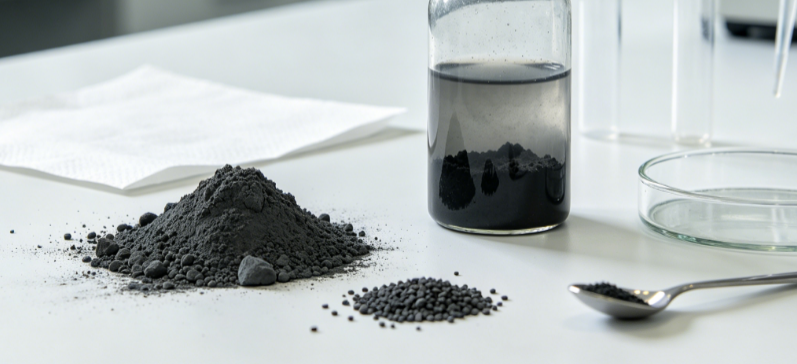
Analytical Framework – From Primary Assay to Crystal Structure, Activity, and Trace Impurity Profiling
We offer a tiered analytical strategy tailored to your quality control, production optimization, or raw material acceptance needs. Our platform includes:
• Total manganese (Mn) and active MnO₂ content – Redox titration (ferrous ammonium sulfate/permanganate) and ICP‑OES/ICP‑MS. Our primary reference method is the active MnO₂ determination by oxalic acid/permanganate back‑titration (based on the reduction of MnO₂ by oxalate in acidic medium, followed by titration of excess oxalate with KMnO₄), as specified in ISO 12985 and GB/T 29617. This method determines the “active oxygen” equivalent (typically expressed as MnO₂%) with a repeatability of ±0.2% absolute. Total manganese (including Mn in lower oxidation states) is determined by ICP‑OES (Agilent 5110) after complete acid digestion (HCl + HNO₃ + H₂O₂). We report both total Mn (as MnO₂ equivalent) and active MnO₂ (%); the difference indicates the presence of Mn₂O₃, Mn₃O₄, or other inactive phases. For ultra‑trace toxic metals (Pb, Cd, As, Hg, Cr), we use ICP‑MS (Agilent 8900) with collision/reaction cell, achieving sub‑ppm detection limits (0.01–0.1 mg/kg) as required for battery and food‑contact applications.
• Crystal structure and phase identification – X‑ray diffraction (XRD) with quantitative Rietveld analysis. Using a PANalytical X’Pert Pro MPD, we scan 10–80° 2θ and identify the MnO₂ polymorph – typically γ‑MnO₂ (ramsdellite‑pyrolusite intergrowth) or ε‑MnO₂ (hexagonal) – both of which are electrochemically active, in contrast to the less active β‑MnO₂ (pyrolusite). We quantify phase purity (%) and crystallite size (Scherrer) and detect any impurity phases (e.g., Mn₂O₃, Mn₃O₄, or SiO₂). We also refine the unit cell parameters and microstrain – parameters that correlate with electrochemical performance. Our Rietveld refinement achieves detection limits of 0.5% for minor phases.
• Specific surface area (BET) and porosity – Nitrogen adsorption and mercury porosimetry. Using a Micromeritics TriStar II Plus, we measure BET surface area (m²/g) after degassing at 120°C under vacuum – typical values range from 20 to 100 m²/g for battery‑grade AMD. We also determine total pore volume and pore size distribution (by BJH from desorption branch) to assess mesoporosity. For macroporosity and bulk density, we offer mercury intrusion porosimetry (AutoPore IV). These parameters directly influence discharge capacity and rate capability.
• Particle size distribution (PSD) – Laser diffraction with dry or wet dispersion. We use a Malvern Mastersizer 3000 with air dispersion (Aero S) for dry powder, or wet dispersion with sodium hexametaphosphate to break agglomerates. We report D10, D50, D90, span, and volume‑weighted mean over a range of 0.02–2000 µm. For sub‑micron particles, we offer dynamic light scattering (Zetasizer Ultra) or TEM image analysis as complementary methods.
• Moisture and loss on ignition (LOI) – Oven drying and TGA. We determine free moisture by drying at 105°C to constant weight, and LOI at 500°C (to remove bound water and organic volatiles) and at 900°C (to assess decomposition of MnO₂ to Mn₂O₃). We use simultaneous TGA‑DSC (Netzsch STA 449) from 25°C to 1000°C under air to obtain a detailed thermal fingerprint, which identifies dehydration, oxygen loss, and phase transformation temperatures – crucial for predicting thermal stability and drying conditions.
• Chemical activity and reactivity – Oxalic acid consumption and pyrophosphate extraction. We perform a standard reactivity test by measuring the rate of oxalic acid consumption (or potassium iodide oxidation) in acidic medium, reporting the “activity index” – a semi‑quantitative measure of electrochemical and catalytic activity. We also determine the “available oxygen” as a direct measure of the active component.
No other service offers simultaneous integration of redox titration for active MnO₂, ICP‑MS, XRD with Rietveld, BET, laser diffraction, TGA, and activity testing under one ISO 17025‑accredited system for activated manganese dioxide powder – delivering a complete quality profile from bulk chemistry to crystal structure and physical properties.
Why Our Laboratory Is the Preferred Partner for Activated Manganese Dioxide Analysis
Our specialization in manganese oxide materials and battery chemical analysis has enabled us to overcome the unique challenges of AMD testing: interference from coexisting metals (Fe, Cu) in redox titrations (requiring masking agents and carefully controlled acidity), difficulty in achieving complete dissolution for ICP (requiring HF and microwave digestion for refractory phases), very low crystallinity and nanoscale particles that challenge conventional XRD, and hygroscopicity affecting moisture and activity measurements. Our distinct advantages include:
1. Optimised sample handling to preserve activity and prevent oxidation/reduction. We store samples in inert‑atmosphere desiccators and analyse immediately after receipt. For redox titration, we perform the oxalate‑permanganate reaction under a nitrogen blanket to avoid atmospheric oxygen interference.
2. Multi‑method cross‑validation for active MnO₂. For each batch, we cross‑check active MnO₂ by both oxalate titration and iodometric titration (KI‑thiosulfate), which gives independent confirmation. Discrepancy >0.3% triggers an investigation using XANES (available upon request) to resolve the valence state.
3. Extensive reference materials and proficiency testing. We maintain certified reference materials for MnO₂ (including NIST SRM 101d and in‑house standards), and we participate in FAPAS® and BAM round‑robins for manganese oxides, consistently achieving |z|‑score < 0.5.
4. Ultra‑low detection limits for critical impurities. Our ICP‑MS/MS with O₂ and H₂ reaction gases eliminates polyatomic interferences (e.g., ⁴⁰Ar¹⁵N on ⁵⁵Mn is not a problem for Mn, but for As and Cd we use appropriate cells) and achieves LOQs of 0.005 mg/kg for Pb, 0.01 for Cd, 0.02 for As, 0.005 for Hg – meeting the most stringent requirements for battery materials (e.g., ASTM F963 for toy safety, EU RoHS).
5. ISO 17025 accreditation and global regulatory acceptance. Our methods comply with ISO 12985, ASTM D5523, JIS K 1462, and GB/T 29617. Our test reports are accepted by battery manufacturers (primary and secondary), catalyst producers, water treatment system suppliers, and chemical trading companies worldwide.
Technical Depth – Beyond Basic Quality Indicators
While many laboratories report only active MnO₂%, we provide mechanistic and performance‑predictive insights for advanced process control:
• Distinction between γ‑MnO₂ and ε‑MnO₂ and their electrochemical relevance. Using XRD with detailed pattern fitting, we can quantify the degree of microtwinning and stacking disorder – parameters that correlate strongly with discharge capacity and rate capability. We provide a “structural index” that summarises the γ/ε character.
• Quantification of lower‑valence manganese species (Mn³⁺, Mn²⁺). By combining total Mn (from ICP) and active MnO₂ (from titration), we calculate the average manganese oxidation state (AOS) – a key indicator of material quality. For example, theoretical γ‑MnO₂ has Mn oxidation state of 3.85–3.95; lower values indicate partial reduction (e.g., to Mn₂O₃). We report the AOS and the estimated Mn³⁺ fraction.
• Surface area – particle size – activity correlation. We correlate BET surface area with oxalic acid consumption rate to compute a “specific activity” (mmol oxalate consumed per m²) – useful for normalising performance across different batches and predicting battery or catalytic performance.
• Thermal stability and phase transition during drying. Using TGA‑DSC, we identify the onset temperature of oxygen loss (which marks the conversion to Mn₂O₃) – this guides safe drying temperatures for manufacturing.
Supporting Your Specific Activated Manganese Dioxide Testing Objectives
Your search for activated manganese dioxide detection likely aligns with one or more of these scenarios. We provide precisely tailored solutions:
• Raw material incoming inspection for battery production. We test each batch for active MnO₂ (%), total Mn, moisture, BET surface area, D50 particle size, and critical impurities (Fe, Cu, Co, Ni, Pb, Cd, As, Hg). Based on your specification (e.g., GB/T 29617 for alkaline battery MnO₂), we issue a certificate of analysis (COA) with clear pass/fail judgement. Typical turnaround: 3‑5 working days.
• Process optimisation for activation and grinding. For AMD producers, we analyse samples from different production stages – ore beneficiation, acid treatment, thermal activation, grinding, and classification – providing feedback on phase evolution, particle size reduction, surface area development, and active oxygen content. Our data helps you adjust roasting temperature, acid concentration, or grinding parameters.
• Troubleshooting for poor battery or catalytic performance. If your AMD fails to meet discharge capacity or catalytic activity, we conduct a forensic comparison between the suspect batch and a reference good batch. We measure full XRD for structural deviations, BET for surface area loss, and trace metal profiling for contamination (e.g., elevated Cu or Fe which can accelerate self‑discharge). We identify the root cause and recommend corrective actions (e.g., re‑activation, washing, or blending).
• Regulatory compliance for export and environmental safety. We provide comprehensive data packages for REACH, RoHS, and battery directive compliance, including full heavy metal declarations and classification/dangerous goods documentation (if applicable).
• Research and custom method development. For academic or industrial R&D, we offer customised characterisation including in‑situ XRD during heating, high‑pressure BET, electrochemical testing (galvanostatic discharge in simulated battery cells), and dissolution kinetics. We also perform method validation and inter‑laboratory studies for novel AMD materials.
Partner with Us for Definitive Activated Manganese Dioxide Characterisation
Choosing our laboratory gives you access to a dedicated manganese oxide and battery materials analysis team with over 15 years of experience in the field. We provide free sampling kits (sealed, inert‑packaged containers for moisture‑sensitive powder), a detailed sampling protocol (to avoid segregation and contamination), and direct consultation with our senior materials chemist for data interpretation and process advice. No project is too large or too small – from a single R&D sample to routine quality control of full production lots.
Contact our technical team with your activated manganese dioxide analysis requirements. We will provide a customised project quotation and, for qualifying clients, a free preliminary screening (active MnO₂% by titration, BET surface area, and D50) on up to three samples. Your search for authoritative, high‑depth characterisation of activated manganese dioxide ends here – because we deliver the structural, chemical, and performance‑linked insight that routine single‑parameter tests cannot provide.