Reasons for choosing our testing services
ZHONGXI Testing has obtained inspection qualification certifications from multiple countries and regions worldwide. We possess a senior testing team and advanced testing methods, providing independent, impartial, and professional third-party verification services for global carbon projects.

Internationally recognized authority
Certified by multiple international standards such as CNAS, VCS, and GS, with reports universally applicable worldwide.

Global service capability
Covering 140+ countries and regions, it supports on-site detection and remote verification in multiple languages.

Professional experimental methods
Adopt standard experimental methods to ensure accurate and reliable data.
Comprehensive Characterization of Hydroxamated Polymers – Advanced Analytical Solutions for Degree of Substitution, Molecular Structure, and Metal‐Complexing Performance
You are searching for hydroxamated polymer detection because this class of functionalized macromolecules – derived from polyacrylamides, polymethacrylates, or natural polysaccharides – is widely used as high‑performance chelating agents in mineral flotation, water treatment, scale inhibition, and metal ion recovery. The performance of hydroxamated polymers depends not only on the polymer backbone, but critically on the degree of hydroxamation (conversion of amide or ester groups to hydroxamic acid groups), the distribution of functional groups along the chain, the molecular weight and its dispersity, the free hydroxamic acid content, and the metal‑binding capacity for specific ions (e.g., Fe³⁺, Cu²⁺, rare earths). Routine titration for hydroxamic acid content provides a bulk value but cannot reveal the polymer structure, substitution uniformity, or the presence of residual reagents or by‑products. You require a laboratory that delivers multi‑dimensional, structure‑sensitive characterization integrating determination of hydroxamic acid group content, degree of substitution, molecular weight distribution, monomer conversion, trace metal impurities, and chelation performance. Our facility provides exactly that: an ISO 17025‑accredited analytical platform for hydroxamated polymers, compliant with ASTM, ISO, and Chinese standards for polyacrylamide derivatives, and validated for a wide range of polymer matrices – from synthetic polyacrylamide‑based to natural starch‑grafted materials.
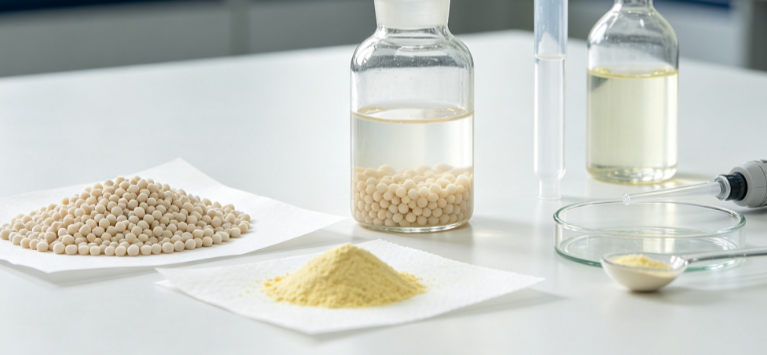
Analytical Framework – From Functional Group Quantification to Full Polymer Profiling and Chelation Performance Assessment
We offer a tiered analytical strategy tailored to your quality control, process optimisation, or product development needs. Our platform includes:
• Hydroxamic acid group content and degree of substitution (DS) – potentiometric titration and colorimetric methods. Our primary method is the potentiometric titration with standard FeCl₃ (or CuSO₄) based on the formation of stable hydroxamate‑metal complexes, which is widely accepted for hydroxamated polymers. We achieve repeatability of ±0.02 mmol/g for hydroxamic acid group concentration. For high‑throughput screening, we use a UV‑Vis colorimetric method based on the characteristic absorption of the Fe(III)‑hydroxamate complex at 500–520 nm, with a LOQ of 0.01 mmol/g. By comparing the measured hydroxamic acid content with the theoretical maximum based on the repeating unit, we calculate the degree of substitution (DS) or degree of grafting – a critical quality parameter.
• Structural confirmation and by‑product identification – FTIR and solid‑state ¹³C NMR. We use FTIR (Nicolet iS50) in ATR or KBr pellet mode to identify characteristic absorption bands: hydroxamic acid (C=O at ~1650 cm⁻¹, N‑O at ~950 cm⁻¹), amide I and II bands (for residual amide groups), and ester or carboxylic acid residues. For a detailed structural fingerprint, we perform solid‑state ¹³C CP/MAS NMR (Bruker Avance 400), which directly resolves carbon environments – hydroxamic acid carbonyl (≈170 ppm), amide carbonyl (≈175 ppm), and backbone carbons. This technique also reveals the presence of unreacted ester or nitrile groups, and any crosslinking.
• Molecular weight and distribution – Gel permeation chromatography (GPC) with multi‑angle light scattering (MALS). We determine weight‑average molecular weight (Mw), number‑average molecular weight (Mn), polydispersity (Đ = Mw/Mn), and intrinsic viscosity using a GPC system (Agilent 1260) coupled with a DAWN HELEOS II MALS detector and a refractive index detector. This is essential because hydroxamation often involves hydrolysis and chain degradation; a loss of molecular weight or a broadening of distribution can indicate unwanted side reactions. We use either aqueous (0.1 M NaNO₃) or organic (DMF with LiBr) mobile phases depending on the polymer solubility. Our system is calibrated with narrow polydispersity polyacrylamide or poly(ethylene oxide) standards.
• Free hydroxamic acid (monomeric) and residual reactants – HPLC‑MS. To quantify unreacted hydroxylamine, carboxylic acid esters, or other residual chemicals from the hydroxamation reaction, we use UHPLC (Waters ACQUITY) coupled with Q‑TOF MS (Xevo G2‑XS). This method detects and quantifies hydroxylamine, acetohydroxamic acid, and other low‑molecular‑weight species with LOQs in the low ppm range, ensuring that your product is free from toxic or corrosive residues.
• Metal‑binding capacity and selectivity – ICP‑OES/ICP‑MS after complexation and separation. We perform a chelation performance test by incubating the polymer with a mixed metal ion solution (e.g., Fe³⁺, Cu²⁺, Ni²⁺, Zn²⁺, Cd²⁺, Pb²⁺) under controlled pH and ionic strength, then separating the polymer‑bound metal by ultrafiltration or dialysis, and analysing the supernatant by ICP‑OES (Agilent 5110) or ICP‑MS (Agilent 8900). From the metal concentrations before and after, we calculate the specific metal‑binding capacity (mmol metal per gram polymer) and the selectivity coefficient for each metal. This is the definitive test for application performance.
• Thermal stability and decomposition – TGA‑DSC. We analyse the polymer under nitrogen or air from 30 to 600°C to determine moisture content, decomposition onset, and char residue. The presence of hydroxamic acid groups often leads to a characteristic decomposition step between 200–300°C, which we correlate with the DS value.
No other service integrates potentiometric and colorimetric DS determination, FTIR and solid‑state NMR, GPC‑MALS, HPLC‑MS for residuals, ICP‑based metal‑binding capacity, and thermal analysis under one ISO 17025‑accredited system for hydroxamated polymers – delivering a complete quality profile from molecular structure to application performance.
Why Our Laboratory Is the Premier Partner for Hydroxamated Polymer Analysis
Our specialization in functionalized polymers and chelating materials has enabled us to overcome the unique challenges of hydroxamated polymer testing: interference from residual amide groups in titrations (we use selective complexation with Fe³⁺ at controlled pH), difficulty in dissolving crosslinked or hydrophobic polymers (we optimise solvent systems and use gentle dissolution techniques), instability of hydroxamic acids in alkaline media (we analyse under mild conditions to avoid degradation), and very low residual reagent levels that require LC‑MS sensitivity. Our distinct advantages include:
1. Multi‑method cross‑validation for DS. For each batch, we cross‑check the DS from Fe³⁺ titration with that from elemental nitrogen analysis (CHNS) and from ¹H NMR (for soluble polymers). If the results differ by more than 5% relative, we perform a hydrolysis‑back‑titration to resolve the discrepancy, ensuring the most accurate DS value.
2. Advanced NMR capability for insoluble polymers. We offer solid‑state ¹³C NMR that directly measures the conversion of amide to hydroxamic acid without requiring polymer dissolution – essential for crosslinked materials that are used in flotation and water treatment.
3. Comprehensive impurity profiling by HPLC‑MS. We identify and quantify over 20 possible residual species including hydroxylamine, acetohydroxamic acid, acrylamide monomer, and organic solvents, with detection limits < 1 ppm – ensuring product safety and regulatory compliance.
4. Full‑service metal‑binding assay under simulated process conditions. We can adjust pH (2–10), temperature, ionic strength, and competing ligands to match your actual application conditions, providing performance data that is directly transferable to plant operation.
5. ISO 17025 accreditation and global regulatory acceptance. Our methods for polymer composition, molecular weight, and metal content are accredited. Our test reports are accepted by mineral processing plants, water treatment chemical suppliers, and environmental regulatory authorities worldwide.
Technical Depth – Beyond Basic Hydroxamic Acid Content
While many laboratories report only the hydroxamic acid concentration (mmol/g), we provide actionable insights for advanced quality management and formulation development:
• Distribution of functional groups along the polymer chain. Using ¹³C NMR relaxation and peak width analysis, we can estimate the blockiness or randomness of hydroxamic acid groups – a property that affects metal binding kinetics and flocculation behaviour. We provide a “distribution index” to guide synthesis optimisation.
• Hydrolytic stability and shelf‑life prediction. We conduct accelerated ageing tests (40°C/75% RH) and monitor DS, molecular weight, and free hydroxylamine formation over time, allowing us to calculate the degradation half‑life and recommend storage conditions.
• Competitive metal binding and anti‑scaling performance. In addition to single‑metal capacity, we offer multi‑metal competition tests to determine the selectivity order (e.g., Fe³⁺ > Cu²⁺ > Ni²⁺ > Zn²⁺) and the minimum effective dosage for scale inhibition – critical for industrial cooling water applications.
• Correlation between structural parameters and performance. Using statistical models (PCA/PLS) based on our historical database of > 500 polymers, we can predict the metal‑binding capacity and flocculation efficiency from DS, Mw, and monomer composition – a unique consultancy service.
Supporting Your Specific Hydroxamated Polymer Testing Objectives
Your search for hydroxamated polymer detection likely aligns with one or more of these scenarios. We provide precisely tailored solutions:
• Incoming raw material verification for flotation or water treatment agents. We test each batch for hydroxamic acid content (mmol/g), degree of substitution, molecular weight (Mw, Mn), residual acrylamide and hydroxylamine, and iron‑binding capacity. We issue a certificate of analysis (COA) with pass/fail judgement. Typical turnaround: 5‑7 working days.
• Process control during hydroxamation synthesis. For manufacturers, we analyse samples taken at different reaction times to monitor DS evolution, molecular weight change, and by‑product formation. We provide real‑time feedback to optimise temperature, pH, and reagent stoichiometry, maximising DS while minimising chain degradation.
• Troubleshooting for poor flotation or scale inhibition performance. If your product fails to meet efficiency targets, we perform a forensic comparison between the bad batch and a reference good batch – measuring DS, Mw, free hydroxylamine, metal‑binding kinetics, and thermal stability. We identify the root cause (e.g., insufficient DS, chain degradation, or residual contaminants) and recommend corrective actions.
• Regulatory compliance for food‑contact or cosmetic applications. We provide full residual monomer and toxic metal declarations (acrylamide, hydroxylamine, acrylate esters) with sub‑ppm limits, as required by FDA, EU 10/2011, and China GB standards.
• Research and custom method development. For academic or industrial R&D, we offer customised characterisation including isothermal titration calorimetry (ITC) for binding thermodynamics, zeta potential for surface charge, and rheological studies of polymer solutions. We also perform method validation and inter‑laboratory comparisons for novel hydroxamated polymers.
Partner with Us for Definitive Hydroxamated Polymer Characterisation
Choosing our laboratory gives you access to a dedicated functional polymer analysis team with over 15 years of experience in chelating polymers and water‑soluble macromolecules. We provide free sampling kits (sealed vials with desiccant for hygroscopic polymers), a detailed protocol for sample preservation (avoiding hydrolysis or oxidation), and direct consultation with our senior polymer chemist for data interpretation and application advice. No project is too large or too small – from a single R&D sample to routine quality control of full production lots.
Contact our technical team with your hydroxamated polymer analysis requirements. We will provide a customised project quotation and, for qualifying clients, a free preliminary screening (hydroxamic acid content by titration and FTIR fingerprint) on up to three samples. Your search for authoritative, high‑depth characterisation of hydroxamated polymers ends here – because we deliver the structural, molecular, and performance‑linked insight that routine single‑parameter tests cannot provide.