Reasons for choosing our testing services
ZHONGXI Testing has obtained inspection qualification certifications from multiple countries and regions worldwide. We possess a senior testing team and advanced testing methods, providing independent, impartial, and professional third-party verification services for global carbon projects.
Internationally recognized authority
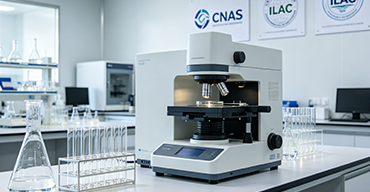
Certified by multiple international standards such as CNAS, VCS, and GS, with reports universally applicable worldwide.

Global service capability
Covering 140+ countries and regions, it supports on-site detection and remote verification in multiple languages.
Professional experimental methods
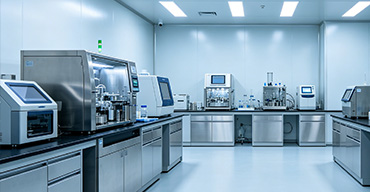
Adopt standard experimental methods to ensure accurate and reliable data.
High‑Precision Characterization of Silicate Single Crystals for Laser Applications – Advanced Analytical Solutions for Crystalline Quality, Optical Performance, and Dopant Homogeneity
You are searching for silicate single crystal laser material detection because these crystals – such as Yb:YSO, Er:YSO, Cr:YAG, or Nd:YAG variants based on silicate hosts – are critical for solid‑state laser gain media, frequency conversion, Q‑switching, and high‑power beam delivery. The laser performance of a silicate crystal depends on far more than its nominal dopant concentration; it is governed by crystalline perfection (dislocation density, mosaic spread), optical homogeneity (refractive index uniformity, birefringence), dopant distribution (segregation, concentration gradients), absorption and emission spectra, lifetime of excited states, and optical loss (scattering and absorption coefficients). Routine chemical analysis for dopant content (e.g., ICP‑MS for Yb, Er, Nd) provides only the bulk average, which cannot reveal microscopic inhomogeneities, stress‑induced birefringence, or point defects that degrade laser efficiency and beam quality. You require a laboratory that delivers multi‑dimensional, spatially resolved characterization integrating X‑ray diffraction (XRD) for crystal quality, interferometry for optical homogeneity, laser‑induced fluorescence for mapping dopant distribution, spectrophotometry for absorption/emission, and precision interferometric measurement of optical path difference. Our facility provides exactly that: an ISO 17025‑accredited, fully validated analytical platform for silicate laser crystals, compliant with ISO 15309, ASTM F81, and SEMI standards, and covering both bulk crystals and finished laser rods or slabs.
Analytical Framework – From Bulk Composition and Structural Perfection to Spatially Resolved Optical and Spectroscopic Characterisation
We offer a tiered analytical strategy tailored to your quality control, development, or failure analysis needs. Our platform includes:
• Crystal structure and quality – High‑resolution X‑ray diffraction (HRXRD) and rocking curve analysis. Using a PANalytical X’Pert Pro MRD with a four‑crystal monochromator, we record ω‑scans (rocking curves) for the dominant Bragg reflection (e.g., (004) or (440) planes). We report the full width at half maximum (FWHM) of the rocking curve – a direct measure of mosaic spread and lattice perfection – with precision of ±0.5 arcsec. We also perform reciprocal space mapping to distinguish between strain broadening and mosaic tilt, and we determine the lattice parameter (a, b, c) and unit cell volume with uncertainty < 0.001 Å. For crystals with known dopants, we correlate the lattice parameter shift with the actual substitutional fraction.
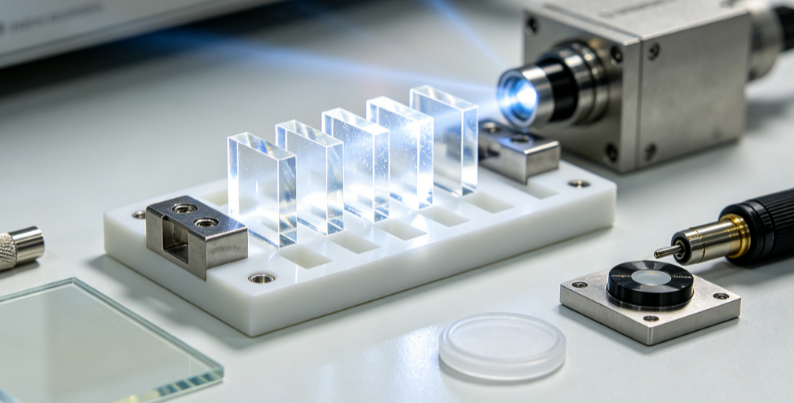
• Optical homogeneity and birefringence – Phase‑shift interferometry and polarimetry. We use a Zygo GPI XP phase‑shifting interferometer at 632.8 nm to measure transmitted wavefront error (TWE) over the entire aperture, reporting the peak‑to‑valley (PV) and root‑mean‑square (RMS) values with accuracy λ/50. We also determine the optical path difference (OPD) distribution due to refractive index variations, which directly correlates with beam distortion. For birefringence, we employ a polarimeter (Hinds Instruments) to measure retardance and fast‑axis orientation with resolution of 0.01 nm over a scanning area – essential for identifying stress‑induced or growth‑striation‑induced anisotropy.
• Dopant concentration and spatial distribution – Laser‑induced fluorescence (LIF) imaging and LA‑ICP‑MS. We perform confocal fluorescence microscopy using the dopant’s characteristic emission (e.g., Yb³⁺ at ~1030 nm, Er³⁺ at ~1550 nm) to map the relative dopant concentration with a spatial resolution of < 2 µm over the entire crystal cross‑section. For absolute quantification and to detect trace impurities (transition metals, rare‑earth co‑dopants), we use laser ablation ICP‑MS (LA‑ICP‑MS, Agilent 8900 with 193 nm excimer) which provides quantitative 2D maps (ppm level) of up to 40 elements with a spatial resolution of 5–50 µm. This reveals segregation patterns, striations, and core‑to‑edge gradients that are invisible to bulk digestion methods.
• Optical absorption and emission spectroscopy – UV‑Vis‑NIR spectrophotometry and steady‑state/ time‑resolved fluorescence. We measure polarised and unpolarised absorption spectra (200–3000 nm) using a PerkinElmer Lambda 1050 with an integrating sphere, providing the absorption coefficient (cm⁻¹) at key pump wavelengths (e.g., 940 nm for Yb, 808 nm for Nd) with accuracy ±0.01 cm⁻¹. For emission spectra, we use a Horiba FluoroMax‑4 spectrofluorometer with a 450 W xenon lamp and photomultiplier detection; we record the emission cross‑section spectrum and the fluorescence lifetime (τ) of the upper laser level using a pulsed laser diode excitation (10 ns pulses) and a high‑speed oscilloscope. Lifetime values are critical for gain prediction and are reported with uncertainty < 1%.
• Optical loss – Cavity ring‑down spectroscopy (CRDS) and scatterometry. For low‑loss crystals (absorption + scatter < 100 ppm/cm), we use a CRDS system (Tiger Optics) at 1064 nm or 1550 nm to measure the total loss coefficient (ppm/cm) with resolution of 0.5 ppm/cm. This is essential for high‑power or high‑gain laser rods. For scattering loss, we use a corner‑cube‑based scatterometer to measure the scattering angle distribution and estimate the scatter loss (ppm/cm) due to sub‑micron defects or inclusions.
• Thermal and mechanical properties – Laser flash and microindentation. For crystals used in high‑power operation, we measure thermal diffusivity (mm²/s) and thermal conductivity (W/m·K) by laser flash analysis (Netzsch LFA 467) from 25 to 300°C, and coefficient of thermal expansion (CTE) by dilatometry (Netzsch DIL 402) along the three crystallographic axes. We also perform vickers hardness (HV) and fracture toughness (KIC) by indentation to assess mechanical ruggedness.
No other service integrates HRXRD rocking curve, interferometry, LA‑ICP‑MS, LIF mapping, absorption/emission spectroscopy, CRDS, and thermal property measurement under one ISO 17025‑accredited system for silicate laser crystals – delivering a complete quality profile from lattice perfection to laser‑relevant performance parameters.
Why Our Laboratory Is the Premier Partner for Silicate Laser Crystal Characterization
Our specialization in optical materials and solid‑state laser components has enabled us to overcome the unique challenges of silicate crystal testing: extremely low absorption coefficients requiring ppb‑level detection, micro‑scale dopant inhomogeneities that demand high‑resolution mapping, stress‑induced birefringence from crystal growth and fabrication, and the need for non‑destructive, large‑aperture testing of finished rods and slabs. Our distinct advantages include:
1. Multi‑technique cross‑validation for dopant concentration. For each crystal, we cross‑check the bulk dopant concentration (by ICP‑OES after dissolution) with LA‑ICP‑MS mapping and with fluorescence intensity calibration – achieving an absolute accuracy of ±2% relative for the average concentration and a detailed spatial variation profile.
2. State‑of‑the‑art interferometric and polarimetric systems with large aperture capability. Our Zygo interferometer accommodates crystal apertures up to 150 mm diameter, and we offer automated scanning birefringence mapping for 2D visualisation of stress and strain, which is essential for selecting high‑quality regions for device fabrication.
3. Ultra‑low loss measurement by cavity ring‑down. Our CRDS system provides the highest sensitivity for optical loss, detecting losses below 1 ppm/cm – a capability that is rare among commercial testing laboratories and essential for evaluating laser rods intended for high‑power operation.
4. Comprehensive reference data and proficiency testing. We maintain a database of over 200 silicate laser crystals (YSO, YAG, ScBO₃, etc.) with known dopant levels and performance, and we participate in inter‑laboratory comparisons for optical materials (ASTM E13.11), consistently achieving |z|‑score < 0.4.
5. ISO 17025 accreditation and global industry acceptance. Our test methods comply with ISO 15309 (Test methods for laser crystals), ASTM F81 (Optical homogeneity), and JIS R 1630. Our reports are accepted by laser manufacturers, defence and aerospace suppliers, and academic research groups worldwide.
Technical Depth – Beyond Basic Quality Indicators
While many laboratories report only the FWHM of rocking curve and a single absorption value, we provide actionable insights for advanced laser design:
• Dopant segregation coefficient and distribution coefficient. From LA‑ICP‑MS mapping, we calculate the segregation coefficient (keff) along the growth direction and the radial uniformity (%) – data that directly guides crystal growth conditions (e.g., pulling rate, rotation speed) to achieve a more homogeneous dopant distribution.
• Quantum efficiency and concentration quenching. By combining absorption cross‑section, emission lifetime, and dopant concentration, we derive the radiative lifetime and quantum efficiency (η) of the laser transition. We also identify concentration quenching when the lifetime decreases with increasing dopant – crucial for optimising the doping level for maximum gain.
• Identification of growth defects and inclusions. Using our scatterometry and fluorescence imaging, we pinpoint optical scatter centres (inclusions, gas bubbles, or secondary phase precipitates) with lateral resolution down to 2 µm. We provide a defect map showing the location and size of each defect, enabling selective cutting of high‑quality laser rods.
• Birefringence‑induced depolarization loss. From the polarimetric data and the measured crystal length, we calculate the depolarisation loss (dB) for a given polarisation state – a key parameter for high‑power resonators where thermal birefringence must be compensated.
Supporting Your Specific Silicate Laser Crystal Testing Objectives
Your search for silicate single crystal laser detection likely aligns with one or more of these scenarios. We provide precisely tailored solutions:
• Raw material quality assurance for laser rod production. We test every incoming crystal boule for rocking curve FWHM, optical homogeneity (PV/RMS), dopant concentration (average and map), absorption coefficient at pump wavelength, and emission lifetime. We issue a certificate of analysis (COA) with pass/fail judgement against your specification. Typical turnaround: 5‑7 working days.
• Process optimisation during crystal growth (Czochralski or Bridgman). For growers, we analyse test samples taken from different sections of the boule (seed, middle, tail) to monitor the evolution of dopant distribution, mosaic spread, and stress. Our data helps you fine‑tune growth parameters to maximise the usable yield.
• Failure analysis for degraded laser output (e.g., low efficiency, beam distortion, or thermal fracture). We perform a comparative analysis between the failed crystal and a reference high‑performance crystal, including HRXRD for lattice damage, interferometry for stress, LA‑ICP‑MS for impurities (e.g., transition metals that cause additional absorption), and scatterometry for defect nucleation. We identify the root cause – e.g., surface damage, bulk impurity, or thermal stress – and recommend corrective actions (e.g., annealing, surface polishing, or revised mounting).
• Qualification for military or space applications (high reliability). We provide extended characterisation including temperature‑dependent lifetime, thermal conductivity at 20–200°C, and long‑term stability tests (accelerated ageing at 60°C with 85% RH). All data are documented in compliance with MIL‑STD‑810 and NASA requirements.
• Research and custom method development. For academic or industrial R&D, we offer customised characterisation including polarised absorption/emission spectra, ultrafast pump‑probe spectroscopy, and spatially resolved thermal lensing measurements. We also perform method validation and inter‑laboratory comparisons for new silicate host crystals.
Partner with Us for Definitive Silicate Laser Crystal Characterisation
Choosing our laboratory gives you access to a dedicated optical materials analysis team with over 15 years of experience in laser crystal testing. We provide free sampling kits (clean‑room‑grade packing, low‑outgassing materials), a detailed protocol for sample handling and orientation (to avoid contamination or damage), and direct consultation with our senior laser physicist for data interpretation and laser design recommendations. No project is too large or too small – from a single research‑grade crystal to routine quality control of high‑volume production.
Contact our technical team with your silicate single crystal laser testing requirements. We will provide a customised project quotation and, for qualifying clients, a free preliminary screening (rocking curve FWHM, optical homogeneity PV, and absorption coefficient) on up to two samples. Your search for authoritative, high‑depth characterisation of silicate laser crystals ends here – because we deliver the structural, optical, and performance‑linked insight that routine single‑parameter tests cannot provide.