Reasons for choosing our testing services
ZHONGXI Testing has obtained inspection qualification certifications from multiple countries and regions worldwide. We possess a senior testing team and advanced testing methods, providing independent, impartial, and professional third-party verification services for global carbon projects.

Internationally recognized authority
Certified by multiple international standards such as CNAS, VCS, and GS, with reports universally applicable worldwide.

Global service capability
Covering 140+ countries and regions, it supports on-site detection and remote verification in multiple languages.

Professional experimental methods
Adopt standard experimental methods to ensure accurate and reliable data.
High‑Precision Analytical Solutions for Defluorinated Calcium Phosphate – Comprehensive Quality, Purity, and Safety Characterization for Feed, Food, and Industrial Applications
You are searching for defluorinated calcium phosphate (DCP) detection because this essential mineral feed additive and food phosphate source must meet stringent specifications for fluoride content, phosphorus and calcium bioavailability, heavy metal limits, and physical flowability. Unlike standard phosphate rock analysis, defluorinated calcium phosphate requires rigorous control of residual fluoride (typically < 0.1%), free phosphorus pentoxide (P₂O₅), calcium to phosphorus ratio, trace toxic elements (As, Pb, Cd, Hg), and acid‑insoluble residues. Routine wet chemical methods for “total phosphorus” or “fluoride” often suffer from interference and cannot detect the speciation of phosphate (e.g., mono‑, di‑, or tricalcium phosphate) or the presence of unreacted fluorapatite – both of which critically affect animal nutrition and processing safety. You require a laboratory that delivers multi‑parameter, validated characterisation integrating precise fluoride determination, available phosphorus (citrate‑soluble), total phosphorus, calcium, magnesium, heavy metals, and physical properties (particle size, moisture, density). Our facility provides exactly that: an ISO 17025‑accredited analytical platform for defluorinated calcium phosphate, compliant with AOAC, ISO 6490, and Chinese GB/T 22549 standards, and validated for both feed‑grade and food‑grade materials.
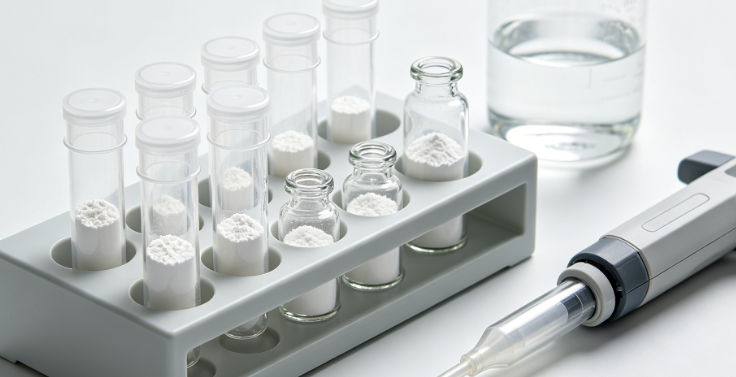
Analytical Framework – From Primary Assay to Advanced Fluoride Speciation and Bioavailability Assessment
We offer a tiered analytical strategy tailored to your quality control, procurement, or regulatory filing needs. Our platform includes:
• Total phosphorus (as P₂O₅) and available phosphorus (citrate‑soluble P) – gravimetric quinoline phosphomolybdate and spectrophotometric methods. Our primary method is the gravimetric determination as quinoline phosphomolybdate (AOAC 965.05) which achieves repeatability of ±0.1% absolute P₂O₅ – the reference method for international trade. For available phosphorus (the fraction soluble in neutral ammonium citrate), we perform the AOAC 967.01 or ISO 6491 method, reporting both total P₂O₅ and citrate‑soluble P₂O₅, along with the “relative bioavailability index” calculated from the citrate solubility. For high‑throughput screening, we use ICP‑OES (Agilent 5110) for total P, Ca, Mg, Na, K, and Fe.
• Calcium content and Ca/P ratio – permanganometric titration and ICP‑OES. Calcium is determined by classical KMnO₄ titration after precipitation as calcium oxalate (ISO 6490) with a precision of ±0.1% Ca, and cross‑checked by ICP‑OES. We then calculate the Ca/P weight ratio – typically 2.2–2.5 for feed‑grade DCP – and compare with the theoretical ratio for CaHPO₄·2H₂O (2.35). Any deviation indicates the presence of other calcium salts (e.g., CaCO₃, Ca₃(PO₄)₂) or unreacted raw material.
• Total fluoride and residual fluoride – ion‑selective electrode (ISE) with acid diffusion and steam distillation. We determine total fluoride by the potentiometric ISE method after perchloric acid steam distillation (AOAC 965.32), which separates F⁻ from interfering species (e.g., Al, Fe). We achieve LOQ of 0.001% F (10 ppm) and a repeatability of ±0.002%. For rapid screening, we use alkaline fusion followed by ISE. This is the critical quality parameter: defluorinated calcium phosphate for feed must typically contain < 0.05% F, and for food‑grade < 0.003% F. Our method ensures you can confidently meet these limits.
• Free moisture, loss on ignition, and volatile matter – oven drying and TGA. We measure moisture at 105°C (AOAC 925.10), and loss on ignition at 800°C to assess organic matter, carbonate, and crystal water. Using simultaneous TGA‑DSC (Netzsch STA 449), we identify the dehydration temperature (for CaHPO₄·2H₂O to CaHPO₄) and the decomposition of any calcium carbonate – providing a thermal fingerprint for batch‑to‑batch consistency.
• Toxic heavy metals (As, Pb, Cd, Hg, Cr) – ICP‑MS/MS and hydride generation AAS. For feed safety, we use Agilent 8900 ICP‑MS/MS with reaction/collision cell to eliminate polyatomic interferences (e.g., ⁴⁰Ar³⁵Cl on ⁷⁵As, ⁴⁰Ar¹⁶O on ⁵⁶Fe) after microwave digestion (HNO₃ + HCl). We achieve LOQs of 0.02 mg/kg for As, Pb, 0.005 for Cd, and 0.01 for Hg – well below EU and FDA feed additive limits. For arsenic speciation (inorganic vs. organic), we offer an optional HPLC‑ICP‑MS method.
• Acid‑insoluble matter and free silica – gravimetric and spectrophotometric methods. We determine acid‑insoluble residue (e.g., sand, silicates) by dissolving the sample in dilute HCl, filtering, and igniting (AOAC 971.02), with a detection limit of 0.01%. This parameter is critical because high acid‑insoluble content reduces nutritional value and can damage milling equipment.
• Crystalline phase identification – X‑ray diffraction (XRD). We use PANalytical X’Pert Pro to identify the principal crystalline phases (e.g., CaHPO₄·2H₂O, CaHPO₄, Ca₃(PO₄)₂, CaCO₃, fluorapatite). This distinguishes true defluorinated DCP from blends or under‑processed products, and we provide a semi‑quantitative phase estimation by Rietveld refinement.
• Particle size and flowability – laser diffraction and angle of repose. Using Malvern Mastersizer 3000 with dry dispersion, we report D10, D50, D90 and span. We also measure angle of repose and Hausner ratio to predict handling and mixing behaviour in feed formulations.
No other service integrates quinoline gravimetric P, ISE fluoride, ICP‑MS toxic metals, TGA, XRD, and particle sizing under one ISO 17025‑accredited system for defluorinated calcium phosphate – delivering a complete quality profile from chemical purity to physical handling.
Why Our Laboratory Is the Preferred Partner for Defluorinated Calcium Phosphate Testing
Our specialisation in mineral feed additive and phosphate chemistry analysis has enabled us to overcome the unique challenges of DCP testing: interference from calcium and phosphate in fluoride ISE measurement (we use a total ionic strength adjustment buffer, TISAB, and standard addition to overcome this), incomplete digestion for heavy metal analysis (we use sealed microwave digestion with HNO₃/HCl), differentiation between total and available phosphorus – we run parallel citrate solubility assays, and distinguishing true defluorinated product from mixtures (we combine XRD with chemical mass balance). Our distinct advantages include:
1. Multi‑method cross‑validation for critical parameters. For each batch, we cross‑check total P from gravimetric and ICP‑OES; fluoride from ISE and ion chromatography; Ca from titration and ICP. Discrepancy >0.2% (absolute) triggers an investigation using XRD and SEM‑EDS to resolve the cause – ensuring you receive a fully reconciled result.
2. Ultra‑low fluoride detection (0.001% F) and speciation. Our steam distillation method effectively separates fluoride from interfering cations, and we provide an optional F⁻ vs. SiF₆²⁻ speciation to detect the presence of residual fluosilicates – a unique service for clients with the strictest regulatory requirements.
3. Full compliance with international feed and food standards. Our methods align with AOAC, ISO 6490 (animal feeding stuffs), Codex Alimentarius, EU Regulation 1831/2003, and Chinese GB/T 22549. Our reports are accepted by feed mill quality departments, phosphate producers, and regulatory authorities worldwide.
4. Comprehensive reference materials and proficiency testing. We maintain certified reference materials for DCP (including NIST SRM 694 and in‑house standards) and participate in FAPAS® and AOCS proficiency tests, achieving |z|‑score < 0.5 for all key parameters.
Technical Depth – Beyond Basic Chemical Composition
While many laboratories report only P₂O₅ and F content, we provide actionable insights for advanced quality management and product development:
• Bioavailability prediction from citrate‑soluble phosphorus. We calculate a “relative bioavailability” compared to a reference DCP standard, and we can also perform a simulated gastric digestion test (pH 1.2, 37°C) to measure the fraction of phosphorus released under physiological conditions – a service that directly supports animal nutrition claims.
• Identification of under‑defluorinated material. Using the Ca/P ratio together with XRD, we can determine if residual fluorapatite (Ca₁₀(PO₄)₆F₂) is present, which indicates incomplete defluorination. We report a “defluorination completeness index” based on the intensity of the apatite (211) XRD peak.
• Trace element source identification. By combining ICP‑MS full‑scan data with principal component analysis, we can trace the origin of certain impurities (e.g., rare earths, uranium) back to specific phosphate rock deposits – a forensic capability for supply chain integrity.
• Stability and storage behaviour. We assess moisture sorption isotherms (DVS) and caking tendency under controlled humidity, providing guidance on packaging and maximum shelf‑life under typical storage conditions.
Supporting Your Specific Defluorinated Calcium Phosphate Testing Objectives
Your search for defluorinated calcium phosphate detection likely aligns with one or more of these scenarios. We provide precisely tailored solutions:
• Raw material acceptance for feed mills. We test each incoming shipment for total P₂O₅, citrate‑soluble P, Ca, F, heavy metals (As, Pb, Cd, Hg), moisture, and acid‑insoluble matter. We issue a certificate of analysis (COA) with a pass/fail judgement relative to your purchase specification (e.g., EU 2020/1020, or Chinese GB/T 22549). Typical turnaround: 3‑5 working days.
• Process control during defluorination (calcination or hydrothermal treatment). We analyse intermediate samples (raw rock, calcined meal, washed product, dried final product) to monitor the decrease in fluoride, increase in available P, and evolution of Ca/P ratio. This allows you to optimise the calcination temperature, retention time, and washing conditions.
• Troubleshooting for animal performance issues (e.g., low weight gain, bone deformities). If your DCP is suspected of being ineffective or toxic, we conduct a forensic comparison between the problem batch and a reference good batch – analysing fluoride speciation, citrate solubility, heavy metal profile, and XRD for apatite residuals. We identify whether the issue is due to high F, low bioavailability, or toxic metal contamination, and recommend corrective measures.
• Regulatory compliance for export (EU, US, China). We provide comprehensive data packages for EU Feed Additive Registration, FDA GRAS, and Chinese Feed Additive Approval, including all required purity, heavy metal, and safety test results.
• Research and custom method development. For academic or industrial R&D, we offer customised characterisation including FTIR for phosphate speciation, ³¹P solid‑state NMR for chemical environment, and dissolution kinetics in simulated gastric fluid. We also perform method validation and inter‑laboratory comparisons for novel defluorination processes.
Partner with Us for Definitive Defluorinated Calcium Phosphate Characterisation
Choosing our laboratory gives you access to a dedicated phosphate mineral and feed additive analysis team with over 12 years of experience in phosphorus chemistry. We provide free sampling kits (pre‑cleaned, sealed containers), a detailed sampling protocol (to avoid moisture change and segregation), and direct consultation with our senior chemist for data interpretation and process advice. No project is too large or too small – from a single batch for compliance testing to routine quality control of continuous production.
Contact our technical team with your defluorinated calcium phosphate testing requirements. We will provide a customised project quotation and, for qualifying clients, a free preliminary screening (total P₂O₅, F, and Ca) on up to three samples. Your search for authoritative, high‑depth characterisation of defluorinated calcium phosphate ends here – because we deliver the chemical, physical, and nutritional insight that routine single‑parameter tests cannot provide.