Reasons for choosing our testing services
ZHONGXI Testing has obtained inspection qualification certifications from multiple countries and regions worldwide. We possess a senior testing team and advanced testing methods, providing independent, impartial, and professional third-party verification services for global carbon projects.

Internationally recognized authority
Certified by multiple international standards such as CNAS, VCS, and GS, with reports universally applicable worldwide.

Global service capability
Covering 140+ countries and regions, it supports on-site detection and remote verification in multiple languages.

Professional experimental methods
Adopt standard experimental methods to ensure accurate and reliable data.
Comprehensive Characterization of Magnetic Iron Oxide Black (Fe₃O₄) – Advanced Analytical Services for Phase Purity, Magnetic Performance, and Trace Impurity Control
You are searching for magnetic iron oxide black (magnetite, Fe₃O₄) detection because this multifunctional material is essential for pigment applications, magnetic recording media, ferrite production, catalyst supports, and biomedical diagnostics. The performance of magnetic iron oxide black depends on far more than total iron content; it critically requires precise control over phase purity (magnetite vs. maghemite or hematite), stoichiometry (Fe²⁺/Fe³⁺ ratio), magnetic properties (saturation magnetization, coercivity), particle size and distribution, specific surface area, and trace impurities (e.g., Si, Al, Ca, Mn, Cr, Pb, Cd). Routine chemical titration for Fe²⁺ and total Fe provides only a bulk value and cannot identify the presence of non‑magnetic phases, surface oxidation, or contaminant elements that affect colour strength, dispersibility, or magnetic response. You require a laboratory that delivers multi‑dimensional, structure‑sensitive characterization integrating X‑ray diffraction (XRD) for phase identification and quantitative phase analysis, Mössbauer spectroscopy for iron valence and site occupancy, vibrating sample magnetometry (VSM) for magnetic properties, inductively coupled plasma mass spectrometry (ICP‑MS) for ultratrace impurity profiling, and BET/PSD for physical characteristics. Our facility provides exactly that: an ISO 17025‑accredited, fully validated analytical platform for magnetic iron oxide black, compliant with ISO 1248, ASTM D4944, and Chinese GB/T 1863 standards, and covering both pigment‑grade and high‑purity functional materials.
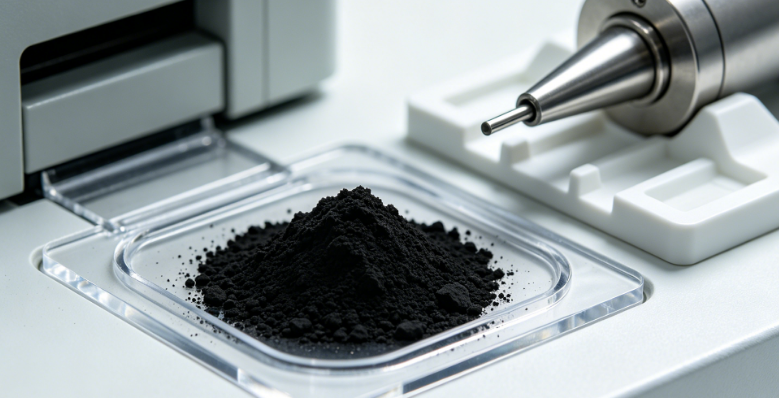
Analytical Framework – From Stoichiometry and Phase Purity to Magnetic Behaviour and Trace Contaminant Mapping
We offer a tiered analytical strategy tailored to your quality control, process optimization, or regulatory needs. Our platform includes:
• Total iron, ferrous iron (Fe²⁺), and ferric iron (Fe³⁺) – redox titration with potassium dichromate and cerimetric methods. Our primary method is the standard redox titration using potassium dichromate after dissolution in HCl, coupled with a separate determination of Fe²⁺ by titration with cerium(IV) sulfate or potassium permanganate under a CO₂ atmosphere to prevent air oxidation. This yields both total Fe (as Fe₃O₄ equivalent) and the Fe²⁺/Fe³⁺ ratio, which directly confirms the magnetite stoichiometry (theoretical Fe²⁺/Fe³⁺ = 0.5). We achieve repeatability of ±0.05% absolute for Fe²⁺ and an overall assay accuracy of ±0.1%. This is the fundamental quality check for magnetic oxide black.
• Phase identification and quantitative phase analysis – X‑ray diffraction (XRD) with Rietveld refinement. Using a PANalytical X’Pert Pro MPD with Co Kα or Cu Kα radiation, we collect patterns over 10–80° 2θ. We perform quantitative Rietveld refinement to determine the weight fractions of magnetite (Fe₃O₄), maghemite (γ‑Fe₂O₃), hematite (α‑Fe₂O₃), and any other crystalline impurities (e.g., quartz, calcite). Our detection limit for secondary phases is 0.5 wt%. We also extract the lattice parameter (a) of the spinel structure, which is sensitive to cation distribution and oxidation state – a value of 8.396 Å for pure Fe₃O₄, with deviations indicating maghemitization or cation substitution.
• Magnetic property evaluation – Vibrating Sample Magnetometry (VSM) at room temperature and cryogenic conditions. We use a Lake Shore VSM 7400 to measure the magnetic hysteresis loop over a field range of ±2 T, reporting saturation magnetization (Mₛ, emu/g), remanent magnetization (Mᵣ), coercivity (H꜀, Oe), and squareness (Mᵣ/Mₛ). For magnetite, the expected Mₛ at room temperature is ~92 emu/g for pure bulk material; lower values indicate oxidation (maghemite) or non‑magnetic impurities. For nanoparticles, we offer zero‑field‑cooled (ZFC) and field‑cooled (FC) magnetization curves to determine the blocking temperature (TB), which correlates with particle size. This magnetic fingerprint is crucial for applications in data storage and magnetic resonance imaging.
• Cation distribution and oxidation state – Mössbauer spectroscopy (⁵⁷Fe) at 300 K and 77 K. For definitive verification of the Fe occupancy in tetrahedral and octahedral sites, we perform transmission Mössbauer spectroscopy using a ⁵⁷Co/Rh source. We report the isomer shift (δ), quadrupole splitting (ΔEQ), and hyperfine field (Bhf) for each iron site, along with the relative area fractions. This directly quantifies the degree of inversion and detects any maghemite or hematite contamination with unmatched specificity. This service is offered on a collaborative basis with our partner spectroscopy laboratory.
• Ultralow trace impurity profiling (Si, Al, Ca, Mg, Mn, Cr, V, Pb, Cd, As, etc.) – ICP‑MS/MS and GD‑MS. Trace elements can drastically affect colour, sintering behaviour, and magnetic properties. We use Agilent 8900 ICP‑MS/MS with reaction/collision cells to eliminate polyatomic interferences (e.g., ⁴⁰Ar¹⁶O on ⁵⁶Fe, ⁴⁰Ar³⁵Cl on ⁷⁵As) after microwave digestion (HCl + HNO₃ + HF) in sealed vessels. We achieve LOQs of 0.01–0.05 mg/kg for most metals. For direct solid analysis, we offer GD‑MS (Thermo Scientific Element GD) providing bulk concentrations for over 70 elements with detection limits < 0.001 µg/g, which is ideal for detecting light elements (B, C, N) that are challenging by wet chemistry.
• Particle size and specific surface area – Laser diffraction, BET, and TEM. We measure primary particle size by transmission electron microscopy (TEM, FEI Talos) with statistical analysis of >300 particles, providing number‑average diameter and size distribution. For agglomerated powders, we report D10, D50, D90 by laser diffraction (Malvern Mastersizer 3000) with wet dispersion. Specific surface area is determined by nitrogen physisorption (BET, Micromeritics TriStar II) after degassing at 150°C, with precision ±0.1 m²/g. These parameters directly influence pigment dispersion, packing density, and magnetic behaviour of nanoparticles.
• Surface chemistry and coating assessment – X‑ray photoelectron spectroscopy (XPS) and Thermogravimetric Analysis (TGA). For surface‑modified or coated products (e.g., with silica, organosilanes, or fatty acids), we use Thermo Scientific K‑Alpha XPS to quantify surface elemental composition, oxidation states of Fe (Fe²⁺ vs. Fe³⁺), and the presence of organic or inorganic coating species. TGA (Netzsch STA 449) under air or inert gas quantifies organic content, moisture, and decomposition profiles, providing a complete surface characterization.
No other service integrates redox titration, XRD‑Rietveld, VSM, Mössbauer, ICP‑MS, BET, TEM, and XPS under one ISO 17025‑accredited system for magnetic iron oxide black – delivering a comprehensive quality profile from stoichiometry to magnetic functionality.
Why Our Laboratory Is the Premier Partner for Magnetic Iron Oxide Black Analysis
Our specialization in magnetic materials and iron oxide chemistry has enabled us to overcome the unique challenges of magnetite testing: instability of Fe²⁺ under atmospheric conditions (we perform titrations under inert atmosphere), difficulty in distinguishing magnetite from maghemite by conventional XRD (we combine Mössbauer and VSM for definitive discrimination), ultratrace impurities that affect magnetic properties (our GD‑MS provides complete bulk impurity coverage), and the need for magnetic performance prediction – our VSM data directly correlates with end‑use behaviour. Our distinct advantages include:
1. Multi‑method cross‑validation for phase purity and stoichiometry. For each batch, we cross‑check the Fe²⁺/Fe³⁺ ratio from titration with the cation distribution derived from Mössbauer spectroscopy and the lattice parameter from XRD. If the values disagree by more than 3%, we initiate an investigation using high‑temperature XRD or Thermogravimetric Analysis in reducing atmosphere to identify the cause (e.g., partial oxidation, non‑stoichiometry, or impurity phases). This triple‑check ensures the most accurate characterization.
2. State‑of‑the‑art magnetic measurement with temperature control. Our VSM system is equipped with a cryostat and high‑temperature oven, allowing measurements from 10 K to 1073 K. We provide temperature‑dependent magnetization curves to assess magnetic stability and Curie temperature – critical for high‑temperature applications.
3. Ultra‑low detection limits for critical impurities. Our ICP‑MS/MS with reaction gases achieves LOQs of 0.005 mg/kg for Cd, Pb, 0.01 for As, and 0.02 for Cr, Mn, Cu – well below the limits for electronic and biomedical applications. For isotopic tracing, we offer isotope dilution MS for the highest accuracy.
4. Comprehensive reference materials and proficiency testing. We maintain certified reference materials for Fe₃O₄ (including NIST SRM 680a and our in‑house standards) and participate in ASTM and FAPAS® inter‑laboratory studies, consistently achieving |z|‑score < 0.4.
5. ISO 17025 accreditation and global regulatory acceptance. Our methods comply with ISO 1248 (Iron oxide pigments), ASTM D4944 (Magnetic properties), and Chinese GB/T 1863 (Iron oxide black). Our test reports are accepted by pigment manufacturers, magnetic material producers, cosmetic ingredient suppliers, and environmental regulatory agencies worldwide.
Technical Depth – Beyond Basic Purity and Magnetic Values
While many laboratories report only total Fe and Mₛ, we provide actionable insights for advanced quality management and product development:
• Distinction between magnetite, maghemite, and hematite – quantitative phase mapping. By combining XRD‑Rietveld with Mössbauer hyperfine parameters, we produce a phase purity index that identifies even 1% maghemite or hematite – a critical factor because maghemite has lower magnetization and hematite is antiferromagnetic, both degrading performance. We report the weight fraction of each phase and the “magnetic phase purity” as a single metric.
• Cation vacancy and non‑stoichiometry assessment. From the lattice parameter and the Fe²⁺/Fe³⁺ ratio, we calculate the oxygen stoichiometry and the concentration of cation vacancies – parameters that affect conductivity, catalytic activity, and magnetic anisotropy. This is especially important for high‑purity electronic applications.
• Particle size‑magnetic property correlation. For nanoparticles, we correlate the primary crystallite size (from XRD Scherrer) with the blocking temperature (from ZFC/FC) and the saturation magnetization. We provide a “size‑activity map” that predicts the optimal particle size range for your specific application – a unique service that saves R&D time.
• Surface coating uniformity and coverage fraction. Using XPS depth profiling and TGA, we quantify the thickness and coverage (%) of organic or inorganic coatings. This is essential for predicting dispersibility in organic media and for assessing the stability of magnetic fluids.
Supporting Your Specific Magnetic Iron Oxide Black Testing Objectives
Your search for magnetic iron oxide black detection likely aligns with one or more of these scenarios. We provide precisely tailored solutions:
• Raw material acceptance for pigment production. We test each shipment for total Fe, Fe²⁺/Fe³⁺ ratio, phase purity (XRD), moisture, oil absorption, and heavy metal impurities (Pb, Cd, As, Hg). We issue a certificate of analysis (COA) with pass/fail judgement against your specification (e.g., ASTM D4944). Typical turnaround: 4‑6 working days.
• Process control during synthesis (coprecipitation, thermal decomposition, or milling). We analyse intermediate products (precipitate, calcined powder, milled material) to monitor the evolution of phase composition, crystallite size, and magnetic properties – enabling you to optimize reaction temperature, atmosphere, and milling duration.
• Troubleshooting for poor magnetic performance or colour shift. If your product fails to meet Mₛ or colour strength, we conduct a forensic comparison between the problematic batch and a reference good batch. We measure XRD for phase anomalies, VSM for magnetic loss, ICP‑MS for unexpected impurities (e.g., Mn, Cr), and TEM for particle morphology changes. We identify the root cause (e.g., partial oxidation, contamination from milling media, or inadequate washing) and recommend corrective measures.
• Regulatory compliance for cosmetics and biomedical applications. We provide comprehensive data packages for EU Cosmetics Regulation (EC 1223/2009), FDA GRAS, and ISO 10993 biocompatibility, including full elemental profiles, nanoparticle size distribution, and heavy metal declarations.
• Research and custom method development. For academic or industrial R&D, we offer customised characterisation including high‑field magnetization (up to 9 T), AC susceptibility, in‑situ heating XRD, and SQUID magnetometry. We also perform method validation and inter‑laboratory comparisons for novel doped or functionalized magnetite materials.
Partner with Us for Definitive Magnetic Iron Oxide Black Characterisation
Choosing our laboratory gives you access to a dedicated magnetic materials analysis team with over 15 years of experience in iron oxide chemistry and magnetism. We provide free sampling kits (sealed, oxygen‑impermeable containers), a detailed protocol for sample handling (to prevent oxidation), and direct consultation with our senior magnetic materials scientist for data interpretation. No project is too large or too small – from a single R&D sample to routine quality control of full production lots.
Contact our technical team with your magnetic iron oxide black testing requirements. We will provide a customised project quotation and, for qualifying clients, a free preliminary screening (XRD phase identification, Fe²⁺/Fe³⁺ ratio, and Mₛ by VSM) on up to three samples. Your search for authoritative, high‑depth characterisation of magnetic iron oxide black ends here – because we deliver the structural, chemical, and magnetic insight that routine single‑parameter tests cannot provide.