Reasons for choosing our testing services
ZHONGXI Testing has obtained inspection qualification certifications from multiple countries and regions worldwide. We possess a senior testing team and advanced testing methods, providing independent, impartial, and professional third-party verification services for global carbon projects.

Internationally recognized authority
Certified by multiple international standards such as CNAS, VCS, and GS, with reports universally applicable worldwide.

Global service capability
Covering 140+ countries and regions, it supports on-site detection and remote verification in multiple languages.

Professional experimental methods
Adopt standard experimental methods to ensure accurate and reliable data.
High‑Precision Characterization of Silica aerogels – Advanced Analytical Solutions for Porous Structure, Thermal Performance, Surface Chemistry, and Mechanical Integrity
You are searching for silica aerogel detection because this ultra‑light, highly porous material is critical for thermal insulation, acoustic barriers, catalyst supports, drug delivery systems, and aerospace components. Unlike conventional porous materials, silica aerogels derive their exceptional performance from a delicate balance of specific surface area (> 600 m²/g), pore volume, pore size distribution (mesopore/micropore ratio), skeletal density, thermal conductivity, hydrophobicity/hydrophilicity, and mechanical robustness. Routine bulk density or simple BET measurements are insufficient; you require a laboratory that delivers comprehensive, multi‑technique characterization covering textural properties (BET, BJH, t‑plot, meso‑ and microporosity), physical properties (bulk and skeletal density, porosity), thermal conductivity (steady‑state or transient methods), surface chemistry (FTIR, XPS, contact angle), and mechanical strength (compression or three‑point bending). Our facility provides exactly that: an ISO 17025‑accredited, fully validated analytical platform for silica aerogels, compliant with ASTM C167, ISO 9277, DIN 51091, and IUPAC recommendations, and validated for hydrophobic, hydrophilic, pure, and composite aerogels.
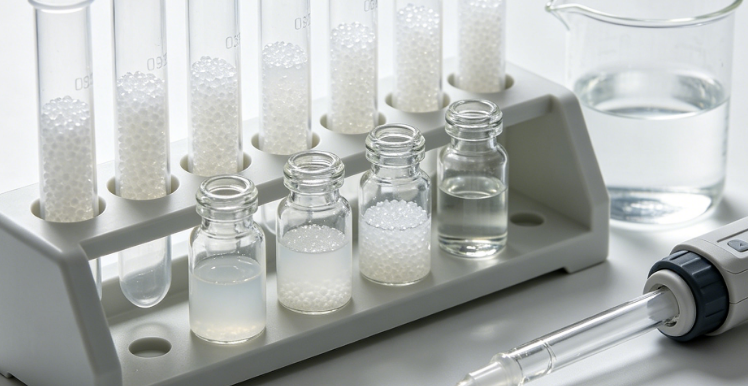
Analytical Framework – From Textural Properties and Density to Thermal Conductivity and Surface Chemical Fingerprinting
We offer a tiered analytical strategy tailored to your quality control, R&D optimisation, or regulatory submission needs. Our platform includes:
• Specific surface area, pore volume, and pore size distribution – nitrogen physisorption (BET, BJH, t‑plot, DFT). We use a Micromeritics TriStar II Plus or ASAP 2460 with nitrogen adsorption at 77 K. After optimized degassing (typically 200°C for 6–8 hours under vacuum to avoid aerogel collapse), we report multi‑point BET surface area (m²/g) with precision ±1 m²/g, total pore volume (cm³/g) from the adsorption at p/p₀ ~ 0.99, and BJH pore size distribution (mesopores, 2–50 nm) from the desorption branch. For microporosity (< 2 nm), we perform t‑plot and DFT analysis, providing a micropore volume and external surface area. We also report the pore diameter (DBJH) and the pore size distribution curve – essential for insulation and catalyst applications.
• Bulk density, skeletal density, and total porosity – helium pycnometry and geometric dimensioning. We determine skeletal density (g/cm³) using a Micromeritics AccuPyc II 1340 with helium gas, achieving precision ±0.001 g/cm³. Bulk density is measured by weighing a precisely machined specimen (or by mercury intrusion for powder, but we prefer geometrical volume measurement for monoliths). Total porosity is calculated as Porosity (%) = (1 – Bulk density/Skeletal density) × 100. Typical aerogels have porosities > 90%, and our method provides ±0.5% accuracy.
• Thermal conductivity – steady‑state heat flow meter (HFM) and transient hot‑wire (THW) methods. For rigid aerogel panels or monoliths, we use a FOX 200 heat flow meter (ASTM C518) at mean temperatures from 0°C to 100°C, measuring thermal conductivity (W/m·K) with an accuracy of ±2%. For powder or granular aerogels, we employ transient hot‑wire method (Hot Disk TPS 2500) with a sensor sandwiched between samples, providing thermal conductivity and thermal diffusivity at room temperature and elevated temperatures. We report thermal conductivity at 25°C, 50°C, 75°C, and 100°C to capture temperature dependence.
• Surface chemistry and hydrophobicity – FTIR, XPS, and contact angle measurement. We identify organic modifications (e.g., methyl, trimethylsilyl groups) and silanol content using FTIR (Nicolet iS50) in transmission or ATR mode, reporting the intensity ratio of C‑H (2950 cm⁻¹) to Si‑O (1100 cm⁻¹) as a hydrophobicity index. XPS (Thermo Scientific K‑Alpha) provides quantitative surface atomic percentages of C, O, Si and the C/Si ratio, which correlates with the degree of surface alkylation. Static water contact angle (WCA) is measured using a goniometer (Krüss DSA100) on flat surfaces, with accuracy ±1°; hydrophobic aerogels typically show WCA > 140°, hydrophilic aerogels < 20°. We also measure oil contact angle for oleophilic applications.
• Mechanical properties – uniaxial compression and microindentation. For monolithic aerogels, we perform compression tests (Instron 5960) on cylindrical samples (diameter 25 mm, height 20 mm) at a crosshead speed of 1 mm/min, reporting compressive strength (MPa) and elastic modulus (MPa) at 10% strain. We also determine Young’s modulus from the linear region of the stress‑strain curve. For fragile or thin‑film samples, we use nanoindentation (Nanomechanics iMicro) with a Berkovich tip to extract hardness and reduced modulus.
• Thermal stability and organic content – TGA‑DSC and evolved gas analysis. We heat samples from 25°C to 1000°C in air or nitrogen at 10°C/min using a Netzsch STA 449 to record mass loss steps (desorption of water, combustion of organic modifiers, condensation of silanols) and phase transitions. We report onset of decomposition (Tonset) and char yield – critical for predicting service temperature limits.
No other service integrates BET, BJH, helium pycnometry, thermal conductivity (both HFM and THW), XPS/FTIR/contact angle, mechanical testing, and TGA under one ISO 17025‑accredited system for silica aerogels – delivering a complete structure‑property relationship in a single report.
Why Our Laboratory Is the Premier Partner for Silica aerogel Characterization
Our specialization in high‑porosity nanomaterials and thermal insulation analysis has enabled us to overcome the unique challenges of silica aerogel testing: ultra‑low density leading to fragile specimens – we use specially designed sample holders and non‑contact handling; extremely high specific surface area and micro‑/mesoporous bimodal distributions – we employ multiple adsorption models (BET, t‑plot, DFT) and cross‑validate with mercury porosimetry; hydrophobic coatings that interfere with standard BET degassing – we use controlled temperature ramping to avoid pore collapse; and accurate thermal conductivity measurement without convection errors – we use vacuum‑compatible sensors and guard‑ring systems. Our distinct advantages include:
1. Multi‑method cross‑validation for porosity and density. We cross‑check bulk density from geometrical measurement with that from mercury intrusion (for powders) and also estimate porosity from BET total pore volume and skeletal density – if the porosities calculated from different methods differ by >2%, we perform high‑pressure mercury intrusion to resolve any closed‑pore fractions.
2. State‑of‑the‑art thermal conductivity measurement across a wide temperature range. Our HFM system operates from −10°C to 110°C with NIST‑traceable calibration, and our Hot Disk system extends measurements up to 300°C and down to 10⁻³ W/m·K – covering all typical aerogel insulation applications. We also measure thermal conductivity under reduced pressure (vacuum) to assess the aerogel's performance in space or low‑pressure environments.
3. Comprehensive hydrophobic/hydrophilic characterization with surface sensitivity. We combine XPS (information depth ~10 nm) with FTIR (bulk) and water contact angle (surface) to provide a hydrophobicity gradient – revealing whether the surface treatment penetrates the bulk or is limited to the outer layer. This is a unique service that predicts long‑term aging behaviour.
4. Expert mechanical testing with custom‑designed fixtures. We have developed low‑load compression fixtures that accommodate aerogel samples as small as 10 mm diameter and 5 mm height, and we use non‑contact laser extensometry to measure strain without damaging the sample. Our nanoindentation capability allows testing of aerogel thin films without substrate interference.
5. ISO 17025 accreditation and global acceptance. Our methods for BET (ISO 9277), thermal conductivity (ISO 8301), mechanical properties (ISO 844), and contact angle (ISO 15989) are ISO 17025‑accredited. Our reports are accepted by aerogel manufacturers, insulation system integrators, space agencies, and research institutions worldwide.
Technical Depth – Beyond Basic Surface Area and Density
While many laboratories report only BET and density, we provide mechanistic and application‑relevant insights for advanced quality and design:
• Pore network connectivity and tortuosity. Using nitrogen adsorption coupled with mercury intrusion, we determine the pore connectivity index by comparing the pore volume from both methods – a key factor for permeability and acoustic damping.
• Quantification of surface silanol (Si‑OH) vs. silyl (Si‑CH₃) groups. From XPS C1s and Si2p spectra, we deconvolute the contributions of C‑Si, C‑C, and Si‑O bonds, and combine with FTIR peak integration (Si‑OH ~ 3400 cm⁻¹ vs. Si‑CH₃ ~ 2960 cm⁻¹) to derive a “surface coverage ratio” – predictive of moisture uptake and aging.
• Thermal degradation kinetics and lifetime prediction. Using TGA‑DSC at multiple heating rates, we calculate activation energy (Ea) of decomposition (Flynn‑Wall‑Ozawa method) and provide a service life estimate at your operating temperature using the Arrhenius model – a valuable tool for insulation system reliability.
• Anisotropy in thermal and mechanical properties. For aerogels produced with directional freezing or casting, we measure thermal conductivity and compressive modulus along two orthogonal directions to quantify anisotropy – essential for predicting anisotropic performance in the final application.
Supporting Your Specific Silica aerogel Testing Objectives
Your search for silica aerogel detection likely aligns with one or more of these scenarios. We provide precisely tailored solutions:
• R&D and formulation optimisation. We support aerogel synthesis development by offering rapid feedback on BET surface area, pore volume, density, and thermal conductivity for multiple samples per batch, allowing you to fine‑tune precursor composition, drying conditions, and surface modification.
• Quality assurance for production batches. We test each production lot for BET, density, thermal conductivity, and hydrophobicity (contact angle), and we issue a certificate of analysis (COA) with pass/fail criteria. Typical turnaround: 5‑7 working days.
• Certification for commercial insulation products. We provide thermal conductivity data at multiple mean temperatures and compressive strength in compliance with ASTM C518, C167, and EN 826 – essential for product datasheets and building code approvals.
• Failure analysis and troubleshooting. If your aerogel shows degraded performance (higher k‑value, lower strength, or loss of hydrophobicity), we conduct a forensic investigation comparing the failed batch with a reference – measuring surface chemistry (XPS/FTIR), pore structure, and thermal stability to identify the cause (e.g., moisture ingress, pore collapse, or oxidation).
• Regulatory and safety compliance. We provide fire resistance (UL 94) and outgassing (ASTM E595) testing for aerogels used in aerospace and building applications.
Partner with Us for Definitive Silica aerogel Characterisation
Choosing our laboratory gives you access to a dedicated aerogel and porous materials team with over 12 years of experience in aerogel science. We provide free sampling kits (desiccated containers and custom‑designed protective packaging to prevent breakage), a detailed protocol for sample preparation and shipping (including orientation marking for anisotropic materials), and direct consultation with our senior aerogel specialist for data interpretation and performance prediction. No project is too large or too small – from a single research‑grade monolith to routine quality control of industrial‑scale production.
Contact our technical team with your silica aerogel analysis requirements. We will provide a customised project quotation and, for qualifying clients, a free preliminary screening (BET surface area, bulk density, and thermal conductivity at 25°C) on up to two samples. Your search for authoritative, high‑depth characterisation of silica aerogels ends here – because we deliver the textural, thermal, chemical, and mechanical insight that routine single‑parameter tests cannot provide.