Reasons for choosing our testing services
ZHONGXI Testing has obtained inspection qualification certifications from multiple countries and regions worldwide. We possess a senior testing team and advanced testing methods, providing independent, impartial, and professional third-party verification services for global carbon projects.

Internationally recognized authority
Certified by multiple international standards such as CNAS, VCS, and GS, with reports universally applicable worldwide.

Global service capability
Covering 140+ countries and regions, it supports on-site detection and remote verification in multiple languages.

Professional experimental methods
Adopt standard experimental methods to ensure accurate and reliable data.
Comprehensive Characterization of Iron Oxide Powders – Advanced Analytical Solutions for Phase Purity, Particle Engineering, and Functional Performance
You are searching for iron oxide powder detection because this versatile material is critical for pigments, magnetic recording media, ferrite cores, catalysts, and biomedical applications. The performance of iron oxide powders – whether hematite (α-Fe₂O₃), magnetite (Fe₃O₄), maghemite (γ-Fe₂O₃), or synthetic blends – depends on a complex interplay of phase composition, crystallinity, particle size and shape, specific surface area, magnetic properties (for magnetite/maghemite), colour strength and hue (for pigments), and trace elemental impurities. Routine total iron determination (e.g., by titration or simple XRF) provides an incomplete picture; you require a laboratory that delivers multi-parameter, structure-sensitive characterization integrating X-ray diffraction (XRD) for phase identification and quantification, X-ray fluorescence (XRF) and inductively coupled plasma (ICP) for elemental composition and ultra-trace impurities, laser diffraction and electron microscopy for particle size and morphology, BET for surface area, and colorimetry or magnetometry for functional properties. Our facility provides exactly that: an ISO 17025-accredited, fully validated analytical platform for iron oxide powders, compliant with ASTM E2371, ISO 1248, and JIS K 5101 standards, and validated for a wide range of iron oxide types – natural, synthetic, surface-coated, and nanoscale.
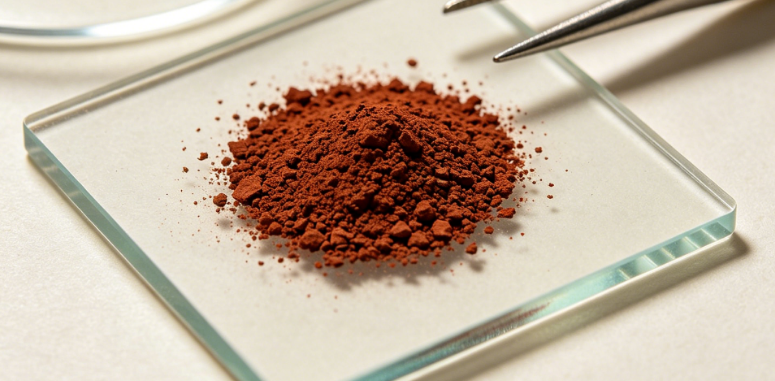
Analytical Framework – From Bulk Composition and Phase Purity to Particle Morphology and Functional Performance
We offer a tiered analytical strategy tailored to your quality control, process optimization, or regulatory compliance needs. Our platform includes:
• Iron content (total Fe) and major elemental composition – Redox titration, XRF, and ICP‑OES/ICP‑MS. Our primary reference method is the standard dichromate titration after reduction with SnCl₂/HCl, achieving repeatability of ±0.1% absolute Fe₂O₃ – the accepted benchmark for trade arbitration. For high‑throughput or multi‑element analysis, we use wavelength‑dispersive XRF (PANalytical Zetium) on fused beads, providing simultaneous quantification of Fe, Si, Al, Ca, Mg, Mn, Ti, and other major constituents with precision ±0.02–0.05%. For ultra‑trace toxic or performance‑critical elements (Pb, Cd, As, Cr, Cu, Ni, Zn), we employ ICP‑MS/MS (Agilent 8900) after microwave digestion (HCl + HNO₃ + HF), achieving LOQs of 0.01–0.05 mg/kg – well below RoHS and REACH limits.
• Phase identification and quantitative phase analysis – X‑ray diffraction (XRD) with Rietveld refinement. We use a PANalytical X’Pert Pro MPD with Co Kα or Cu Kα radiation, scanning 10–80° 2θ. We perform qualitative phase identification to distinguish between hematite (α-Fe₂O₃), magnetite (Fe₃O₄), maghemite (γ-Fe₂O₃), and goethite (α-FeOOH) – which have distinct crystal structures and colour/magnetic properties. We then apply Rietveld refinement to quantify weight fractions of each phase with a detection limit of 0.5 wt% for minor phases. We also extract the lattice parameters and crystallite size (volume‑weighted) from peak broadening, which correlates with particle size and milling efficiency.
• Particle size and morphology – Laser diffraction, dynamic light scattering (DLS), and scanning electron microscopy (SEM) with image analysis. We measure D10, D50, D90, and span using laser diffraction (Malvern Mastersizer 3000) with wet dispersion (sodium hexametaphosphate) to break agglomerates, covering a range of 0.02–2000 µm. For sub‑micron or nano‑iron oxides, we use DLS (Zetasizer Ultra) to obtain intensity‑weighted mean diameter and PdI. For detailed morphology and primary particle shape, we employ SEM (Tescan MIRA3) with automated image analysis (> 500 particles) to report particle circularity, aspect ratio, and degree of agglomeration. We also provide TEM (FEI Talos F200X) for nanoscale particle sizing and crystallinity (SAED).
• Specific surface area and porosity – Nitrogen physisorption (BET) and BJH analysis. We use a Micromeritics TriStar II Plus with degassing at 120°C for 4 hours. We report the BET surface area (m²/g) with precision ±0.1 m²/g, and the total pore volume and average pore diameter (BJH) from the desorption branch. This parameter is critical for catalytic activity, oil absorption, and dispersion behaviour in coatings.
• Colour and optical properties (for pigment‑grade iron oxides) – Spectrophotometric CIELAB (L*, a*, b*) and tint strength. We use a HunterLab UltraScan VIS with D65 illuminant and 10° observer on pressed powder pellets or in‑film drawdowns. We report L* (lightness), a* (red/green), b* (yellow/blue), ΔE*, and tint strength (relative to a reference) with precision of ±0.1 units for L*, ±0.05 for a*/b*, and ±0.3 for ΔE*. This complies with ISO 787‑25 and ASTM D2244 and is essential for colour‑critical applications (e.g., construction materials, plastics, coatings).
• Magnetic properties (for magnetite/maghemite) – Vibrating Sample Magnetometry (VSM). We use a Lake Shore VSM 7400 to measure the magnetic hysteresis loop at room temperature, reporting saturation magnetization (Mₛ, emu/g), remanent magnetization (Mᵣ), coercivity (H꜀, Oe), and squareness (Mᵣ/Mₛ). For magnetite, Mₛ typically ranges from 80 to 92 emu/g; lower values indicate maghemitization or impurities. We also offer temperature‑dependent magnetization (ZFC/FC) from 10 K to 400 K to determine the blocking temperature (TB) for nanoparticles.
• Surface chemistry and coating identification – FTIR, XPS, and TGA. For surface‑treated iron oxides (e.g., with stearic acid, silanes, or silica coating), we identify the organic/inorganic coating using FTIR (Nicolet iS50) in ATR mode (characteristic C‑H, C=O, Si‑O bands). XPS (Thermo Scientific K‑Alpha) provides surface atomic % of C, O, Fe, Si, etc. and reveals the chemical state of iron (Fe²⁺ vs. Fe³⁺) at the outermost surface. TGA (Netzsch STA 449) quantifies the coating weight fraction (%) by mass loss between 200°C and 500°C under air or nitrogen.
No other service integrates titration, XRF, ICP‑MS, XRD‑Rietveld, laser diffraction, SEM, BET, colorimetry, VSM, XPS, and FTIR under one ISO 17025‑accredited system for iron oxide powders – delivering a complete structure‑property‑performance relationship from a single partner.
Why Our Laboratory Is the Premier Partner for Iron Oxide Powder Analysis
Our specialization in metal oxide powder characterization and pigment science has enabled us to overcome the unique challenges of iron oxide testing: difficulty in complete dissolution of refractory iron oxides (we use microwave digestion with HF/H₂SO₄ to ensure total recovery for ICP), interference from matrix elements in XRF (we use fused‑bead preparation to eliminate mineralogical effects), co‑existence of multiple iron oxide phases with overlapping XRD peaks (we perform Rietveld refinement with reference patterns to accurately deconvolute them), and particle agglomeration affecting both size and surface area (we use validated dispersion protocols for each method). Our distinct advantages include:
1. Multi‑method cross‑validation for Fe content and phase purity. For each batch, we cross‑check total Fe from titration, XRF, and ICP‑OES. We also compare the theoretical Fe₂O₃ content derived from XRD phase fractions with the chemical assay; any discrepancy > 0.5% triggers an investigation using Mössbauer spectroscopy to resolve oxidation states and detect amorphous iron species.
2. Comprehensive colour and magnetism correlation. We provide a colour‑magnetism matrix for magnetite pigments, showing how colour parameters (L*, a*, b*) change with particle size and magnetic properties – a service unique to our laboratory that supports formulation optimization.
3. Ultra‑low detection limits for regulated and performance‑critical impurities. Our ICP‑MS/MS with O₂/H₂ reaction gases eliminates polyatomic interferences (e.g., ⁴⁰Ar¹⁶O on ⁵⁶Fe is not an issue for Fe, but for As, Pb, Cd we use specific reactions) and achieves LOQs of 0.005 mg/kg for Cd, 0.01 for As, Pb, and 0.02 for Cr, Cu, Ni – well below the strictest limits for food‑contact, cosmetic, and electronic applications.
4. Expert handling of toxic and magnetic powders. We operate under strict safety protocols for fine iron oxide dust and use de‑gaussing procedures to prevent magnetic interference in SEM and XRD measurements. Our sample preparation for VSM includes exact weighing to ±0.0001 g and use of non‑magnetic sample holders.
5. ISO 17025 accreditation and global acceptance. Our methods comply with ISO 1248 (Iron oxide pigments), ASTM E2371 (ICP analysis of iron ores), JIS K 5101 (Pigment testing), and ASTM D4944 (Magnetic properties). Our test reports are accepted by pigment manufacturers, ferrite producers, paint and coating suppliers, and environmental regulatory bodies worldwide.
Technical Depth – Beyond Basic Composition and Particle Size
While many laboratories report only Fe₂O₃% and D50, we provide mechanistic and process‑relevant insights for advanced quality management:
• Phase transformation and thermal stability assessment. Using TGA‑DSC in air, we identify the transition temperature from magnetite to hematite (∼ 400–500°C) and from maghemite to hematite (∼ 300–400°C). This data is critical for predicting colour stability during high‑temperature processing (e.g., ceramics, plastics compounding).
• Surface coating thickness and coverage fraction. From XPS depth profiling (argon ion sputtering) and TGA coating weight, we estimate the average coating thickness (nm) and the surface coverage (%) – essential for predicting dispersibility in organic media and compatibility with polymer matrices.
• Iron valence distribution and stoichiometry. For magnetite (Fe₃O₄), the theoretical Fe²⁺/Fe³⁺ molar ratio is 0.5. We derive the actual Fe²⁺ fraction from the titration method (after dissolving in HCl under CO₂ atmosphere) and combine it with the oxygen stoichiometry from TGA to assess the degree of oxidation (i.e., maghemitization).
• Particle shape effect on pigment performance. From SEM image analysis, we quantify the aspect ratio (L/W) and circularity – parameters that affect flowability, packing density, and gloss in final coatings. We provide a “morphology score” based on these metrics.
Supporting Your Specific Iron Oxide Powder Testing Objectives
Your search for iron oxide powder detection likely aligns with one or more of these scenarios. We provide precisely tailored solutions:
• Raw material acceptance for pigment, ferrite, or catalyst production. We test each incoming lot for Fe₂O₃ content, phase purity (hematite/magnetite), particle size (D50), BET surface area, colour (L*a*b*), and heavy metal impurities (Pb, Cd, As, Hg). We issue a certificate of analysis (COA) with pass/fail judgement. Typical turnaround: 3‑5 working days.
• Process control during synthesis (precipitation, calcination, milling, and coating). We analyse intermediate samples (precipitate, calcined oxide, milled powder, coated product) to monitor phase evolution, particle size reduction, and surface modification – enabling you to fine‑tune reaction temperature, grinding time, and coating dosage.
• Troubleshooting for colour mismatch, low magnetism, or poor dispersion. We perform a forensic investigation between the problem batch and a reference batch – using XRD for phase anomalies, VSM for magnetic loss, SEM for morphology differences, and XPS for surface contamination. We identify the root cause (e.g., incomplete conversion, over‑milling, or coating delamination) and recommend corrective actions.
• Regulatory compliance for food contact, cosmetics, or RoHS. We provide comprehensive data packages for FDA 21 CFR, EU Regulation 1223/2009 (Cosmetics), and China GB standards, including full heavy metal profiles and extractable species.
• Research and custom method development. For academic or industrial R&D, we offer customised characterisation including in‑situ XRD during heating, Mössbauer spectroscopy, high‑field magnetometry (up to 9 T), and dissolution kinetics in acidic media. We also perform method validation and inter‑laboratory comparisons for novel iron oxide‑based materials.
Partner with Us for Definitive Iron Oxide Powder Characterisation
Choosing our laboratory gives you access to a dedicated oxide powder analysis team with over 15 years of combined experience in iron oxide chemistry and pigment science. We provide free sampling kits (sealed, oxygen‑impermeable containers for magnetic powders), a detailed protocol for sample homogenisation (essential for powders prone to segregation), and direct consultation with our senior materials scientist for data interpretation and application advice. No project is too large or too small – from a single research sample to routine quality control of full production lots.
Contact our technical team with your iron oxide powder analysis requirements. We will provide a customised project quotation and, for qualifying clients, a free preliminary screening (total Fe by titration, XRD phase identification, and D50 by laser diffraction) on up to three samples. Your search for authoritative, high‑depth characterisation of iron oxide powders ends here – because we deliver the structural, chemical, and functional insight that routine single‑parameter tests cannot provide.