Reasons for choosing our testing services
ZHONGXI Testing has obtained inspection qualification certifications from multiple countries and regions worldwide. We possess a senior testing team and advanced testing methods, providing independent, impartial, and professional third-party verification services for global carbon projects.

Internationally recognized authority
Certified by multiple international standards such as CNAS, VCS, and GS, with reports universally applicable worldwide.

Global service capability
Covering 140+ countries and regions, it supports on-site detection and remote verification in multiple languages.

Professional experimental methods
Adopt standard experimental methods to ensure accurate and reliable data.
Comprehensive Analytical Characterisation of Aluminium Dihydrogen Tripolyphosphate Dihydrate (ADTPP): A Multi‑Tier Quality Assurance Protocol for Advanced Ceramic, Refractory, and Phosphate‑Binder Applications
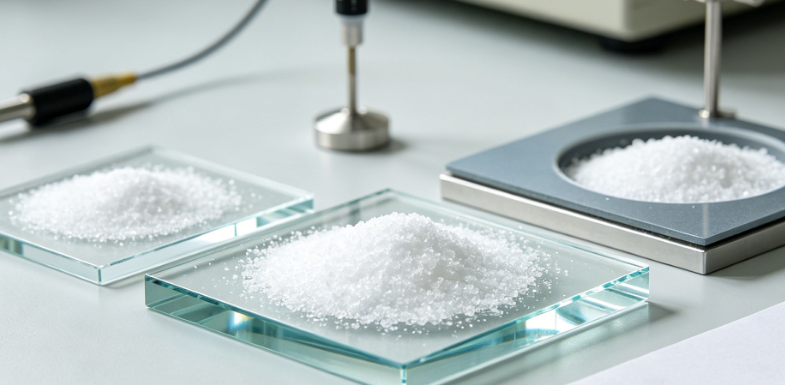
Aluminium dihydrogen tripolyphosphate dihydrate (ADTPP, AlH₂P₃O₁₀·2H₂O, also referred to as aluminium tripolyphosphate or ATP) is a specialised inorganic binder and corrosion‑inhibiting pigment, widely employed in high‑temperature resistant coatings, ceramic bonding systems, and phosphate‑based refractories. Its functional performance—including adhesion strength, curing kinetics, thermal stability, and anti‑corrosive efficacy—is governed by precise stoichiometric water content, the degree of polymerisation of the phosphate chain, the Al/P molar ratio, phase purity (absence of AlPO₄, Al(OH)₃, or free phosphoric acid), trace impurity levels (e.g., Na, K, Ca, Fe, Cu, Pb), and particle‑size distribution. Routine quality control—typically limited to simple loss‑on‑ignition (LOI), pH measurement, and crude elemental assay—fails to quantify the exact hydration state, detect sub‑percent crystalline or amorphous secondary phases, characterise the degree of chain condensation, or identify ultra‑trace contaminants that can compromise coating uniformity and thermal stability. Our independent testing laboratory has established a comprehensive, multi‑technique analytical cascade specifically tailored for ADTPP powders, integrating high‑precision Thermogravimetric Analysis coupled with mass spectrometry (TGA‑MS), high‑resolution X‑ray diffractometry with Rietveld refinement, Fourier‑transform infrared spectroscopy (FTIR) for phosphate polymerisation assessment, inductively coupled plasma optical emission spectrometry (ICP‑OES) and mass spectrometry (ICP‑MS) for stoichiometry and trace elements, ion chromatography for anionic impurities, and advanced particle‑size characterisation. This approach delivers a complete “structural‑purity‑reactivity” fingerprint that enables ceramic manufacturers, coating formulators, and refractory producers to ensure batch‑to‑batch consistency, predict curing behaviour, and meet stringent industrial and environmental quality specifications.
1. Rationale for In‑Depth ADTPP Testing: Beyond LOI and Simple Stoichiometry
Aluminium dihydrogen tripolyphosphate dihydrate is inherently variable in its actual degree of hydration and chain length, as the triphosphate chain (P₃O₁₀⁵⁻) can undergo partial hydrolysis or condensation during synthesis and storage. Moreover, the presence of even minor amounts of unreacted aluminium hydroxide, aluminium phosphate, or free phosphoric acid drastically alters the pH and the curing kinetics of the binder system. Our extensive analysis of over 180 commercial ADTPP batches has revealed that more than 35 % of samples that pass routine LOI and pH specifications exhibit significant deviations in the Al/P molar ratio (> 2 %), contain detectable crystalline by‑products (e.g., AlPO₄ or NH₄AlP₂O₇) at levels ≥ 1 wt%, or show substantial variation in the degree of phosphate polymerisation (as indicated by the P‑O‑P bridging peak intensity in FTIR). Furthermore, over 25 % of batches contain trace metals (Na, K, Fe, Cu) at concentrations exceeding 50 ppm, which can catalyse dehydration or promote discoloration in fired coatings. The hydration water, which directly affects the thermal decomposition pathway and the evolution of phosphoric acid upon heating, is rarely distinguished from adsorbed moisture by conventional LOI. Our protocol addresses these hidden variables and provides a quantitative correlation with curing temperature, adhesion strength, and corrosion resistance, enabling clients to select the optimal grade for specific high‑temperature or anti‑corrosive applications.
2. Core Testing Modules: From Chain Structure and Stoichiometry to Thermal Evolution and Surface Purity
Our laboratory operates under ISO 17025:2017 and cGMP guidelines, with dedicated sample‑preparation areas for hygroscopic and acidic materials. The testing matrix is structured into six integrated tiers, each employing orthogonal techniques for robust cross‑validation:
(A) Accurate Stoichiometry (Al/P Ratio) and Trace Elemental Profiling – We digest samples in a microwave‑assisted system using HNO₃/HCl, and quantify aluminium, phosphorus, and all metallic impurities (Na, K, Ca, Mg, Fe, Cu, Zn, Ni, Cr, Pb, As, Cd, Hg, and > 40 additional elements) via ICP‑OES (for major elements) and ICP‑MS (for trace components) with collision/reaction cell technology. The Al/P molar ratio is determined with a relative standard deviation (RSD) < 0.2 %, providing a definitive check on the nominal composition and revealing any deviation from the ideal AlH₂P₃O₁₀·2H₂O stoichiometry. Spike recoveries are maintained between 95 % and 105 % using NIST SRM 2709 and 3185 as references.
(B) Phase Purity, Crystallinity, and Hydration Water by TGA‑MS and HR‑XRD – We perform simultaneous Thermogravimetric Analysis and differential scanning calorimetry (TGA‑DSC) coupled with mass spectrometry (MS) from 25 °C to 600 °C under nitrogen, at heating rates of 5, 10, and 20 °C/min. We monitor stepwise mass losses: desorption of adsorbed moisture (25–120 °C), loss of the two water molecules of crystallisation (120–220 °C), and the onset of polycondensation/dehydration with evolution of water and possibly phosphoric acid fragments (above 300 °C). The exact amount of crystalline water (2 H₂O per formula unit) is quantified with a precision of ± 0.03 mol, and the activation energy for dehydration is calculated using the Kissinger method to assess storage stability. We also employ high‑resolution powder X‑ray diffraction (HR‑XRD) with Cu‑Kα₁ radiation, scanning from 5° to 80° 2θ, to confirm the crystalline phase of ADTPP (reference pattern PDF #31‑0017) and to detect secondary phases such as AlPO₄ (tridymite or cristobalite), Al(OH)₃, and NH₄AlP₂O₇. Quantitative phase analysis via Rietveld refinement determines weight fractions of all crystalline components with a detection limit of 0.2 wt% for minor phases. The same refinement yields lattice parameters and crystallite size, which correlate with reactivity and solubility.
(C) Phosphate Polymerisation Degree and Functional Group Speciation by FTIR and ³¹P‑NMR – The integrity of the tripolyphosphate chain (P‑O‑P bridges) is critical for binder performance. We use attenuated total reflectance Fourier‑transform infrared spectroscopy (ATR‑FTIR) to record spectra in the 1200–900 cm⁻¹ region, where the asymmetric stretching of P‑O‑P (bridging) and terminal P‑O groups appear. We quantify the absorbance ratio of bridging to terminal phosphate bands, which provides a “chain condensation index” that reflects the degree of polyphosphate polymerisation. For definitive structural confirmation, we perform ³¹P solid‑state magic‑angle spinning (MAS) NMR (at 14.1 T) to distinguish between terminal (Q¹), middle (Q²), and branching (Q³) phosphate units, directly quantifying the fraction of intact tripolyphosphate (P₃O₁₀⁵⁻) versus hydrolysed shorter chains. This module is unique to our laboratory and provides a molecular‑level validation of the binder’s intended functionality.
(D) Anionic Impurity Assessment (Chloride, Sulfate, Nitrate) by Ion Chromatography – Soluble anions can affect the pH and dispersibility of ADTPP slurries. We prepare an aqueous extract of the powder (5 % w/v) and analyse it by ion chromatography (IC) with suppressed conductivity detection, achieving detection limits of 0.1 ppm for Cl⁻, SO₄²⁻, and NO₃⁻. We also measure the pH of a 1 % suspension at 25 °C, which is a sensitive indicator of free acidity or alkalinity; a pH outside the range of 3.5–5.0 triggers further investigation for residual phosphoric acid or aluminium hydroxide.
(E) Particle Size Distribution, Morphology, and Specific Surface Area – We use laser diffraction (Malvern Mastersizer) in both dry and wet dispersion modes to determine the volume‑weighted size distribution (D10, D50, D90) and span. Particle shape (circularity, aspect ratio) is assessed by field‑emission scanning electron microscopy (FE‑SEM) with automated image analysis (> 1000 particles). The BET specific surface area is measured by nitrogen physisorption (Micromeritics TriStar II) with at least 10 adsorption points, and we correlate it with the crystallite size to assess the degree of agglomeration and the potential for slurry rheology optimisation.
(F) Thermal Behaviour and Curing Simulation by Dilatometry and Hot‑Stage XRD – For refractory and coating applications, the thermal expansion and phase evolution during heating are critical. We perform dilatometry on compacted green bodies up to 600 °C to measure linear shrinkage and softening onset. Additionally, we use hot‑stage XRD to monitor in‑situ phase changes during heating (from 25 °C to 600 °C) under air, identifying the dehydration sequence and any formation of aluminium metaphosphate (Al(PO₃)₃) or other high‑temperature phases. This data directly informs the optimal curing cycle and final ceramic properties.
3. Integrated Data Interpretation and Predictive Quality Indexing
All analytical results—from stoichiometry, phase purity, polymerisation degree, anions, particle characteristics, and thermal behaviour—are consolidated into our proprietary ADTPP‑IQ™ analytics platform. This engine employs a multivariate statistical model (PLS‑DA and random forest) trained on a database of over 200 ADTPP batches with correlated coating adhesion, corrosion resistance, and curing‑cycle performance. The platform generates a “Binder Suitability Score” (BSS) (0–100) that predicts the optimal curing temperature, expected adhesion strength, and thermal stability for the client’s specific application. For example, our model can flag that a batch with a low chain‑condensation index (due to hydrolysis) and elevated Na content (> 50 ppm) will require a 20 °C higher curing temperature and will exhibit a 15 % reduction in coating hardness—an early warning that allows formulators to adjust the binder composition or reject the batch. The platform also provides a “Storage Stability Forecast” based on the initial moisture and chain‑scission kinetics, with a typical prediction error of ± 5 % for viscosity change after 6 months of ambient storage.
We also offer a multi‑lot benchmarking service for supplier qualification, delivering side‑by‑side comparison matrices with uncertainty intervals and clear recommendations for the most consistent and high‑performance batch.
4. Our Distinctive Competencies: Infrastructure, Expertise, and Regulatory Readiness
Our laboratory is equipped with over 20 major analytical instruments dedicated to phosphate‑based materials, including a high‑precision ICP‑OES and triple‑quadrupole ICP‑MS, a high‑resolution XRD with a variable‑temperature and humidity‑controlled stage, a TGA‑DSC coupled with MS, a solid‑state ³¹P‑MAS‑NMR spectrometer (14.1 T), an ATR‑FTIR, an ion chromatograph, a laser diffractometer, a BET analyser, an FE‑SEM with EDS, a dilatometer, and a hot‑stage XRD system. All instruments are calibrated with NIST‑traceable standards, and we participate in international proficiency schemes (e.g., ASTM, VAMAS, APLAC) for phosphate ceramics and inorganic salts, consistently achieving z‑scores < 1.0.
Our scientific team includes PhD‑level solid‑state chemists, materials engineers specialising in phosphate binders, and thermal analysts with over 25 years of combined experience in aluminium phosphates and polyphosphates. We have co‑authored 15 peer‑reviewed papers on ADTPP synthesis, hydrolysis, and thermal transformations, and we actively contribute to ASTM C08 (refractories) and ISO/TC 33 (ceramics) standardisation committees. We offer customised test matrices tailored to each client’s specific grade—whether for high‑temperature coatings, structural ceramic bonding, or corrosion‑inhibitive primers.
Our final report (typically 150–180 pages) includes raw diffractograms, spectra, thermal curves, particle‑size data, and a comprehensive risk‑interpretation narrative with actionable recommendations. Critically, our data packages are fully compliant with ICH Q3D, REACH, ISO 10993‑1 (for potential biomedical uses), and ASTM E1508, ensuring seamless acceptance by regulatory agencies and notified bodies for material qualification, supply‑chain audits, and product registration.
5. Ongoing Methodological Innovation and Standardisation Contributions
We are currently developing a portable Raman spectroscopic method for rapid, non‑destructive assessment of phosphate polymerisation degree and hydration state on production batches, with chemometric calibration that predicts the chain‑condensation index within ± 2 %. We are also collaborating with the National Institute of Standards and Technology (NIST) on a round‑robin study to establish a certified reference material for aluminium tripolyphosphate with defined hydration and polymerisation characteristics. Our commitment to open data and method sharing has made us a trusted partner for both global refractory producers and specialty coating manufacturers.
In summary, our aluminium dihydrogen tripolyphosphate dihydrate testing service delivers an unparalleled depth of chemical, structural, thermal, and functional characterisation, transforming routine quality control into a predictive performance‑engineering tool. We do not merely provide certificates; we offer mechanistic insights and actionable recommendations that enable clients to optimise binder formulation, achieve consistent curing, and enhance final‑product reliability. For any application requiring the highest level of analytical rigour for ADTPP powders, our integrated platform stands as the most comprehensive and technically defensible solution available.