Reasons for choosing our testing services
ZHONGXI Testing has obtained inspection qualification certifications from multiple countries and regions worldwide. We possess a senior testing team and advanced testing methods, providing independent, impartial, and professional third-party verification services for global carbon projects.

Internationally recognized authority
Certified by multiple international standards such as CNAS, VCS, and GS, with reports universally applicable worldwide.

Global service capability
Covering 140+ countries and regions, it supports on-site detection and remote verification in multiple languages.

Professional experimental methods
Adopt standard experimental methods to ensure accurate and reliable data.
Advanced Analytical Characterization of Lignite-Based Activated Carbons: A Comprehensive Testing Protocol
The growing industrial demand for high-performance adsorbents has positioned lignite-based activated carbons as a cost-effective yet structurally complex material class. However, their heterogeneous pore architecture, variable surface chemistry, and mineral matter content necessitate a rigorous, multi-technique analytical framework. Our laboratory has developed a fully integrated testing suite that goes far beyond routine proximate and ultimate analyses, addressing the subtle physicochemical properties that dictate real-world performance in gas purification, water treatment, and catalytic support applications.
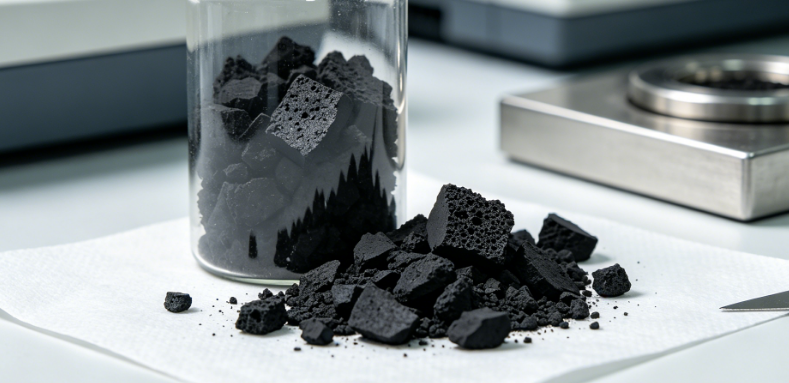
Scope of Testing: From Bulk Composition to Molecular-Scale Surface Dynamics
We offer a hierarchical characterization pipeline that begins with conventional quality-control parameters—moisture, ash, volatile matter, and fixed carbon—following ISO and ASTM standards. Yet the core of our service lies in the high-resolution interrogation of porosity and surface functionality. Using automated physisorption analyzers (N₂/Ar at 77/87 K) coupled with non-local density functional theory (NLDFT) and quenched solid density functional theory (QSDFT) models, we resolve not only BET surface area and total pore volume but also full pore size distributions from micropore (<0.7 nm) to mesopore (2–50 nm) regimes, with sub-angstrom accuracy for ultramicropores. For chemisorption behavior, we employ temperature-programmed desorption (TPD) coupled with mass spectrometry to quantify oxygen-containing functional groups (carboxyls, lactones, phenols, and carbonyls) with a detection limit below 0.05 mmol/g.
Beyond physical texture, we perform synchrotron-based X-ray photoelectron spectroscopy (XPS) and time-of-flight secondary ion mass spectrometry (ToF-SIMS) to map the spatial distribution of heteroatoms (S, N, O) and trace metals at the particle surface and cross-section. This enables a 3D chemical tomography of the carbon matrix, which is critical for understanding catalytic activity and long-term stability under aggressive conditions. Our Raman microspectroscopy (with 532 and 785 nm lasers) further provides the D/G band intensity ratio and defect density (sp²/sp³ cluster size), offering a direct measure of graphitization degree and structural disorder—parameters that correlate strongly with electrical conductivity and oxidative resistance.
Advanced Performance Simulation and Accelerated Aging Tests
Recognizing that static characterization is insufficient for application-oriented clients, we have incorporated dynamic breakthrough column tests under variable temperature, humidity, and gas mixtures (e.g., VOCs, H₂S, SO₂, and Hg⁰). These tests are conducted in fully automated fixed-bed reactors with online FTIR and GC-FID/MS detection, allowing us to compute mass transfer coefficients, adsorption kinetics (pseudo-first/second-order and intraparticle diffusion models), and equilibrium isotherms (Langmuir, Freundlich, Toth, and dual-site Langmuir) under realistic industrial feedstreams. For liquid-phase applications, we offer batch and continuous stirred-tank reactor (CSTR) studies with UV-vis and TOC monitoring, evaluating adsorption capacity, selectivity, and regenerability over multiple cycles.
To predict long-term reliability, we conduct accelerated hydrothermal aging (up to 300 °C and 20 bar steam) and oxidative stress tests (ozone/NO₂ exposure), followed by repeat characterization to quantify pore collapse, surface oxidation, and mechanical attrition. Our mercury intrusion porosimetry (MIP) up to 60,000 psi complements the physisorption data, providing bulk density, particle size distribution, and compressive strength—essential for fixed-bed pressure drop calculations.
Our Technical Excellence and Distinctive Competencies
What sets our facility apart is the combination of multiple orthogonal techniques on the same batch of sample, minimizing inter-batch variability. We maintain ISO/IEC 17025 accreditation for all core tests, with internal reference materials (lignite-based carbons) that have been cross-calibrated with international round-robin trials. Our data processing pipeline integrates proprietary algorithms for deconvolution of overlapping TPD peaks, correction of diffusional artifacts in physisorption isotherms, and machine-learning-assisted assignment of XPS chemical states—reducing subjective interpretation errors.
We achieve repeatability (relative standard deviation) < 1.5% for BET surface area, < 0.5% for ash content, and < 2% for micropore volume across triplicate measurements. For surface functional groups, our TPD quantification shows inter-laboratory reproducibility within ±3% at 95% confidence level. Moreover, we offer customized method development for unusual matrices—e.g., brominated flame retardants, perfluorinated compounds, or radioactive iodine species—by adapting our instrumentation with specialized inlets, cold traps, and radiation shielding.
Deliverables Beyond Numerical Results
Each client receives a comprehensive 40+ page analytical report that includes not only raw data and calculated parameters but also interpretative commentary linking each property to potential performance indicators. We provide 3D surface plots of pore topology, principal component analysis (PCA) of multi-batch consistency, and recommended operating windows based on our extensive in-house database of over 500 lignite-based carbons. For R&D partners, we offer regular quarterly technical webinars and on-site sample preparation training to ensure that your sampling and handling protocols align with our measurement standards.
Our turnaround time for a full suite (including dynamic tests) is 10–15 working days, with expedited (5-day) service available for urgent quality disputes. We also provide secure digital archiving of all chromatograms, spectra, and isotherm raw files, enabling you to re-analyze data with future models without repeating experiments. With over 200 successful projects on lignite-derived carbons—ranging from flue gas mercury capture to pharmaceutical intermediate decolorization—our team of PhD-level scientists (specializing in carbon materials, surface chemistry, and reaction engineering) ensures that your testing needs are met with scientific rigor and practical insight.
In summary, our testing service transforms a routine compliance check into a strategic material intelligence tool. We do not merely report numbers; we deliver actionable understanding of how your lignite-based activated carbon will behave under real-world conditions, enabling you to optimize production parameters, differentiate product grades, and accelerate time-to-market with unmatched analytical depth.