Reasons for choosing our testing services
ZHONGXI Testing has obtained inspection qualification certifications from multiple countries and regions worldwide. We possess a senior testing team and advanced testing methods, providing independent, impartial, and professional third-party verification services for global carbon projects.

Internationally recognized authority
Certified by multiple international standards such as CNAS, VCS, and GS, with reports universally applicable worldwide.

Global service capability
Covering 140+ countries and regions, it supports on-site detection and remote verification in multiple languages.

Professional experimental methods
Adopt standard experimental methods to ensure accurate and reliable data.
Advanced Multi-Parameter Characterization of Flexible Graphite Materials: A Specialized Testing Framework for High-Performance Applications
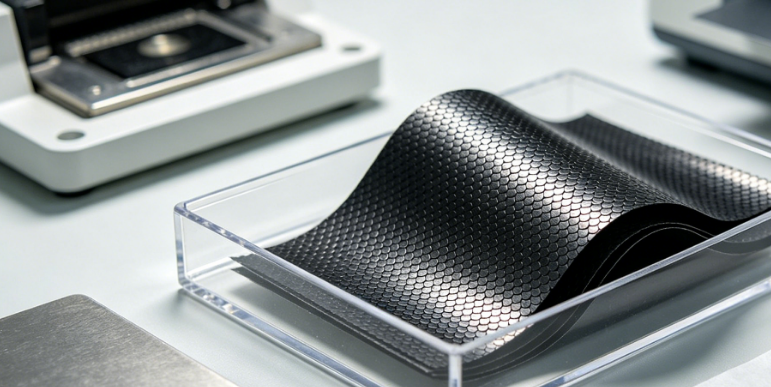
The intrinsic anisotropy, outstanding thermal stability, and exceptional compressibility of flexible graphite (exfoliated graphite foil) make it indispensable for critical sealing, thermal management, and bipolar plate applications. However, its heterogeneous microstructure and highly orientation-dependent physical properties impose stringent requirements on quality assessment. Clients seeking testing for flexible graphite are typically navigating the complex interplay between processing parameters and end-use reliability. Our laboratory has therefore developed a dedicated, multi-scale testing protocol that moves far beyond routine thickness and density measurements, delivering a quantitative, mechanistic understanding of material behavior under simulated operational extremes.
Precision Mechanical and Sealing Performance Assessment Under Realistic Conditions
Standard compressive stress-strain evaluations are insufficient for capturing the viscoelastic relaxation and creep-recovery hysteresis that dictate gasket longevity. We employ high-resolution dynamic mechanical analysis (DMA) in compression mode, equipped with a custom-designed, low-friction platen system to eliminate lateral buckling artifacts. This enables us to measure stress relaxation moduli (E(t)) and creep compliance (J(t)) under cyclic thermal ramps (up to 800 °C in inert atmospheres) while simultaneously recording strain field evolution via digital image correlation (DIC) on the sample surface—a technique rarely applied to foil-type materials. For sealing integrity, we conduct pressurized helium leak tests at differential pressures up to 50 MPa, complemented by real-time acoustic emission monitoring to detect micro-delamination events that precede catastrophic failure. Our thermal compression set tests are performed in situ within a thermomechanical analyzer (TMA), providing creep rate constants and activation energies for deformation with a displacement resolution of ±0.1 µm, ensuring that your material's long-term flange compatibility is quantitatively assured.
Comprehensive Thermophysical, Electrical, and Chemical Purity Profiling
Because flexible graphite's performance is critically dependent on its crystallite orientation and defect density, we integrate laser flash analysis (LFA) with in-plane and through-plane thermal diffusivity measurements over a temperature gradient from 25 °C to 1200 °C. This dual-directional approach, coupled with specific heat capacity (DSC) determination, yields highly accurate anisotropic thermal conductivity tensors with an expanded uncertainty of less than 2.5% (k=2). For electrical behavior, we utilize a four-point probe array configured for both orthogonal axes, combined with temperature-dependent resistivity sweeps from cryogenic (-196 °C) to elevated temperatures, allowing us to model the semi-metal to semiconductor transition behavior where applicable. Crucially, for nuclear and semiconductor-grade applications, our inductively coupled plasma mass spectrometry (ICP-MS) coupled with combustion ion chromatography (CIC) delivers ultra-trace quantification of halogens (F, Cl, Br, I) and sulfur down to sub-ppb levels (detection limit < 0.05 ppm for Cl), alongside full ash composition analysis via X-ray fluorescence (XRF) with matrix-matched calibration. Furthermore, our simultaneous thermal analysis (STA) coupled with evolved gas analysis (EGA-MS) identifies and quantifies residual intercalant species (e.g., sulfuric acid or organic volatiles) with a mass resolution of 1 amu, directly linking purity profiles to outgassing risks in vacuum environments.
Microstructural Correlation and Environmental Durability Evaluation
To bridge the gap between microscopic defects and macroscopic failures, we perform high-resolution scanning electron microscopy (SEM) with automated image analysis to quantify worm-like particle size distribution, basal plane alignment, and fold density across multiple sample cross-sections. This is synergistically combined with Raman micro-spectroscopy mapping (532 nm and 785 nm lasers) to generate 2D spatial heatmaps of the G/D band intensity ratio (ID/IG), revealing localized graphitization gradients and strain-induced defects. For oxidative stability—a key determinant of service life—we subject specimens to isothermal and ramped Thermogravimetric Analysis (TGA) under various O2/N2 partial pressures, with kinetic deconvolution to isolate oxidation onset temperatures and apparent activation energies (using the Kissinger-Akahira-Sunose method). We further offer accelerated environmental aging under combined humidity, elevated temperature, and corrosive gas (NO2/SO2) atmospheres, followed by repeat mechanical testing to generate predictive service-life models based on the Arrhenius law.
Our Distinctive Competencies and Analytical Advantages
Our laboratory's core superiority resides in the synchronous integration of orthogonal characterization techniques on a single sample set, eliminating inter-specimen variability that often plagues sequential testing. We adhere to a rigorous ISO/IEC 17025 quality management framework, utilizing certified reference materials (CRMs) specific to graphitic matrices for every batch. We have developed patented sample-holding fixtures that prevent edge-induced stress concentrations and ensure true plane-strain conditions during compressive tests—a critical detail often overlooked by standard test houses. Our data interpretation pipeline incorporates machine-learning algorithms to classify abnormal stress-strain signatures and automatically flag micro-fracture precursors, offering clients real-time anomaly detection rather than retrospective analysis.
We achieve exceptional inter-laboratory reproducibility: < 1% RSD for density, < 1.5% for tensile strength perpendicular to the foil plane, and < 3% for high-temperature thermal diffusivity across three independent measurement campaigns. Our dedicated team of PhD-level material scientists provides not merely a report of numbers, but a comprehensive interpretive summary that links each measured parameter to your specific processing history (e.g., rolling reduction ratio, annealing temperature) and final application constraints—be it high-pressure steam valves, molten salt battery seals, or aerospace thermal straps. With a standard turnaround of 7–10 working days for the full ultra-trace and mechanical suite, and a flexible consultation model for tailoring test matrices to emerging R&D challenges, we ensure that you receive actionable, statistically robust intelligence to optimize production processes, qualify new vendors, or troubleshoot field failures with unparalleled scientific rigor.