Reasons for choosing our testing services
ZHONGXI Testing has obtained inspection qualification certifications from multiple countries and regions worldwide. We possess a senior testing team and advanced testing methods, providing independent, impartial, and professional third-party verification services for global carbon projects.

Internationally recognized authority
Certified by multiple international standards such as CNAS, VCS, and GS, with reports universally applicable worldwide.

Global service capability
Covering 140+ countries and regions, it supports on-site detection and remote verification in multiple languages.

Professional experimental methods
Adopt standard experimental methods to ensure accurate and reliable data.
Comprehensive Decolorization Performance and Quality Assessment of Activated Carbons: A Specialized Analytical Service for Adsorptive Purification Processes
The industrial decolorization of sugar syrups, edible oils, pharmaceutical intermediates, and fine chemicals relies critically on the selective adsorption capacity, pore architecture, and surface chemical compatibility of activated carbon. Clients seeking testing for decolorization-grade activated carbon are typically confronted with the challenge of balancing cost against color removal kinetics, spent carbon regeneration, and process consistency—all while meeting stringent product clarity and safety standards. Our laboratory has developed a multi-tiered, application-driven testing protocol that moves far beyond standard methylene blue and caramel decolorizing power indices, delivering a mechanistic, predictive profile that directly correlates with real-world filtration performance, from bench-scale screening to full-scale industrial deployment.
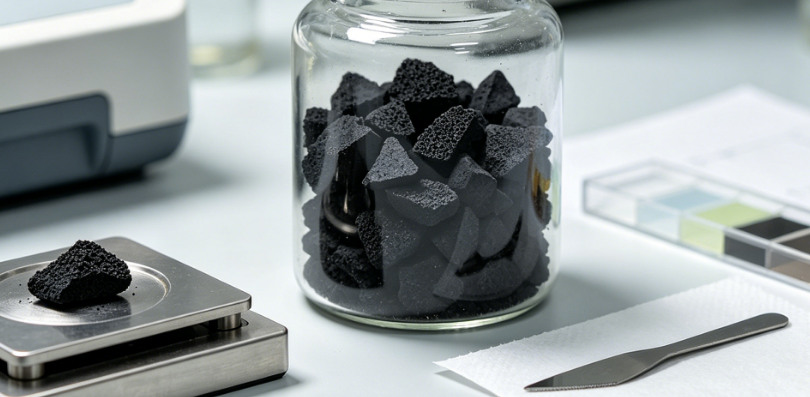
Precision Decolorization Efficiency under Simulated Industrial Conditions
Routine batch adsorption tests often fail to capture the dynamic behavior of continuous decolorization systems. We employ a fully automated decolorization test rig that operates under controlled temperature (20–90 °C), pH (2–10), and agitation regimes, using a panel of industry-relevant chromophores including caramel (ICUMSA method), melanoidins, anthocyanins, chlorophyll derivatives, and synthetic dye mixtures (e.g., acid blue 74, methyl orange). Our online UV-Vis spectrophotometric monitoring (with fiber-optic probes) provides real-time residual color measurements at multiple wavelengths (420 nm, 520 nm, 620 nm), enabling the precise calculation of decolorization percentage, specific color removal capacity (mg dye/g carbon), and adsorption kinetic constants (pseudo-first-order, pseudo-second-order, and intraparticle diffusion models) with a time resolution of 0.5 seconds. For more realistic simulation, we perform continuous flow fixed-bed breakthrough experiments under varying bed heights, linear velocities, and influent color loads, generating complete breakthrough curves fitted to the Thomas, Yoon-Nelson, and modified dose-response models to predict exhaustion time, bed capacity, and mass transfer zone length—essential data for filter sizing and replacement scheduling.
Advanced Pore Structure and Surface Chemistry Profiling for Colorant Accessibility
Decolorization efficiency is governed not only by total surface area but by the mesopore/macropore network that provides access to large chromophore molecules. We perform comprehensive porosimetry using nitrogen physisorption at 77 K (with 120-point isotherm over a relative pressure range from 10⁻⁶ to 0.995) and mercury intrusion porosimetry (MIP) up to 60,000 psi. By applying density functional theory (DFT) with a slit-pore and cylindrical-pore hybrid model, we resolve full pore size distributions from ultramicropores (0.4 nm) to macropores (200 µm), with sub-ångström accuracy for micropores and 0.2 nm resolution for mesopores. Critically, we quantify the mesopore volume fraction (2–50 nm) and the ratio of micropore to mesopore surface area, which directly correlate with accessibility for dextrans, caramelized sugars, and polymeric color bodies. Simultaneously, our surface chemical analysis—including X-ray photoelectron spectroscopy (XPS) for O/C and N/C ratios, temperature-programmed desorption (TPD) coupled with mass spectrometry for oxygen functional group densities (carboxyl, lactone, phenol, carbonyl) with a detection limit of 0.02 mmol/g, and Boehm titration for acidic/basic sites—provides a complete electrostatic and polar interaction map, predicting affinity for charged or hydrophobic dyes.
Real-World Interference and Regeneration Performance Testing
Industrial decolorization feeds often contain co-adsorbing species (salts, proteins, sugars, oils) that compete for active sites and foul the carbon surface. We offer competitive adsorption tests using defined model solutions containing dye plus representative interferents (NaCl, sucrose, bovine serum albumin, and oleic acid), measuring selectivity coefficients (αdye/interferent) and reduction in dynamic capacity. For regeneration efficiency—a key economic factor—we subject spent carbons to thermal reactivation (under N₂ or steam at 600–900 °C) and chemical regeneration (with ethanol, NaOH, or H₂O₂) over five consecutive cycles, with full re-characterization of decolorization performance, pore structure, and surface chemistry after each cycle. This yields a regeneration recovery index (RRI) and cumulative cycle capacity loss, enabling life-cycle cost analysis.
Trace Leachables and Purification Safety Screening
For food, pharmaceutical, and cosmetic applications, the carbon itself must not introduce hazardous species. We provide a comprehensive leachable screening using inductively coupled plasma mass spectrometry (ICP-MS/MS) for heavy metals (As, Pb, Cd, Hg, Cr, etc.) in acid digests and ion chromatography (IC) for anions (cyanide, fluoride, chloride, sulfate) leached into deionized water and typical process solvents. Additionally, we perform polycyclic aromatic hydrocarbon (PAH) analysis by GC-MS (ultra-trace level, < 0.1 ppb) and determination of soluble ash, acid-soluble substances, and pH of aqueous extract according to international pharmacopoeia (USP, EP) and food additive standards (JECFA, FCC). Our Endotoxin testing (LAL assay) and microbial contamination screening (TAMC and TYMC per USP <61>) further ensure compliance for direct-contact purification processes.
Our Distinctive Competencies and Analytical Superiority
What fundamentally sets our service apart is the orthogonal and fully correlated integration of decolorization dynamics, pore architecture, surface chemistry, and regeneration tests performed on the same well-characterized sample, eliminating batch variability and enabling direct multivariate correlations. We operate under ISO/IEC 17025 accreditation and maintain proprietary reference decolorization carbons that are calibrated against international round-robin studies (e.g., ASTM D3860, EN 12915). Our in-house modeling platform combines >40 independent parameters (e.g., mesopore volume, lactone group density, pHPZC, Thiele modulus) to generate a “Decolorization Performance Index” (DPI) that ranks your carbon against a database of >200 commercial products, providing a benchmarking tool for supplier selection and process optimization.
We achieve exceptional precision: < 1.0% RSD for BET surface area, < 1.5% for total pore volume, < 2.0% for decolorization percentage at equilibrium, and < 2.5% for breakthrough capacity (q0) across triplicate column runs. Our turnaround time for the full suite (including dynamic and regeneration tests) is 10–15 working days, with expedited 7-day service for urgent quality issues. Crucially, our team of PhD chemists and process engineers provides a comprehensive interpretative report that translates raw data into actionable recommendations—such as optimal particle size, dosage, contact time, and regeneration conditions—tailored to your specific feedstock (e.g., beet sugar, palm oil, or antibiotic mother liquor). With over 100 successful projects on decolorization carbons from diverse raw materials, we empower our clients to standardize incoming material quality, reduce process variability, and achieve consistent final product clarity with the highest level of scientific rigor and regulatory confidence.