Reasons for choosing our testing services
ZHONGXI Testing has obtained inspection qualification certifications from multiple countries and regions worldwide. We possess a senior testing team and advanced testing methods, providing independent, impartial, and professional third-party verification services for global carbon projects.

Internationally recognized authority
Certified by multiple international standards such as CNAS, VCS, and GS, with reports universally applicable worldwide.

Global service capability
Covering 140+ countries and regions, it supports on-site detection and remote verification in multiple languages.

Professional experimental methods
Adopt standard experimental methods to ensure accurate and reliable data.
Comprehensive Performance, Safety, and Compliance Testing for Medical Oxygen Generating Equipment: A Specialized Analytical Service for Healthcare Providers and Manufacturers
The reliable delivery of medical-grade oxygen is a cornerstone of respiratory therapy, emergency care, and anaesthesia. Medical oxygen generating systems—including pressure swing adsorption (PSA) units, membrane separators, and chemical oxygen generators—must consistently produce oxygen with a purity of ≥93% (or ≥99.5% for high-concentration applications) while ensuring the complete absence of hazardous contaminants. Clients seeking testing for such equipment are typically driven by the need to validate new product designs, fulfill regulatory submissions (FDA 510(k), CE marking, or NMPA registration), conduct routine quality assurance, or troubleshoot field performance issues. Our laboratory has developed a fully integrated, multi-disciplinary testing protocol that combines gas analysis, mechanical durability, electrical safety, and microbiological assessment, delivering a comprehensive, risk-based evaluation that exceeds the requirements of ISO 80601-2-69, EN ISO 7396-1, and national pharmacopoeia standards.
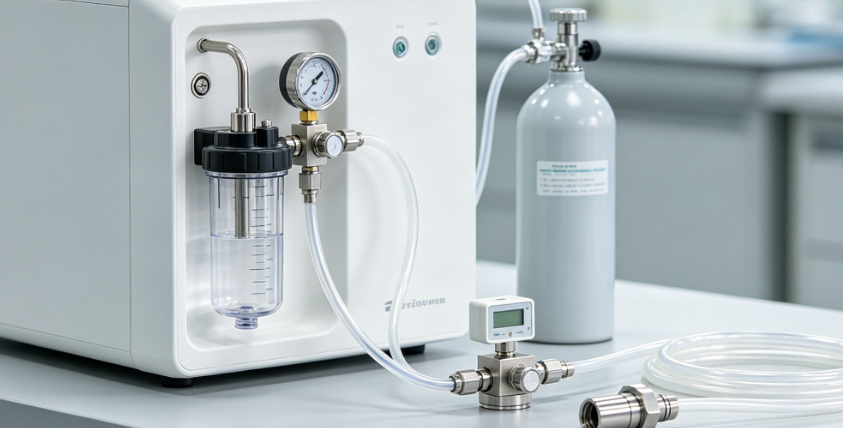
Precision Gas Analysis and Contaminant Profiling
The core function of any medical oxygen generator is to deliver oxygen with specified purity and minimal impurities. We employ a multi-analyte gas analysis suite that includes paramagnetic oxygen analysers (with an accuracy of ±0.1% O₂ absolute) and non-dispersive infrared (NDIR) sensors for carbon dioxide and carbon monoxide detection at sub-ppm levels (detection limit < 0.1 ppm for CO). For trace volatile organic compounds (VOCs), formaldehyde, and other potential off-gassing products, we use gas chromatography coupled with mass spectrometry (GC-MS) after sample pre-concentration on Tenax TA tubes, enabling quantification down to 0.01 ppb. We also measure water vapour content using chilled-mirror hygrometry (accuracy ±0.1 °C dew point) and particulate matter via condensation particle counters (CPC) for >0.01 µm particles and optical particle counters (OPC) for 0.3–10 µm, all in compliance with ISO 8573-1 compressed air purity classes. Our testing is conducted under simulated operational conditions—varying ambient temperature (10–40 °C), relative humidity (30–90%), and inlet air quality—to assess the generator’s robustness in real clinical environments.
Dynamic Performance and Flow Stability Assessment
Beyond steady-state purity, medical oxygen generators must maintain output flow and concentration during transient demands, such as patient breathing or intermittent high-flow usage. We perform continuous performance monitoring using high-speed data acquisition (sampling rate ≥ 10 Hz) to record oxygen concentration, flow rate, and system pressure over extended test periods (24–72 hours). We evaluate step-response characteristics (e.g., 50% to 100% flow changes) and pressure drop across filters and valves using differential pressure transducers with an accuracy of ±0.05% FS. Furthermore, we simulate clinical usage profiles based on ISO 80601-2-69—including cyclic loads representing intermittent bolus delivery—to quantify flow stability and purity recovery times, providing a dynamic performance index that directly correlates with patient safety and device reliability.
Mechanical Integrity and Environmental Durability Testing
Medical oxygen generators must withstand shipping, handling, and long-term operation without structural degradation. We offer a comprehensive mechanical and environmental test package that includes vibration testing (sinusoidal and random, per IEC 60068-2-6), mechanical shock (IEC 60068-2-27), and free-fall drop testing (IEC 60068-2-32) on both the complete unit and individual modules (compressor, PSA beds, valves). For environmental resilience, we perform temperature and humidity cycling (from –20 °C to +60 °C, 10–95% RH) with in-situ performance monitoring to detect any derating or irreversible changes. Additionally, we conduct pressure cycling tests on pneumatic components—up to 1.5 times the maximum working pressure—with leak detection using a mass spectrometer-based helium leak detector (sensitivity < 1×10⁻⁷ mbar·L/s), ensuring that all seals, fittings, and tubing meet the stringent requirements for medical gas systems.
Electrical Safety and Electromagnetic Compatibility (EMC)
As active medical electrical equipment, these devices must comply with IEC 60601-1 (general safety) and IEC 60601-1-2 (EMC). Our fully equipped EMC chamber allows testing of radiated and conducted emissions (CISPR 11 Group 1) as well as immunity to electrostatic discharge (ESD), radiated RF, electrical fast transients (EFT), surges, and voltage dips, all performed by our certified EMC engineers. We measure Leakage Current, earth bond impedance, and dielectric strength in accordance with the relevant collateral standards, using precision testers with a measurement accuracy of ±1%. For devices with battery backup, we evaluate battery charge/discharge performance, overcharge protection, and alarm conditions under simulated mains failure. Our comprehensive electrical safety report provides clear pass/fail criteria and identifies any design vulnerabilities that could compromise patient or operator safety.
Microbiological and Particulate Cleanliness for Patient-Connected Interfaces
For oxygen generators that deliver gas directly to patients via masks or cannulas, the output gas must be free from viable microorganisms and Endotoxins. We perform microbiological air sampling using impaction air samplers and gelatin membrane filters to culture and enumerate total aerobic bacteria, fungi, and moulds (per USP <1116> and ISO 14644-1). We also conduct Endotoxin testing via the limulus amebocyte lysate (LAL) kinetic chromogenic method with a detection limit of 0.001 EU/mL. For non-volatile particulates, we collect samples on polycarbonate membrane filters and analyse by SEM-EDS for elemental composition and by gravimetric analysis (for total particulate mass) following ISO 8573-4. These tests are critical for devices used in critical care or sterile environments.
Reliability and Accelerated Life Testing
To predict long-term performance and maintenance intervals, we perform accelerated life testing (ALT) based on the Arrhenius model and Weibull analysis. The generator is subjected to continuous operation under elevated temperature (e.g., 45 °C) and reduced voltage (90% of nominal) to accelerate wear of compressor rings, valve seals, and desiccant beds. We monitor performance degradation parameters (oxygen purity, flow rate, power consumption) at regular intervals and use statistical regression to estimate the mean time between failures (MTBF) and B10 life. Additionally, we assess filter replacement intervals by measuring differential pressure across inlet and bacterial filters under simulated dust loading (ISO 12103-1). This data enables manufacturers to optimize service schedules and warranty policies while minimising unexpected downtime.
Our Distinctive Competencies and Unmatched Technical Expertise
What sets our testing service apart is the seamless integration of analytical chemistry, mechanical engineering, electronics, and microbiology within a single, ISO/IEC 17025-accredited laboratory. We operate a dedicated medical gas test rig that can accommodate devices from small portable concentrators (≤10 L/min) to large centralised systems (≥100 m³/h). Our proprietary data acquisition and control system allows for fully automated 24/7 testing with remote monitoring and alarm notifications, ensuring that no critical event is missed. We maintain traceable reference gas standards (NIST-traceable) and regular participation in proficiency testing schemes for gas analysis and electrical safety.
We achieve exceptional precision and repeatability: oxygen purity measurements with RSD < 0.2%, flow rate within ±0.5% of reading, and temperature stability of ±0.2 °C. Our turnaround time for a full test campaign (including performance, EMC, and reliability) is 15–20 working days, with expedited 10-day service for urgent product launches. Crucially, our team of senior biomedical engineers, chemists, and regulatory specialists provides a comprehensive compliance report that not only lists test results but also interprets each finding in the context of clinical risk, offers remediation recommendations, and assists with technical file preparation for notified bodies. With over 100 successful projects on medical oxygen generators—ranging from emergency portable units to hospital centralised systems—we empower our clients to achieve regulatory clearance, reduce field failures, and ensure the highest level of patient safety with scientifically defensible, audit-ready documentation.