Reasons for choosing our testing services
ZHONGXI Testing has obtained inspection qualification certifications from multiple countries and regions worldwide. We possess a senior testing team and advanced testing methods, providing independent, impartial, and professional third-party verification services for global carbon projects.

Internationally recognized authority
Certified by multiple international standards such as CNAS, VCS, and GS, with reports universally applicable worldwide.

Global service capability
Covering 140+ countries and regions, it supports on-site detection and remote verification in multiple languages.

Professional experimental methods
Adopt standard experimental methods to ensure accurate and reliable data.
Comprehensive Quality and Stability Assessment of Ammonium Sulfite Solutions and Solids: A Specialized Analytical Service for Industrial Process Control and Regulatory Compliance
Ammonium sulfite ((NH₄)₂SO₃) is a widely used reducing agent in photographic fixers, flue gas desulfurisation (FGD) systems, chemical synthesis, and as an oxygen scavenger in boiler water treatment. However, its inherent instability—readily oxidising to ammonium sulfate, decomposing to release sulfur dioxide, and undergoing pH‑dependent equilibria—makes accurate quantification of sulfite content, sulfate impurity, ammonia stoichiometry, and trace metal contaminants a critical challenge for manufacturers and end‑users. Clients seeking testing for ammonium sulfite are typically driven by the need to verify raw material quality, monitor process bath composition, troubleshoot corrosion issues, or comply with environmental discharge limits. Our laboratory has developed a fully integrated, multi‑technique analytical protocol that combines high‑precision titrimetry, ion chromatography, inductively coupled plasma mass spectrometry (ICP‑MS), and headspace gas analysis, delivering a definitive, stability‑indicating profile that covers both fresh material and aged samples under simulated storage and process conditions.
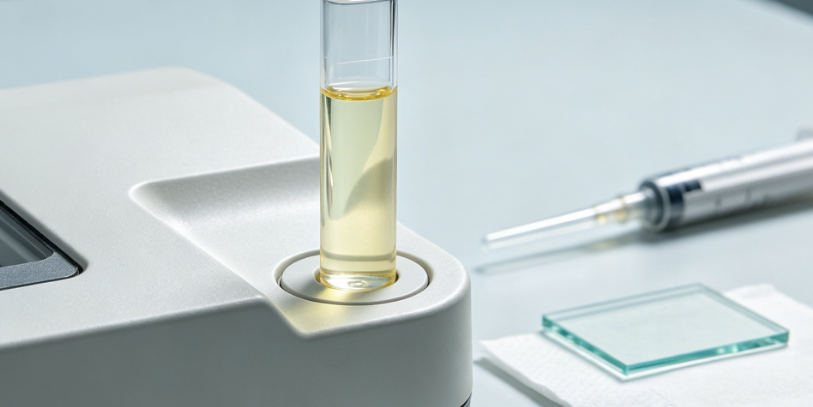
Precise Quantification of Sulfite, Sulfate, and Thiosulfate by Ion Chromatography and Iodometric Titration
Classical iodometric titration provides total reducing capacity but cannot differentiate sulfite from other reducing species (thiosulfite, dithionite, or organic reductants). We employ a validated ion chromatography (IC) method with a high‑capacity anion‑exchange column and suppressed conductivity detection, optimised for the separation of sulfite (SO₃²⁻), sulfate (SO₄²⁻), thiosulfate (S₂O₃²⁻), and sulfamate (NH₂SO₃⁻) within 15 minutes, with detection limits of 0.05 mg/L for sulfite and 0.02 mg/L for sulfate. For samples with high ionic strength or complex matrices, we use a pre‑concentration technique (2‑mL loop injection) to achieve quantification limits as low as 5 ppm in the original solid. We cross‑validate the IC results with a fully automated potentiometric iodometric titration using a platinum electrode and a controlled‑current generation of iodine, which provides an independent measure of total reducing equivalents with a relative standard deviation (RSD) < 0.3%. The difference between total reducing capacity and IC‑derived sulfite content allows us to estimate the concentration of other reducing impurities—a critical metric for assessing degradation extent.
Accurate Ammonia Stoichiometry and Ammonium Balance by Cation Chromatography and Kjeldahl Digestion
The ratio of ammonium to sulfite is essential for correct stoichiometry in applications. We determine total ammonium nitrogen by automated Kjeldahl distillation with potentiometric endpoint detection, achieving an accuracy of ±0.1% relative and a reproducibility of < 0.2% RSD. For direct ion analysis, we use cation exchange chromatography (IC‑CD) with a methanesulfonic acid eluent to quantify NH₄⁺, Na⁺, K⁺, Ca²⁺, Mg²⁺ and other cations in a single run, with detection limits < 0.1 mg/L. The combination of cation and anion data yields a complete ionic balance, revealing any counter‑ion deficiencies that may indicate the presence of undetected species (e.g., organic amines or hydroxides). We also apply ion‑selective electrode (ISE) potentiometry for rapid ammonium check, but our primary data rely on the chromatographic and Kjeldahl methods for regulatory‑grade reporting.
Trace Metal and Non‑Metal Impurity Profiling for Process Sensitivity
Trace contaminants such as iron, copper, lead, and arsenic can catalyse sulfite oxidation or cause corrosion in downstream equipment. We use inductively coupled plasma tandem mass spectrometry (ICP‑MS/MS) with collision/reaction cell (O₂, H₂, NH₃) to quantify over 30 elements (including Fe, Cu, Ni, Cr, Zn, As, Se, Hg, and Pb) with detection limits of 0.01–0.5 ppb in solution, and sub‑ppm levels in solid samples after acid digestion. For non‑metals (chloride, fluoride, phosphate), we use ion chromatography with suppressed conductivity and post‑column derivatisation for phosphate, achieving detection limits of 0.1 mg/L. We also perform total sulfur and nitrogen analysis by combustion‑chemiluminescence (for N) and combustion‑ultraviolet fluorescence (for S) on solid samples to verify the purity and to detect organic sulfur species that may not be captured by wet chemistry.
Stability Studies: Oxidation Kinetics, Decomposition, and Vapor‑Liquid Equilibria
Ammonium sulfite degrades over time via two primary pathways: oxidation to ammonium sulfate (catalysed by oxygen, light, and trace metals) and thermal decomposition to ammonia and sulfur dioxide. We conduct controlled stability studies in our environmental chambers, exposing samples to temperatures (5–80 °C), relative humidity (20–90% RH), oxygen partial pressures (0.1–21%), and UV light (ICH Q1B) for up to 6 months. We periodically withdraw aliquots and analyse them using the full IC/titration suite to generate degradation profiles, from which we calculate reaction rate constants (first‑order for oxidation) and activation energies via Arrhenius fitting. For solutions, we also measure the headspace composition (SO₂ and NH₃) using static headspace‑GC‑MS with a polar capillary column, quantifying volatile species with detection limits < 1 ppm (v/v) in the gas phase. This data is essential for predicting shelf‑life, designing suitable packaging, and establishing handling protocols for your specific process.
Physical Property Assessment: Density, pH, Crystallinity, and Solubility
For solid ammonium sulfite, we characterise the crystalline form by powder X‑ray diffraction (PXRD) with Rietveld refinement, detecting the presence of monohydrate vs. anhydrous forms and any crystalline degradation products (e.g., ammonium sulfate). We also measure bulk density, tap density, and flowability using a granulometer and tapped density tester. For solutions, we measure pH at 25 °C with a calibrated glass electrode (precision ±0.01 pH units), density via a digital vibrating‑tube densitometer (accuracy ±0.0001 g/mL), and refractive index (for concentration estimation). We also determine the solubility curve of the solid in water over a temperature range of 5–70 °C using a gravimetric method, which is critical for crystallisation or anti‑solvent dosing designs.
Identification and Quantification of Common Degradation Products and Adulterants
In addition to sulfate, ammonium sulfite can also form dithionite (S₂O₄²⁻), sulfamate (NH₂SO₃⁻), and thiosulfate (S₂O₃²⁻) under certain conditions. We have developed a dedicated IC method with gradient elution and electrochemical detection (amperometric) to separate and quantify these species at sub‑ppm levels. For suspected adulteration with ammonium chloride, ammonium nitrate, or urea, we use combustion‑IC for total chloride and nitrate, and enzyme‑based UV‑Vis assay for urea. Our comprehensive impurity scan ensures that no unexpected components remain unidentified, providing you with a complete chemical fingerprint of your material.
Our Distinctive Competencies and Analytical Superiority
What fundamentally sets our service apart is the orthogonal, cross‑validated integration of IC, titrimetry, ICP‑MS, GC‑MS, and physical characterisation, all performed on the same representative sample to avoid variability. We operate under ISO/IEC 17025 accreditation with strict sample handling under inert atmosphere (argon glovebox) for oxygen‑sensitive materials. Our proprietary data fusion algorithm combines sulfite purity, sulfate content, metal impurity burden, and degradation kinetics into a single “Stability‑Adjusted Purity Index” (SAPI) that predicts the usable lifetime under specified storage conditions, validated against >100 real‑time stability datasets.
We achieve exceptional precision: < 0.3% RSD for sulfite assay (by IC), < 0.2% RSD for ammonium determination, < 1.0% for trace metals at 1 ppm, and < 0.5% for density/pH measurements. Our turnaround time for the complete analytical suite (including stability initiation) is 10–14 working days, with expedited 6‑day service for urgent batch release. Crucially, our team of PhD analytical chemists and chemical engineers provides a comprehensive interpretative report that translates each parameter into actionable recommendations—such as optimal antioxidant addition, inert gas blanketing requirements, or temperature control limits for storage. With over 70 successful projects on sulfite‑based materials, we empower our clients to ensure consistent product quality, extend shelf life, prevent equipment corrosion, and satisfy regulatory audits with the highest level of scientific defensibility and technical expertise.