Reasons for choosing our testing services
ZHONGXI Testing has obtained inspection qualification certifications from multiple countries and regions worldwide. We possess a senior testing team and advanced testing methods, providing independent, impartial, and professional third-party verification services for global carbon projects.

Internationally recognized authority
Certified by multiple international standards such as CNAS, VCS, and GS, with reports universally applicable worldwide.

Global service capability
Covering 140+ countries and regions, it supports on-site detection and remote verification in multiple languages.

Professional experimental methods
Adopt standard experimental methods to ensure accurate and reliable data.
Comprehensive Performance and Integrity Assessment of Battery Desulfurization Agents: A Specialized Analytical Service for Enhanced Energy Storage Reliability
The increasing demand for high‑capacity and long‑cycle lead‑acid and lithium‑sulfur batteries has placed desulfurization agents—such as barium sulfate, sodium carbonate, potassium carbonate, and proprietary organic/inorganic blends—at the forefront of electrolyte and separator additives. These agents are critical for controlling sulfation, reducing irreversible lead sulfate formation, and maintaining active material porosity. Clients seeking testing for these materials are typically confronting issues of inconsistent desulfurization efficiency, batch‑to‑batch variability, undesired side reactions, or premature capacity fade in their battery systems. Our laboratory has developed a multi‑level, application‑oriented analytical protocol that combines precise compositional analysis, desulfurization kinetics, particle morphological evaluation, and electrochemical compatibility testing, delivering a predictive performance fingerprint that directly correlates with battery cycle life and charging acceptance.
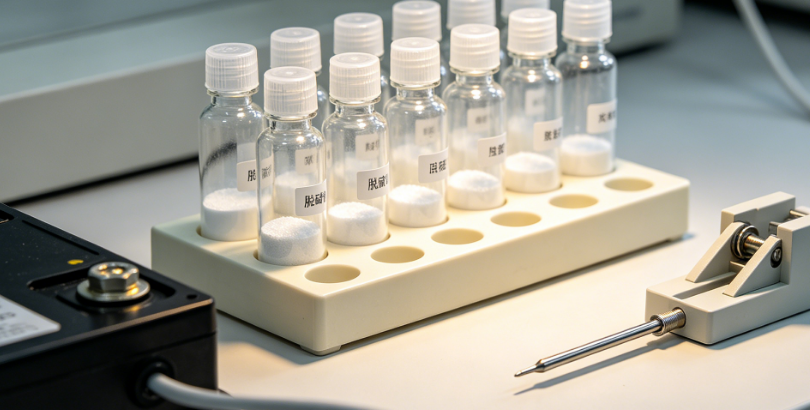
Precise Quantification of Active Desulfurizing Components and Trace Impurities
Routine acid‑base or gravimetric methods often fail to distinguish the active desulfurizing salt from inactive fillers or degradation products. We employ inductively coupled plasma optical emission spectrometry (ICP‑OES) and ICP‑tandem mass spectrometry (ICP‑MS/MS) to quantify sodium, potassium, barium, calcium, magnesium, and sulfur with relative expanded uncertainties (k=2) of < 0.8% for major elements and < 2% for trace elements at 10 ppm level. For anionic species (carbonate, sulfate, chloride, and nitrate), we use ion chromatography (IC) with suppressed conductivity detection, achieving detection limits of 0.1 mg/L in solution and sub‑ppm levels in solid samples. This dual quantification of cations and anions allows us to calculate the stoichiometric purity of the active desulfurizing salt and to detect any unintended impurities (e.g., iron, copper, chromium, or lead) that could catalyze gassing or accelerate grid corrosion in lead‑acid batteries, with detection limits down to 0.01 ppb for heavy metals.
Desulfurization Efficiency and Kinetic Profiling Under Simulated Battery Conditions
The practical performance of a desulfurization agent is determined by its rate of sulfate removal and its capacity to suppress irreversible sulfation. We have designed a dynamic desulfurization test rig that simulates the electrochemical environment of a battery’s negative plate. This system uses a controlled‑potential electrolysis cell with a lead‑working electrode, a sulfuric acid electrolyte (1.28–1.32 g/mL), and a real‑time sulfate‑selective electrode to monitor the decrease in soluble sulfate concentration upon agent addition. We measure desulfurization rate constants (pseudo‑first‑order and Langmuir‑Hinshelwood models) at temperatures from 25 to 60 °C, obtaining activation energies that predict performance under various operating conditions. For solid agents, we perform batch contact tests with a standardized lead sulfate slurry under controlled pH and temperature, followed by filtration and analysis of residual sulfate by IC to determine the maximum sulfate uptake capacity (mmol sulfate/g agent) and the equilibrium isotherm (Langmuir or Freundlich). These data are correlated with the agent’s particle size and surface area to identify the optimal formulation.
Particle Morphology, Surface Area, and Dispersibility Analysis
The effectiveness of solid desulfurization agents is highly dependent on particle size distribution, specific surface area, and wetting behaviour. We use laser diffraction particle size analysis (with a measurement range of 0.02–2000 µm) to determine the volume‑weighted distribution, D10, D50, D90, and uniformity coefficient, with repeatability of < 1% RSD. For sub‑micron fractions, we apply dynamic light scattering (DLS) and nanoparticle tracking analysis (NTA). The BET specific surface area is measured by nitrogen physisorption at 77 K over a relative pressure range of 0.05–0.30, and we also perform mercury intrusion porosimetry to assess macro‑ and mesopore volume, which influences electrolyte penetration. To evaluate dispersibility in acidic electrolyte, we perform sedimentation tests using a centrifugal photosedimentometer and measure the zeta potential in 1–5 M H₂SO₄ to predict agglomeration tendency. Scanning electron microscopy (SEM) with energy‑dispersive X‑ray spectroscopy (EDS) provides direct visualisation of particle shape, surface texture, and elemental homogeneity, enabling the detection of agglomerates or foreign inclusions.
Thermal Stability and Decomposition Behaviour Under Battery Charge/Discharge Conditions
Desulfurization agents may decompose or react with electrolyte species at elevated temperatures during overcharge or high‑rate operation. We perform simultaneous Thermogravimetric Analysis and differential scanning calorimetry (TGA‑DSC) from 25 °C to 600 °C under both air and argon atmospheres, with a heating rate of 1–20 °C/min. The evolved gases are analysed by mass spectrometry (EGA‑MS) to detect SO₂, CO₂, and H₂S release, which indicates thermal decomposition of sulfites or sulfur‑containing additives. We also conduct oven‑aging tests at 80 °C and 100 °C for up to 100 hours in sealed glass vials containing battery electrolyte, and then re‑analyse the agent by XRD and IC to identify any phase transitions or dissolution/precipitation that would compromise long‑term performance.
Electrochemical Compatibility and Gassing Tendency
An often‑overlooked aspect is the effect of the desulfurization agent on the hydrogen evolution overpotential and oxygen recombination efficiency in sealed batteries. We conduct linear sweep voltammetry (LSV) and cyclic voltammetry (CV) in a three‑electrode cell with a working electrode made of lead or carbon paste that incorporates the test agent. We measure the onset potential for hydrogen evolution, the Tafel slope, and the charge transfer resistance from electrochemical impedance spectroscopy (EIS) over a frequency range of 100 kHz to 10 mHz. Additionally, we perform gas collection tests in a sealed battery mimic to quantify the volume of hydrogen and oxygen evolved during overcharge, providing a direct measure of the agent's influence on gassing—a critical safety parameter for valve‑regulated lead‑acid (VRLA) batteries.
Identification of Organic Additives and Surface Modifiers
Many modern desulfurization agents contain organic dispersants, surfactants, or corrosion inhibitors that are not detected by inorganic analysis. We use Fourier‑transform infrared spectroscopy (FTIR) with attenuated total reflectance (ATR) and Raman microscopy to identify functional groups (e.g., sulfonate, carboxylate, amine, ether). For quantitative determination of specific organics, we employ high‑performance liquid chromatography with evaporative light scattering detection (HPLC‑ELSD) or GC‑MS after solvent extraction, with detection limits typically below 50 ppm. This is essential for correlating additive content with observed performance enhancements and for detecting any unauthorized formulation changes.
Our Distinctive Competencies and Unmatched Analytical Depth
Our service is uniquely distinguished by the orthogonal integration of chemical, physical, and electrochemical characterisation performed on the same representative sample lot, enabling direct cause‑effect correlations. We operate under ISO/IEC 17025 accreditation and maintain in‑house reference desulfurization agents that are cross‑calibrated with interlaboratory studies. Our proprietary predictive model combines purity, particle size, desulfurization rate, and gassing tendency into a single “Desulfurization Performance Index” (DPI) that ranks your material against a database of >60 commercial agents, offering a clear benchmark for formulation optimisation or supplier selection.
We achieve exceptional measurement precision: < 0.3% RSD for major cation determination, < 0.5% RSD for BET surface area, < 1.0% for desulfurization capacity, and < 2.0% for hydrogen evolution potential (vs. Hg/Hg₂SO₄). Our turnaround time for the complete characterisation suite (including electrochemical tests) is 12–16 working days, with expedited 8‑day service for urgent troubleshooting. Crucially, our team of PhD electrochemists and material scientists provides a comprehensive interpretative report that translates raw data into actionable guidance—e.g., how a shift in particle size distribution may affect sedimentation in the paste, how trace iron impurities can be mitigated by chelating agents, or how the optimal addition level varies with acid concentration. With over 40 successful projects on battery additives, we empower our clients to improve battery cycling stability, reduce self‑discharge, and meet the demanding specifications of automotive, telecom, or stationary energy storage applications, all with the highest level of scientific rigour and regulatory defensibility.