Reasons for choosing our testing services
ZHONGXI Testing has obtained inspection qualification certifications from multiple countries and regions worldwide. We possess a senior testing team and advanced testing methods, providing independent, impartial, and professional third-party verification services for global carbon projects.

Internationally recognized authority
Certified by multiple international standards such as CNAS, VCS, and GS, with reports universally applicable worldwide.

Global service capability
Covering 140+ countries and regions, it supports on-site detection and remote verification in multiple languages.

Professional experimental methods
Adopt standard experimental methods to ensure accurate and reliable data.
Comprehensive Analytical and Performance Characterization of Expanded Graphite: A Specialized Testing Service for High‑Performance Sealing, Thermal Management, and Energy Storage Materials
Expanded graphite (EG)—produced by the rapid thermal exfoliation of intercalated graphite compounds—exhibits a unique combination of high specific surface area, exceptional compressibility, anisotropic thermal/electrical conductivity, and outstanding chemical resistance. Its performance, however, is critically dependent on a complex set of parameters including expansion ratio, residual intercalant content, porosity distribution, crystallite integrity, and mechanical resilience. Clients seeking testing for expanded graphite typically face challenges related to batch‑to‑batch reproducibility, qualification for nuclear or aerospace applications, optimisation of exfoliation parameters, or troubleshooting premature gasket failure. Our laboratory has established a fully integrated, multi‑scale analytical platform that combines advanced structural, chemical, thermal, and mechanical characterisation, delivering a quantitative, process‑relevant fingerprint that enables our clients to achieve stringent specifications (e.g., ASTM C625, ISO 17842, and nuclear grade standards) and to optimise their manufacturing and quality control workflows.
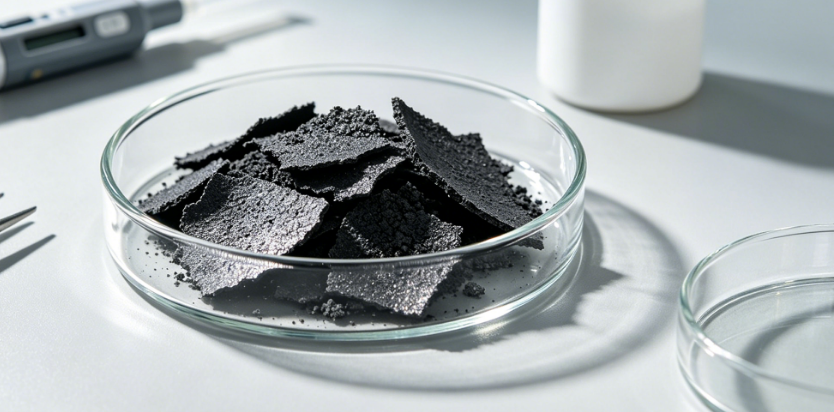
Precision Microstructural Analysis: Expansion Ratio, Specific Surface Area, and Pore Architecture
The unique vermicular morphology of expanded graphite is the primary determinant of its bulk properties. We measure the expansion ratio (volumetric increase from the precursor) using a computer‑controlled image analysis system on calibrated micrographs, achieving repeatability of ±1.5%. For detailed textural characterisation, we perform nitrogen physisorption at 77 K over a relative pressure range from 10⁻⁶ to 0.995 using a high‑resolution volumetric analyser, applying non‑local density functional theory (NLDFT) and Barrett‑Joyner‑Halenda (BJH) models to obtain pore size distributions from ultramicropores (0.4 nm) to mesopores (50 nm) with sub‑ångström resolution. We complement this with mercury intrusion porosimetry (MIP) at pressures up to 60,000 psi to characterise macropores and inter‑particle voids, providing a complete pore hierarchy. The specific surface area (BET) is reported with an expanded uncertainty of < 1.5%, and we correlate the textural data with bulk density (measured by both tapping and Archimedes methods) to predict fluid permeability and sealing behaviour.
Residual Intercalant Quantification and Chemical Purity Profiling
The residual intercalating species—typically sulfuric acid, nitric acid, or organic compounds—significantly affect corrosion propensity, outgassing, and thermal stability. We employ a multi‑technique approach for comprehensive chemical characterisation. Ion chromatography (IC) with suppressed conductivity is used to quantify sulfate, nitrate, and chloride in aqueous extracts with detection limits of 0.1 mg/L. For total sulfur content, we use combustion‑ion chromatography (CIC) with a detection limit of 0.5 ppm, and inductively coupled plasma tandem mass spectrometry (ICP‑MS/MS) after microwave digestion to achieve sub‑ppm detection for trace metals (Fe, Ni, Cr, Cu, Ca, Al, etc.). For organic residues, we perform headspace‑gas chromatography‑mass spectrometry (HS‑GC‑MS) for volatile compounds (e.g., acetic acid, acetone, and hydrocarbons) with detection limits below 1 ppm, and total organic carbon (TOC) analysis by combustion‑infrared method. We also identify surface functional groups (carboxyl, hydroxyl, carbonyl) using X‑ray photoelectron spectroscopy (XPS) and Fourier‑transform infrared spectroscopy (FTIR) with attenuated total reflectance (ATR), providing a complete chemical fingerprint of the EG surface.
Crystalline Perfection and Defect Structure by X‑Ray Diffraction and Raman Spectroscopy
The graphitic crystallinity and the degree of exfoliation are assessed by high‑resolution powder X‑ray diffraction (HR‑XRD) with Rietveld refinement, yielding interlayer spacing (d002), crystallite size (Lc), and stacking height (La) with standard uncertainties of 0.0003 Å and 1.5% for Lc. We also measure the Raman spectrum (with 532 nm and 785 nm lasers) to determine the D/G band intensity ratio (ID/IG) and the G’ (2D) band position, providing quantitative measures of defect density and graphitisation degree. The combination of XRD and Raman data enables us to distinguish between true exfoliation (with preserved crystallinity) and excessive milling‑induced amorphisation—a critical distinction for sealing performance.
Thermal Stability, Oxidation Kinetics, and Outgassing Behaviour
For high‑temperature sealing and thermal management applications, the oxidative stability and volatile release of EG are paramount. We conduct simultaneous Thermogravimetric Analysis and differential scanning calorimetry (TGA‑DSC) from 25 °C to 1000 °C under synthetic air, argon, and nitrogen, at heating rates of 2, 5, and 10 °C/min. We measure the oxidation onset temperature (Ton), the temperature of maximum weight loss (Tmax), and the residual ash content. Using the Kissinger‑Akahira‑Sunose (KAS) method, we determine the apparent activation energy (Ea) for oxidation, which is directly correlated with graphitic order. Evolved gases (CO₂, CO, H₂O, SO₂, NOx) are identified and quantified by evolved gas analysis coupled with mass spectrometry (EGA‑MS), with detection limits of 1 ppb. For vacuum and semiconductor applications, we perform temperature‑programmed desorption (TPD) up to 800 °C using a quadrupole mass spectrometer to measure the total outgassing rate (Torr·L/s·cm²) and to identify desorbing species, with a sensitivity of 10⁻¹² Torr. This comprehensive thermal characterisation provides the data needed to predict service life, qualify materials for critical environments, and optimise drying/degassing protocols.
Mechanical and Sealing Performance Under Simulated Conditions
The practical functionality of expanded graphite gaskets, foils, or sheets depends on their compressibility, recovery, and relaxation behaviour. We use a universal testing machine equipped with precision extensometers and environmental chambers to perform room‑temperature and high‑temperature (up to 400 °C) compression‑relaxation tests per ASTM F36 and DIN 28091. From the stress‑strain curves, we extract modulus of elasticity, compressive strength, creep relaxation modulus, and permanent set with repeatability of < 1%. We also conduct helium leak tests on gaskets fabricated from your EG, achieving leak rate detection as low as 10⁻⁶ mbar·L/s. For foil applications, we measure tensile strength (both in‑plane and through‑thickness) and flexural rigidity by three‑point bending, providing a complete mechanical property matrix under various humidity and temperature conditions. These data are essential for designing reliable seals, predicting creep‑rupture life, and ensuring compatibility with bolt preloads.
Electrical Conductivity and Anisotropic Transport Properties
Expanded graphite is widely used in thermal interface materials and conductive gaskets, where its in‑plane and through‑plane electrical/thermal conductivity are critical. We measure electrical resistivity using a four‑point probe system in both directions, with controlled compaction pressure to simulate application stress. The thermal diffusivity is determined by the laser flash method (LFA) from 25 °C to 600 °C, and combined with specific heat capacity (DSC) and bulk density to derive thermal conductivity with an accuracy of ±3%. We characterise the anisotropy ratio (in‑plane vs. through‑plane) which is a key figure‑of‑merit for heat spreaders and interface pads. This data is correlated with microstructural parameters (preferred orientation from XRD texture analysis) to provide a predictive model for conductivity as a function of expansion ratio and compaction.
Environmental and Chemical Resistance Testing
To validate performance in aggressive media, we subject EG samples to accelerated ageing in acidic (0.1 M H₂SO₄), alkaline (0.1 M NaOH), and saline (3.5% NaCl) solutions at elevated temperatures (50–90 °C) for up to 1000 hours. We periodically measure mass change, thickness change, and mechanical properties, and we monitor ion release by ICP‑MS. This test protocol follows NACE TM0297 and ASTM G31 standards, and provides a chemical durability index that is essential for qualifying EG for chemical processing, petrochemical, and marine applications.
Our Distinctive Competencies and Unmatched Analytical Depth
Our service is uniquely distinguished by the orthogonal integration of structural (XRD, Raman, gas adsorption, MIP), chemical (IC, ICP‑MS/MS, XPS, TGA‑EGA‑MS), thermal (TGA‑DSC, TPD), mechanical (compression, creep, tensile, leak), and transport property (electrical, thermal) tests—all performed on the same representative sample batch to eliminate cross‑batch variability and to enable direct multivariate correlations. We operate under ISO/IEC 17025 accreditation with in‑house reference expanded graphites that have been cross‑calibrated through international round‑robin exercises. Our proprietary data fusion platform combines over 35 independent parameters (including expansion ratio, BET area, sulfate residue, ID/IG, oxidation onset, creep recovery, and thermal conductivity anisotropy) into a single “Expanded Graphite Performance Index” (EGPI) that has been validated against >100 industrial and research‑grade materials, providing an immediate and reliable benchmark for supplier qualification, process optimisation, and failure analysis.
We achieve exceptional measurement precision: < 0.5% RSD for expansion ratio, < 0.01 m²/g for BET area, < 0.5 ppm for sulfur by CIC, < 0.1% for ash content, < 0.5% for compressive modulus, and < 1 °C for oxidation onset temperature. Our turnaround time for the complete EG characterisation suite (including ageing tests) is 12–18 working days, with expedited 7‑day service for urgent material release or troubleshooting. Crucially, our team of PhD‑level carbon scientists, materials engineers, and physical chemists provides a comprehensive interpretative report that goes beyond numerical data—we explain how each parameter affects your specific application, suggest exfoliation process adjustments to improve purity or porosity, and advise on optimal storage and handling conditions. With over 60 successful projects on expanded graphite and its derivatives, we empower our clients to ensure consistent product quality, reduce field failures, and achieve regulatory approval for the most demanding sealing and thermal management applications, all with the highest level of scientific rigour and technical expertise.