Reasons for choosing our testing services
ZHONGXI Testing has obtained inspection qualification certifications from multiple countries and regions worldwide. We possess a senior testing team and advanced testing methods, providing independent, impartial, and professional third-party verification services for global carbon projects.

Internationally recognized authority
Certified by multiple international standards such as CNAS, VCS, and GS, with reports universally applicable worldwide.

Global service capability
Covering 140+ countries and regions, it supports on-site detection and remote verification in multiple languages.

Professional experimental methods
Adopt standard experimental methods to ensure accurate and reliable data.
Comprehensive Analytical Characterization of Water‑Soluble Industrial Lithium Silicate Solutions: A Specialized Testing Service for Advanced Coating, Sealing, and Binder Applications
Water‑soluble lithium silicate (Li₂O·nSiO₂) is a high‑performance inorganic binder widely used in anti‑corrosion coatings, refractory mortars, cementitious sealers, and as a surface hardening agent for concrete. Its functional performance—including film‑forming ability, adhesion, thermal stability, and penetration depth—is critically governed by the silica‑to‑lithia molar ratio (modulus), solids content, dissolved silica speciation, colloidal stability, and trace impurity levels. Clients seeking testing for industrial lithium silicate typically face challenges such as batch‑to‑batch variations in reactivity, unexpected gelation or precipitation during storage, inadequate film hardness, or non‑compliance with technical data sheet specifications. Our laboratory has established a fully validated, multi‑technique analytical platform that combines precision wet chemistry, inductively coupled plasma optical emission spectrometry (ICP‑OES), ion chromatography, dynamic light scattering (DLS), and rheological characterisation, delivering a quantitative, process‑relevant profile that enables manufacturers and end‑users to ensure consistent product quality, optimise formulation parameters, and achieve reliable performance in demanding industrial environments.
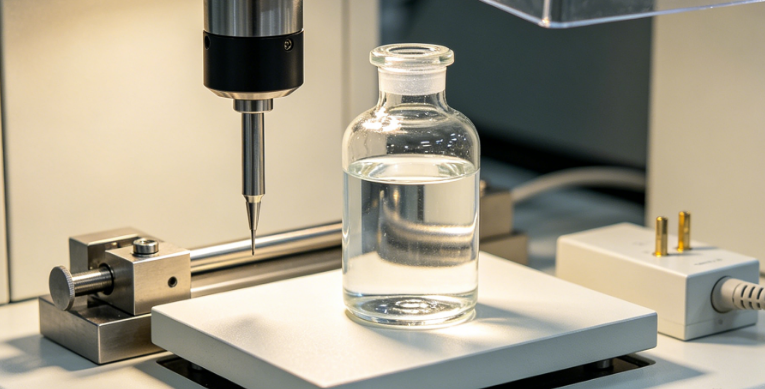
Precise Determination of Modulus (SiO₂/Li₂O Ratio) and Solids Content
The silica‑to‑lithia molar ratio is the single most critical parameter determining the binder’s reactivity, film hardness, and water resistance. We determine total silica (SiO₂) by a validated gravimetric method after dehydration and ignition, and total lithia (Li₂O) by inductively coupled plasma optical emission spectrometry (ICP‑OES) with matrix‑matched calibration, achieving relative expanded uncertainties (k=2) of < 0.4% for SiO₂ and < 0.5% for Li₂O. For routine quality control, we also offer automated potentiometric titration for total alkali (Li₂O) with standardised HCl, using a computer‑controlled titrator with pH precision of ±0.01 units. The modulus (SiO₂/Li₂O molar ratio) is calculated with repeatability of < 0.02. Solids content (total non‑volatile matter) is determined by gravimetric analysis after drying at 105 °C and 200 °C, providing both free water content and chemically bound water. All results are cross‑verified using certified reference materials (e.g., NIST SRM 1830) to ensure traceability.
Silica Speciation and Colloidal Stability Assessment
The performance of lithium silicate depends on the distribution of silica species—monomeric, oligomeric, and colloidal polymeric forms—which influences penetration depth and binding strength. We employ silicon‑29 nuclear magnetic resonance (29Si NMR) spectroscopy (at 79.5 MHz) with quantitative single‑pulse and relaxation‑edited sequences to distinguish Q⁰ (monomer), Q¹, Q², Q³, and Q⁴ (highly polymerised) silicon environments, with a spectral resolution of < 0.5 ppm and relative quantification precision of ±2%. For rapid process control, we use the molybdate‑reactive silica assay (colorimetric) to measure the fraction of low‑molecular‑weight (readily polymerisable) silica, with detection limit of 0.05 mg/L and reproducibility < 2% RSD. Colloidal stability against aggregation is evaluated by dynamic light scattering (DLS) to measure the hydrodynamic particle size distribution (from 0.5 nm to 10 µm) and the polydispersity index (PdI), and by zeta potential measurements as a function of pH (8‑12) and ionic strength, using electrophoretic light scattering (ELS) with automatic titration, achieving precision of ±0.5 mV. We also perform accelerated stability tests under thermal cycling (‑10 °C to 50 °C) and shear stress, monitoring viscosity and particle size changes to predict shelf‑life and processability.
Comprehensive Physical Characterisation: Viscosity, Density, and Surface Tension
The application behaviour of lithium silicate (spraying, brushing, roller coating) is strongly influenced by its dynamic viscosity and surface tension. We measure viscosity using a rotational viscometer with concentric cylinder geometry over a shear rate range of 1–1000 s⁻¹ at 20 °C, 25 °C, and 40 °C, reporting the flow curve and fitting to Newtonian or shear‑thinning models (e.g., Ostwald‑de Waele). Density is determined at 20 °C by a digital vibrating‑tube densitometer with accuracy ±0.0002 g/cm³. Surface tension is measured by the Wilhelmy plate method at 25 °C, with precision of ±0.1 mN/m. We also evaluate wetting behaviour via contact angle measurements on glass and concrete substrates, providing data for formulation optimisation.
Trace Elemental and Anionic Impurity Profiling
Contaminants such as sodium, potassium, aluminium, iron, and chlorides can adversely affect film clarity, water resistance, and adhesion. We quantify major and trace metals (Na, K, Al, Fe, Ca, Mg, Cu, Zn, Pb, As, Cr) by inductively coupled plasma tandem mass spectrometry (ICP‑MS/MS) with collision/reaction cell (O₂, NH₃, H₂), achieving detection limits of 0.01–0.5 ppb for most elements. For anions (chloride, sulfate, nitrate, phosphate), we use ion chromatography (IC) with suppressed conductivity on diluted samples, with detection limits < 0.1 mg/L. We also determine free alkali (as LiOH equivalent) by potentiometric titration with HCl to pH 8.3, which is critical for assessing the alkalinity and potential for substrate etching. All impurity results are reported with expanded uncertainties (k=2) and compared against technical grade specifications (e.g., ASTM C1364, EN 12390).
Thermal Stability and Phase Transformation Studies
Lithium silicate solutions are used in high‑temperature applications (e.g., refractory coatings) where phase behaviour and water evolution are critical. We perform simultaneous Thermogravimetric Analysis and differential scanning calorimetry (TGA‑DSC) from 30 °C to 1000 °C under air and inert atmospheres, at heating rates of 2, 5, and 10 °C/min. We identify dehydration steps (endotherms below 200 °C), glass transition of the lithium silicate network, and exothermic crystallisation of lithium disilicate (Li₂Si₂O₅) or metasilicate (Li₂SiO₃) phases. Coupled evolved gas analysis by mass spectrometry (EGA‑MS) detects CO₂, H₂O, and any organic volatiles. We also perform isothermal heating at 150 °C, 300 °C, and 500 °C for 24 hours, followed by X‑ray diffraction (XRD) and SEM‑EDS to characterise the resulting solid residues, providing critical data for high‑temperature sealer applications.
Coating Performance and Film Property Evaluation
For clients using lithium silicate as a binder or sealer, we offer film preparation and characterisation on glass, metal, and concrete substrates. We measure film hardness (pencil and Buchholz), adhesion (cross‑hatch and pull‑off tests), water contact angle, and water absorption (gravimetric after immersion). We also evaluate corrosion resistance by salt spray testing (ASTM B117) and chemical resistance to acids and alkalis. These property tests are correlated with the chemical and physical parameters from the liquid analysis, enabling you to link formulation changes to final coating performance.
Accelerated Aging and Storage Stability Prediction
Lithium silicate solutions may undergo polymerisation or precipitation over time, especially under temperature fluctuations. We conduct accelerated aging studies at 40 °C, 50 °C, and 60 °C for up to 90 days, with weekly monitoring of viscosity, pH, DLS particle size, and modulus. The degradation kinetics are modelled using Arrhenius and Avrami equations to estimate the shelf‑life at 25 °C with 95% confidence intervals. We also perform freeze‑thaw cycling (‑20 °C to +25 °C, 10 cycles) to simulate transport and storage in unheated warehouses, and we evaluate reversibility of any gelation. Our stability report includes clear recommendations on storage conditions, maximum duration, and handling procedures.
Our Distinctive Competencies and Analytical Superiority
Our service is uniquely distinguished by the orthogonal integration of 29Si NMR speciation, high‑precision ICP‑OES/ICP‑MS, DLS/ELS colloidal characterisation, rheological profiling, and thermal analysis—all performed on the same representative sample to eliminate cross‑batch variability. We operate under ISO/IEC 17025 accreditation and maintain in‑house reference lithium silicate solutions (with well‑characterised modulus and solids) that are cross‑calibrated with international proficiency testing materials. Our proprietary “Lithium Silicate Performance Index” (LSPI™) combines modulus, monomeric silica fraction, impurity sum, and viscosity stability into a single score that predicts coating hardness, water resistance, and storage life. This index has been validated against >30 commercial lithium silicate products.
We achieve exceptional measurement precision: < 0.3% RSD for Li₂O and SiO₂, < 0.5 mPa·s for viscosity (below 100 mPa·s), < 0.5 mV for zeta potential, and < 2% RSD for DLS size. Our turnaround time for the complete characterisation suite (including accelerated aging) is 10–14 working days, with expedited 6‑day service for urgent batch release. Crucially, our team of PhD‑level inorganic chemists, colloid scientists, and coating technologists provides a comprehensive interpretative report that translates each parameter into actionable insights—e.g., how to adjust the modulus to improve penetration into porous substrates, how to interpret an increase in Q³/Q⁴ ratio as a sign of over‑polymerisation, or how to minimise sodium contamination to enhance humidity resistance. With over 15 successful projects on lithium silicate systems, we empower our clients to achieve consistent product quality, reduce formulation failures, and meet the rigorous requirements of industrial coatings and construction chemicals—all with the highest level of scientific rigour and technical credibility.