Reasons for choosing our testing services
ZHONGXI Testing has obtained inspection qualification certifications from multiple countries and regions worldwide. We possess a senior testing team and advanced testing methods, providing independent, impartial, and professional third-party verification services for global carbon projects.

Internationally recognized authority
Certified by multiple international standards such as CNAS, VCS, and GS, with reports universally applicable worldwide.

Global service capability
Covering 140+ countries and regions, it supports on-site detection and remote verification in multiple languages.

Professional experimental methods
Adopt standard experimental methods to ensure accurate and reliable data.
Comprehensive Performance and Quality Assessment of High‑Activity Quicklime (High‑Reactivity CaO): A Specialized Analytical Service for Steelmaking, Environmental, and Chemical Process Applications
High‑activity quicklime (HAQL), characterised by its high surface area, porous structure, and exceptionally rapid hydration rate, is an indispensable agent in steelmaking (fluxing and slag conditioning), flue gas desulfurisation (FGD), water softening, and the production of precipitated calcium carbonate. Its functional efficiency—reaction speed, desulfurisation capacity, and neutralisation power—is critically governed by a complex interplay of free CaO content, apparent porosity and specific surface area, crystal size and microstrain, the presence of dead‑burned (overfired) or unburnt (underfired) fractions, trace impurities (MgO, SiO₂, Al₂O₃, Fe₂O₃, S, and P), and importantly, the standardised activity index (e.g., via HCl neutralisation or temperature rise methods). Clients seeking testing for HAQL are typically motivated by the need to verify supplier adherence to tight industrial specifications (e.g., YB/T 4235, ASTM C110, EN 459‑2), optimise lancing and slagging practices, reduce reagent consumption in FGD systems, or troubleshoot inconsistent dissolution and filtration performance. Our laboratory has established a fully validated, multi‑technique analytical platform that combines classical wet‑chemical analysis, high‑precision thermogravimetry and calorimetry, X‑ray fluorescence (XRF) and diffraction (XRD), surface area and porosity characterisation (BET and mercury porosimetry), and accelerated reactivity testing, delivering a definitive, process‑relevant quality profile that enables manufacturers and end‑users to ensure consistent quicklime activity, minimise off‑grade production, and achieve economic and environmental performance targets.
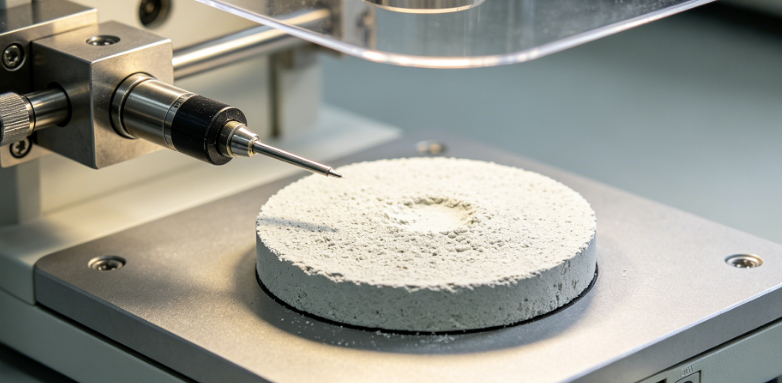
Precise Determination of Active Calcium Oxide (Free CaO) and Total Oxides
The most fundamental quality attribute is the available (free) CaO—the fraction that can actively participate in reactions, as distinct from carbonated CaCO₃ or dead‑burned CaO. We determine free CaO by the sucrose‑EDTA titration method (validated per ASTM C110 and EN 459‑2), which selectively extracts CaO while leaving CaCO₃ and silicates undissolved. This method achieves repeatability of < 0.2% RSD and an expanded uncertainty (k=2) of < 0.4% relative. Simultaneously, we measure total CaO, MgO, SiO₂, Al₂O₃, Fe₂O₃, S, and P₂O₅ by X‑ray fluorescence (XRF) on fused beads, with accuracy ±0.2% for major components and ±0.02% for minor elements. The free CaO value is cross‑validated by Thermogravimetric Analysis (TGA) loss on ignition (LOI) at 500 °C (for organic matter and hydration) and 1000 °C (for carbonate decomposition), providing a complete mass balance. We also determine residual CO₂ by an acid‑evolution volumetric method, which directly quantifies the extent of carbonation—a key indicator of storage or handling degradation. All results are reported with expanded uncertainties (k=2) and are traceable to NIST SRM 143d (quicklime standard).
Standardised Reactivity and Activity Index Determination
The hallmark of high‑activity quicklime is its rapid and exothermic reaction with water, which directly influences its performance in slagging and neutralisation. We perform the industry‑recognised activity test according to ASTM C110 (temperature rise method) and YB/T 4235 (HCl neutralisation method). In the temperature rise test, we record the temperature increase (°C) over 5 minutes during the hydration of a controlled mass of sample in 30 °C water; for top‑grade HAQL, values above 85 °C are expected. In the HCl neutralisation test, we measure the time (in seconds) for a 1‑gram sample to neutralise a 4‑N HCl solution to pH 5.0, with faster neutralisation (e.g., < 90 seconds) indicating higher activity. We also employ a custom‑developed differential scanning calorimetry (DSC) method to quantify the hydraulic reactivity index (HRI)—the heat of hydration (J/g) derived from the exothermic peak under controlled humidity, providing a more reproducible and fundamental measure of reactivity. These activity data are correlated with BET surface area and pore structure to provide a complete picture of the material's driving force for rapid reactions.
Surface Area, Porosity, and Microstructure Analysis
The high reactivity of HAQL is a direct consequence of its high specific surface area, extensive mesoporosity, and low crystallinity. We perform nitrogen physisorption at 77 K over a relative pressure range from 10⁻⁶ to 0.995 to determine the BET surface area (with reproducibility < 1%), micropore volume (t‑plot), and mesopore size distribution (NLDFT and BJH models). For macroporosity (pores > 50 nm) and overall porosity, we use mercury intrusion porosimetry (MIP) up to 60,000 psi, obtaining total intruded volume, bulk density, apparent density, and porosity. We complement these with helium pycnometry for true density. For microstructural characterisation, we use powder X‑ray diffraction (XRD) with Rietveld refinement to determine the CaO crystallite size (Scherrer analysis), lattice microstrain, and the relative amounts of periclase (MgO) and silicates. Smaller crystallite sizes (e.g., < 80 nm) and higher microstrain correlate with faster hydration kinetics. We also provide field‑emission scanning electron microscopy (FE‑SEM) images of fracture surfaces to visually assess grain size and porosity, with energy‑dispersive X‑ray spectroscopy (EDS) for elemental mapping of impurities.
Trace Elemental and Impurity Profiling
Even minor levels of impurities—especially sulfur, phosphorus, and alkali metals—can severely impact steelmaking slag properties and environmental compliance. We quantify major and trace elements (Mg, Al, Si, P, S, K, Na, Fe, Mn, Ti, V, Cr, Ni, Cu, Zn, Pb, As, Cd, Hg) using inductively coupled plasma optical emission spectrometry (ICP‑OES) after acid digestion, and ICP‑tandem mass spectrometry (ICP‑MS/MS) with collision/reaction cell for ultra‑trace levels, achieving detection limits of 0.01–0.5 ppm. For chloride and fluoride, we use ion chromatography (IC) after extraction. The sulfur content is measured by combustion‑infrared detection on a separate aliquot. We also determine free lime (CaO) activity in the presence of impurities using a modified test with controlled CO₂ and humidity to simulate real‑world storage conditions. All impurity results are reported with expanded uncertainties (k=2) and are compared against the stringent limits of YB/T 4235 (high‑grade quicklime), DIN EN 459‑2, and steel industry specific contracts.
Particle Size Distribution and Reactivity‑Related Physical Properties
For injection and handling systems, the particle size distribution (PSD) and dusting tendency of HAQL are critical. We measure PSD from 0.02 µm to 2000 µm by laser diffraction (with dry‑dispersion units) and by wet sieving for coarse fractions, reporting D10, D50, D90, and uniformity coefficient with repeatability < 1% RSD. We also determine bulk density (loose and tapped) and calculate the Hausner ratio for flowability classification. Dust index (fines generation) is assessed by a rotating drum attrition test with sieve analysis of the generated fines. These physical parameters are correlated with the hydration rate to provide a predictive model for process performance.
Hydration Kinetics, Exothermic Behaviour, and Slaking Characteristics
Beyond the standard activity index, we offer detailed hydration kinetics analysis using an automated slaking calorimeter that measures temperature rise over time, heat flow, and the time to 80% hydration (T₈₀) at constant water‑to‑lime ratio. The data are fitted to Avrami‑Erofeev and diffusion‑controlled kinetic models to extract the reaction rate constant and activation energy, providing a fundamental understanding of the reactivity mechanism. We also evaluate the effect of water temperature, stirring speed, and quicklime particle size on the slaking curve, which is essential for designing industrial hydration units and for predicting the performance of hot‑slaking processes.
Accelerated Stability and Carbonation Resistance Testing
High‑activity quicklime is highly susceptible to atmospheric carbonation and hydration, which can significantly reduce its activity during storage and transport. We perform accelerated carbonation tests in a controlled environmental chamber at 40 °C, 60% RH, and 1000 ppm CO₂ for up to 7 days, with periodic re‑analysis of free CaO, LOI, and activity index. The carbonation kinetics are modelled using shrinking‑core and diffusion‑control equations to predict the shelf‑life under typical storage conditions (covered, dry). We also evaluate the effect of packaging (e.g., airtight bags vs. open silos) and provide specific recommendations for minimising activity loss. In addition, we perform re‑carbonation tests to assess the reversibility of the carbonation reaction.
Our Distinctive Competencies and Analytical Superiority
Our service is uniquely distinguished by the orthogonal, fully traceable integration of free CaO assay (sucrose‑EDTA), XRF major oxide quantification, standardised activity index (both temperature‑rise and HCl‑neutralisation), advanced textural characterisation (BET, MIP, XRD microstrain), hydration kinetics calorimetry, and accelerated carbonation stability tests—all performed on the same representative sample to eliminate cross‑batch variability and to enable direct correlations (e.g., BET area vs. activity index, crystallite size vs. slaking rate). We operate under ISO/IEC 17025 accreditation and maintain in‑house reference high‑activity quicklimes that are periodically cross‑checked against NIST SRM 143d and international round‑robin samples. Our proprietary “Quicklime Activity and Performance Index” (QAPI™) combines free CaO purity, reactivity index (temperature rise), BET surface area, and impurity sum into a single score that predicts fluxing efficiency, SO₂ capture capacity, and neutralisation cost‑effectiveness. This index has been validated against >40 commercial HAQL samples from major steel and FGD suppliers.
We achieve exceptional precision: < 0.3% RSD for free CaO, < 0.5% RSD for activity index (temperature rise), < 0.5 m²/g for BET area (at > 5 m²/g), and < 0.02% for sulfur and phosphorus by ICP‑MS. Our turnaround time for the full characterisation suite (including hydration kinetics and carbonation tests) is 10–14 working days, with expedited 6‑day service for urgent batch certification. Crucially, our team of PhD‑level inorganic chemists, ceramic engineers, and steelmaking process specialists provides a comprehensive interpretative report that translates each parameter into actionable guidance—e.g., how to interpret a falling activity index as a sign of incipient carbonation, how to adjust the calcination profile to enhance porosity and reactivity, or how to set maximum limits on MgO and SiO₂ to ensure slag viscosity stability. With over 30 successful projects on high‑activity quicklime and related industrial minerals, we empower our clients to achieve consistent steel quality, reduce reagent consumption in environmental applications, and optimise their lime procurement and handling strategies—all with the highest level of scientific rigour and technical credibility.