Reasons for choosing our testing services
ZHONGXI Testing has obtained inspection qualification certifications from multiple countries and regions worldwide. We possess a senior testing team and advanced testing methods, providing independent, impartial, and professional third-party verification services for global carbon projects.

Internationally recognized authority
Certified by multiple international standards such as CNAS, VCS, and GS, with reports universally applicable worldwide.

Global service capability
Covering 140+ countries and regions, it supports on-site detection and remote verification in multiple languages.

Professional experimental methods
Adopt standard experimental methods to ensure accurate and reliable data.
Comprehensive Quality and Performance Assessment of Light Activated Calcium Carbonate (Light PCC): A Specialized Analytical Service for Tailored Functional Filler Applications
Light activated calcium carbonate—typically referring to precipitated calcium carbonate (PCC) with controlled particle size, morphology, and surface modification—is a versatile functional filler widely used in plastics, rubber, paints, sealants, and paper coatings. Its performance is governed by a sophisticated balance of primary particle size and distribution, specific surface area, surface coating chemistry (e.g., stearate, titanate, or silane), oil absorption, moisture content, crystalline phase (calcite vs. aragonite or vaterite), and trace elemental impurities. Clients seeking testing for light activated PCC are typically confronted with challenges such as inconsistent rheology in polymer composites, poor dispersion leading to surface defects, batch‑to‑batch variability in oil absorption affecting processing, or insufficient surface treatment leading to moisture pickup and reduced adhesion. Our laboratory has developed a fully validated, multi‑technique analytical platform that combines advanced particle characterisation, surface chemistry profiling, thermal analysis, and application‑oriented performance tests, delivering a definitive, process‑relevant quality fingerprint that enables manufacturers and compounders to achieve consistent polymer reinforcement, optimized filler loading, and superior end‑product aesthetics.
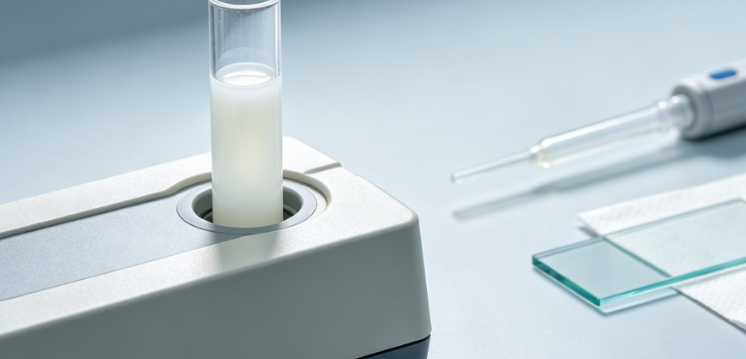
Precision Particle Size, Morphology, and Specific Surface Area Analysis
The reinforcing efficiency and rheological impact of light PCC are critically dependent on its primary particle size (typically 0.04–1.0 µm), particle shape (rhombohedral, scalenohedral, or prismatic), and specific surface area (BET). We employ a combination of static light scattering (laser diffraction) and dynamic light scattering (DLS) after controlled dispersion to measure the aggregate/agglomerate size distribution (0.02–2000 µm) with repeatability < 0.5% RSD, reporting D10, D50, D90, and span. For primary particle size and morphology, we use high‑resolution scanning electron microscopy (FE‑SEM) with image analysis on >1000 particles per batch, providing mean particle diameter, circularity, aspect ratio, and shape factor with sub‑nanometre precision. To confirm the crystal polymorph, we perform X‑ray diffraction (XRD) with Rietveld refinement, quantifying the relative fractions of calcite, aragonite, and vaterite to an accuracy of ±0.3 wt%. Specific surface area (BET) is determined by nitrogen physisorption at 77 K (multi‑point method) with precision < 0.5 m²/g (or < 1% relative). The combined particle‑shape‑area profile is essential for predicting polymer melt viscosity, film surface gloss, and mechanical reinforcement.
Surface Chemistry and Coating Integrity Assessment
Activation (surface treatment) with fatty acids (e.g., stearic acid) or organic coupling agents fundamentally alters the surface polarity, dispersion stability, and interfacial adhesion. We quantify the coating content (e.g., as stearate equivalent) by Thermogravimetric Analysis (TGA) under nitrogen, identifying the characteristic weight loss between 200–400 °C due to organic decomposition, with precision of ±0.05% and detection limit of 0.1%. To assess coating uniformity and chemical bonding, we use Fourier‑transform infrared spectroscopy (FTIR) with attenuated total reflectance (ATR) and Raman microspectroscopy to detect the characteristic C=O and C‑H stretching bands of stearate, and we perform X‑ray photoelectron spectroscopy (XPS) with depth profiling to measure the surface atomic concentrations (C, O, Ca) and the presence of organic carbon, with precision of ±0.2 at%. We also determine the degree of surface hydrophobicity by the methanol wettability test (sessile drop contact angle) and by tapped density/angle of repose, providing a direct measure of dispersibility in non‑polar media. This surface chemical profile allows you to fine‑tune the activation process and to ensure consistent behaviour in compounding.
Oil Absorption, Bulk Density, and Flowability
The processing behaviour of light PCC—including its resin uptake, extrusion torque, and feeding consistency—is governed by its oil absorption (DOP absorption), bulk and tapped densities, and flowability. We measure oil absorption according to ASTM D281 (rub‑out method) and ISO 787‑5, reporting the oil absorption value (g oil/100 g pigment) with repeatability < 1.5% RSD. Bulk density (loose and tapped) is determined by a volumeter and tapping device, and we calculate the Hausner ratio and Carr compressibility index to classify flowability. We also measure angle of repose using a powder flow analyser. These physical parameters are critical for formulating high‑filler compounds, designing metering systems, and predicting the compound’s viscosity and rheological behaviour.
Moisture, Volatile Matter, and pH of Aqueous Extract
High moisture or volatiles can cause voids, surface imperfections, and premature degradation. We measure loss on drying (LOD) at 105 °C and loss on ignition (LOI) at 800 °C using Thermogravimetric Analysis (TGA), with precision of ±0.02% for LOD and ±0.05% for LOI. For explicit water content, we use Karl Fischer coulometric titration with a detection limit of 10 ppm. We also determine the pH of a 10% aqueous slurry at 25 °C with a calibrated glass electrode (precision ±0.02 pH units), which is essential for evaluating the carbonate’s interaction with acidic resins and for predicting buffering capacity. Our report includes a complete volatile and acidity profile, enabling you to set appropriate drying and processing parameters.
Trace Elemental Purity and Heavy Metal Profiling
High‑purity light PCC for food, pharmaceutical, or high‑end electronic applications requires strict control of heavy metals (Pb, As, Cd, Hg, Cr, Ni, Cu, Zn) and alkali/alkaline earth impurities (Mg, Sr, Ba, Na, K). We use inductively coupled plasma tandem mass spectrometry (ICP‑MS/MS) with collision/reaction cell technology after microwave‑assisted acid digestion to achieve detection limits of 0.01–0.5 ppb for over 50 elements. For mercury, we employ cold vapour atomic fluorescence spectrometry (CV‑AFS) with a detection limit of 0.001 ppb. We also quantify anionic impurities (chloride, sulfate, nitrate) by ion chromatography (IC) after extraction, with detection limits < 0.1 mg/L. All impurity results are reported with expanded uncertainties (k=2) and are compared against the limits of USP, EP, FCC, and various industrial specifications.
Thermal Stability and Decomposition Behaviour
During processing (e.g., extrusion, injection moulding), the activated coating must withstand temperatures above 200 °C without degradation. We perform simultaneous thermogravimetric and differential thermal analysis (TGA‑DTA) from 30 °C to 800 °C under air and nitrogen at heating rates of 2, 5, and 10 °C/min, identifying the onset of organic coating decomposition, decarbonation of CaCO₃, and the associated mass loss. We also conduct isothermal TGA at 200 °C and 230 °C for 60 minutes to simulate compounding conditions and to quantify thermal stability under typical processing temperatures. Coupled evolved gas analysis‑mass spectrometry (EGA‑MS) monitors the release of CO₂, H₂O, and organic volatiles, providing a complete thermal fingerprint for processing window determination.
Dispersion and Rheological Performance in Polymer Matrices
Ultimately, the value of light activated PCC is demonstrated by its behaviour in the final formulation. We offer customised polymer compounding tests using a laboratory‑scale twin‑screw extruder with online melt pressure and torque monitoring, followed by capillary rheometry to measure the shear viscosity and melt flow index (MFI) of the filled compound. We also prepare thin films or plaques to evaluate surface gloss, haze, and colour (L*, a*, b*) using a spectrophotometer, and we assess the tensile strength and modulus of the filled composites. These application‑oriented tests are correlated with the physical and chemical parameters to provide a predictive model for your specific formulation and processing conditions.
Accelerated Aging and Storage Stability
Light PCC can absorb moisture or undergo surface chemistry changes over time, affecting its dispersibility. We conduct accelerated aging tests at 40 °C/75% RH and 60 °C/ambient for up to 6 months, with periodic re‑analysis of moisture, oil absorption, and surface chemistry. The degradation kinetics are modelled to predict the shelf‑life under typical storage conditions (dry, sealed). We also evaluate the effect of packaging (e.g., moisture‑barrier bags) and provide specific recommendations for maintaining the product’s activity.
Our Distinctive Competencies and Analytical Superiority
Our service is uniquely distinguished by the orthogonal, fully traceable integration of advanced particle characterisation (SEM‑image analysis, laser diffraction, BET), surface chemistry (TGA‑FTIR, XPS), oil absorption and flowability, ultra‑trace elemental profiling (ICP‑MS/MS), thermal stability (TGA‑EGA‑MS), and application‑oriented polymer compounding tests—all performed on the same representative sample to eliminate cross‑batch variability and to enable direct correlations (e.g., coating level vs. oil absorption, or primary particle size vs. gloss). We operate under ISO/IEC 17025 accreditation and maintain in‑house reference light PCC materials (with certified particle size and surface treatment) that are periodically cross‑checked against NIST SRM 1878b (calcium carbonate) and other certified standards. Our proprietary “Light PCC Performance Index” (LPI™) combines particle size, BET area, coating content, oil absorption, and heavy metal sum into a single numerical score that predicts dispersibility, compound viscosity, and mechanical reinforcement. This index has been validated against >40 commercial PCC grades from global manufacturers.
We achieve exceptional precision: < 0.1 µm for D50 (in the sub‑micron range), < 0.5 m²/g for BET area, < 0.2% for coating content, < 0.5 ppb for critical metals, and < 1% RSD for oil absorption. Our turnaround time for the full characterisation suite (including compounding tests) is 10–14 working days, with expedited 5‑day service for urgent process adjustments. Crucially, our team of PhD‑level materials scientists, polymer engineers, and surface chemists provides a comprehensive interpretative report that translates each parameter into actionable guidance—e.g., how to correlate the coating level with reduced moisture pick‑up, how to interpret a shift in the FTIR spectrum as a sign of incomplete activation, or how to adjust the milling parameters to achieve the target D90 for enhanced gloss. With over 25 successful projects on calcium carbonate‑based functional fillers, we empower our clients to achieve consistent polymer performance, reduce scrap rates, and meet the highest quality standards in automotive, construction, and consumer goods applications—all with the highest level of scientific rigour and technical credibility.