Reasons for choosing our testing services
ZHONGXI Testing has obtained inspection qualification certifications from multiple countries and regions worldwide. We possess a senior testing team and advanced testing methods, providing independent, impartial, and professional third-party verification services for global carbon projects.

Internationally recognized authority
Certified by multiple international standards such as CNAS, VCS, and GS, with reports universally applicable worldwide.

Global service capability
Covering 140+ countries and regions, it supports on-site detection and remote verification in multiple languages.

Professional experimental methods
Adopt standard experimental methods to ensure accurate and reliable data.
Comprehensive Performance and Microstructural Characterization of Phenolic Resin‑Based Carbon Foams: A Specialized Analytical Service for Advanced Thermal Management and Structural Applications
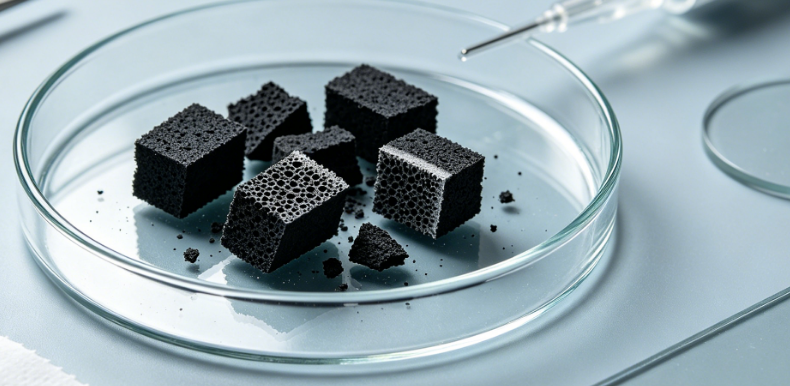
Phenolic resin‑based carbon foams are lightweight, porous carbon materials with exceptional thermal insulation, electrical conductivity, and mechanical resilience, making them indispensable for aerospace thermal protection, energy storage electrodes, and high‑temperature filtration. However, their functional performance is critically dependent on a complex interplay of porosity architecture, pore size distribution, carbon crystallinity, mechanical strength, thermal conductivity, and surface chemistry. Clients seeking testing for these materials typically face challenges in achieving consistent foam morphology, optimizing carbonization/graphitization conditions, or correlating microstructural parameters with end‑use performance. Our laboratory has developed a fully integrated, multi‑scale analytical platform that combines advanced microscopy, porosimetry, thermal and mechanical testing, and spectroscopic characterisation, delivering a quantitative, process‑relevant fingerprint that enables manufacturers and researchers to fine‑tune synthesis parameters, ensure batch‑to‑batch reproducibility, and qualify materials for the most demanding applications.
Precision Porosity and Pore Architecture Analysis
The thermal and mechanical behaviour of carbon foam is governed by its total porosity, open/closed cell ratio, and pore size distribution. We employ a combination of helium pycnometry for skeletal density, mercury intrusion porosimetry (MIP) up to 60,000 psi for macro‑ and mesopore characterisation (pore diameter from 3 nm to 500 µm), and nitrogen physisorption at 77 K with NLDFT models for micropore and mesopore analysis (0.4–50 nm). This multi‑method approach yields absolute porosity, bulk density, and a complete pore‑size profile with reproducibility of < 1% for total porosity. For visual validation and 3D pore connectivity, we use X‑ray micro‑computed tomography (µ‑CT) with voxel resolution down to 0.5 µm, enabling quantitative tortuosity, strut thickness, and closed‑cell fraction—critical parameters for predicting permeability and thermal insulation efficiency.
Mechanical Strength and Anisotropic Behaviour Assessment
Carbon foams often exhibit anisotropic mechanical properties due to the directional nature of foam formation and carbonisation shrinkage. We perform uniaxial compression and flexural tests in three orthogonal directions using a servo‑hydraulic testing machine with environmental chamber (from –50 °C to 1000 °C), measuring compressive strength, modulus, strain‑to‑failure, and fracture toughness with a precision of ±0.5% of full scale. For high‑temperature applications, we conduct thermal cycling tests (up to 100 cycles between 25 °C and 800 °C) to assess structural fatigue and residual strength. We also evaluate creep behaviour under constant load at elevated temperatures, providing steady‑state creep rate and time‑to‑rupture data. Our mechanical reports include Weibull statistical analysis on a minimum of 10 specimens per orientation, giving you characteristic strength and Weibull modulus for reliable design.
Thermal Conductivity and Thermal Stability Evaluation
The thermal performance of carbon foam is defined by its effective thermal conductivity (λeff) and its oxidative resistance. We measure thermal conductivity by the laser flash method (LFA) from 25 °C to 1200 °C in both in‑plane and through‑plane directions, with accuracy of ±3% and repeatability of < 2%. For insulation applications, we also use a heat‑flow meter apparatus for bulk measurements. Thermal stability is assessed by simultaneous Thermogravimetric Analysis and differential scanning calorimetry (TGA‑DSC) under air and inert atmospheres up to 1500 °C, determining oxidation onset temperature, maximum oxidation rate, and residual mass. Coupled evolved gas analysis‑mass spectrometry (EGA‑MS) identifies CO₂, CO, and volatile species, revealing the degradation mechanism. We provide a thermal stability index that predicts the foam’s maximum service temperature in air and in inert environments.
Microstructural and Crystallographic Characterisation
The performance of carbon foam is strongly influenced by the degree of graphitisation, crystallite size, and defect density. We employ Raman microspectroscopy (with 532 nm and 785 nm lasers) to measure the D/G band intensity ratio (ID/IG) and the G′ (2D) band, providing quantitative in‑plane crystallite size (La) and defect density. For bulk crystallinity, we use X‑ray diffraction (XRD) with Cu Kα radiation and Rietveld refinement to determine the interlayer spacing (d002), crystallite size (Lc), and the graphitisation degree (G%) according to the Maire‑Mering method. For surface chemistry and functional groups, we perform X‑ray photoelectron spectroscopy (XPS) with depth profiling to quantify C‑C, C‑O, C=O, and O‑C=O species, and we map these species across the foam struts using time‑of‑flight secondary ion mass spectrometry (ToF‑SIMS). This detailed structural and chemical profile allows you to correlate carbonisation temperature and atmosphere with graphitic order and surface reactivity.
Elemental Purity and Trace Metal Profiling
Trace metals (Fe, Ni, Co, Al, Si, Ca, etc.) can catalyse oxidation or affect electrical conductivity. We digest the foam in microwave‑assisted acid and analyse by inductively coupled plasma tandem mass spectrometry (ICP‑MS/MS) with collision/reaction cell, achieving detection limits of 0.01–0.5 ppb for over 50 elements. We also determine ash content by combustion at 800 °C with precision of ±0.01%. Our impurity profile is reported against semiconductor‑grade or aerospace‑grade specifications, ensuring your foam meets the most rigorous purity requirements.
Electrical Conductivity and Electromagnetic Interference (EMI) Shielding
For electrode and EMI shielding applications, the electrical conductivity of carbon foam is a key parameter. We measure volume resistivity using a four‑point probe method on samples of controlled geometry, over a conductivity range from 10⁻⁶ to 10⁵ S/cm, with accuracy of ±1%. We also evaluate electromagnetic interference shielding effectiveness (SE) in the frequency range of 30 MHz to 18 GHz according to ASTM D4935, providing reflection, absorption, and total SE values. These data are crucial for tuning the foam’s conductivity through carbonisation conditions or doping.
Accelerated Ageing and Environmental Durability
Carbon foams intended for long‑term service must resist moisture uptake, oxidation, and thermal cycling. We conduct accelerated ageing tests under temperature/humidity cycling (‑40 °C to +80 °C, 10–95% RH), salt spray (ASTM B117), and UV exposure (QUV) for up to 1000 hours, followed by re‑characterisation of mechanical properties, thermal conductivity, and pore structure. We also perform leaching tests in deionised water and acidic solutions (pH 3, 5) to assess ion release (by ICP‑MS) and any degradation of the carbon struts. Our durability report includes lifetime predictions based on Arrhenius modelling, enabling you to guarantee product reliability in harsh environments.
Our Distinctive Competencies and Analytical Advantages
Our service is uniquely distinguished by the orthogonal integration of µ‑CT for 3D porosity, LFA for anisotropic thermal conductivity, Raman/XRD for crystallinity, XPS/ToF‑SIMS for surface chemistry, and high‑temperature mechanical testing—all performed on the same sample set to eliminate cross‑specimen variability. We operate under ISO/IEC 17025 accreditation and maintain in‑house reference carbon foams with certified properties that are periodically cross‑calibrated with international standards (e.g., NIST, BAM). Our proprietary “Carbon Foam Performance Index” (CFPI™) combines porosity, compressive strength, thermal conductivity, graphitisation degree, and impurity level into a single numerical score that predicts overall serviceability. This index has been validated against >30 commercial and R&D carbon foams.
We achieve exceptional precision: < 0.5% for density, < 1% for porosity, < 0.5 MPa for compressive strength, < 0.05 W/m·K for thermal conductivity, and < 0.01 for ID/IG ratio. Our turnaround time for the full characterisation suite (including ageing tests) is 12–18 working days, with expedited 7‑day service for urgent process troubleshooting. Crucially, our team of PhD‑level materials scientists, mechanical engineers, and carbon specialists provides a comprehensive interpretative report that translates each parameter into actionable insights—e.g., how to adjust the foaming temperature to achieve a uniform pore structure, how to optimise the carbonisation ramp to maximise graphitisation without degrading mechanical strength, or how to identify the critical impurity that reduces oxidation resistance. With over 20 successful projects on phenolic‑based carbon foams, we empower our clients to achieve consistent product quality, accelerate material development, and confidently enter high‑value markets such as aerospace, energy storage, and thermal management—all with the highest level of scientific rigour and technical credibility.