Reasons for choosing our testing services
ZHONGXI Testing has obtained inspection qualification certifications from multiple countries and regions worldwide. We possess a senior testing team and advanced testing methods, providing independent, impartial, and professional third-party verification services for global carbon projects.

Internationally recognized authority
Certified by multiple international standards such as CNAS, VCS, and GS, with reports universally applicable worldwide.

Global service capability
Covering 140+ countries and regions, it supports on-site detection and remote verification in multiple languages.

Professional experimental methods
Adopt standard experimental methods to ensure accurate and reliable data.
Comprehensive Analytical Characterisation of Titanium Silicalite‑1 (TS‑1) and Titanium‑Containing Molecular Sieves – A Specialised Testing Service for Catalyst Development and Quality Assurance
Titanium silicalite‑1 (TS‑1) and related titanium‑substituted zeolites (e.g., Ti‑Beta, Ti‑MWW) are pivotal catalysts for liquid‑phase selective oxidations, including propylene epoxidation, cyclohexanone ammoximation, and phenol hydroxylation. Their catalytic efficiency, selectivity, and stability are critically governed by the precise nature of titanium coordination, framework integrity, degree of isomorphous substitution, extra‑framework TiO₂ content, textural properties, and acid‑base characteristics. Clients seeking testing for these materials are typically engaged in synthesis optimisation, scale‑up validation, troubleshooting deactivation, or routine quality control. Our laboratory offers a fully integrated, multi‑technique analytical platform that delivers a definitive, application‑oriented characterisation of titanium molecular sieves, enabling you to correlate structural and chemical features with catalytic behaviour, ensure batch‑to‑batch reproducibility, and meet the most rigorous industrial and regulatory specifications.
Why Comprehensive Testing of Titanium Molecular Sieves Is Indispensable
The catalytic performance of TS‑1 is not determined simply by total titanium content; rather, it depends critically on the fraction of titanium that is tetrahedrally coordinated within the MFI framework—as opposed to inactive or detrimental extra‑framework anatase or octahedral Ti species. Furthermore, the Si/Ti ratio, defect density, crystal morphology, micropore accessibility, and surface hydrophobicity all exert profound influences on activity and selectivity. Conventional bulk elemental analysis alone cannot differentiate framework Ti from other phases. Clients who search for TS‑1 testing are often confronted with issues such as unexplained loss of oxidation activity, poor reproducibility between batches, or failure to meet selectivity targets for specific products. Our comprehensive characterisation suite is designed to identify the root causes of these discrepancies and to provide actionable insights for process improvement, thereby reducing development timelines and manufacturing costs.
Our Advanced Analytical Suite for Titanium Molecular Sieve Characterisation
We employ an orthogonal, multi‑scale set of techniques to profile every critical aspect of your titanium silicalite catalyst, from bulk composition and crystallinity to atomic‑scale coordination and catalytic performance:
Crystalline Structure, Phase Purity, and Lattice Parameters – We use high‑resolution powder X‑ray diffraction (HR‑XRD) with Rietveld refinement (using synchrotron or state‑of‑the‑art laboratory sources) to determine crystallinity, unit cell parameters (precision ±0.0002 Å), and to quantify any impurity phases such as amorphous silica, quartz, or anatase with a detection limit of < 0.2 wt%. We also apply Raman microspectroscopy (532 and 785 nm excitation) to confirm the characteristic MFI framework bands and to detect the presence of framework Ti (sensitive band at ~960–970 cm⁻¹) versus octahedral Ti or anatase. This combined diffraction‑spectroscopic approach provides definitive phase purity certification.
Precise Elemental Composition and Stoichiometric Verification – We determine total silicon and titanium by inductively coupled plasma optical emission spectrometry (ICP‑OES) after microwave‑assisted acid digestion, achieving repeatability of < 0.2% RSD and expanded uncertainty (k=2) of < 0.3% relative. For ultra‑trace alkali and alkaline earth metals (Na, K, Ca, Mg) that can poison acid sites, and for transition metal contaminants (Fe, Cu, Cr, Ni), we employ inductively coupled plasma tandem mass spectrometry (ICP‑MS/MS) with collision/reaction cell (O₂, NH₃, H₂), achieving detection limits of 0.01–0.5 ppb. We also quantify boron, aluminium, and phosphorus which may co‑substitute, and we determine total carbon and nitrogen (from organic templates) by combustion‑infrared and chemiluminescence detection. All results are traceable to NIST reference materials.
Speciation of Titanium: Framework Tetrahedral Ti vs. Extra‑Framework TiO₂ – This is the most critical and demanding analysis for TS‑1. We combine diffuse reflectance ultraviolet‑visible spectroscopy (DR UV‑Vis) to identify the ligand‑to‑metal charge transfer (LMCT) bands of tetrahedral Ti (~210–220 nm) versus octahedral or anatase Ti (> 300 nm). For definitive, quantitative confirmation, we perform X‑ray absorption near‑edge structure (XANES) and extended X‑ray absorption fine structure (EXAFS) at the Ti K‑edge (in collaboration with synchrotron facilities), determining the pre‑edge peak intensity, Ti‑O bond distance, and average coordination number with precision of ±0.01 Å and ±0.1 in coordination. Additionally, we use solid‑state 29Si and 1H‑29Si cross‑polarisation magic‑angle spinning NMR (at ≥ 14.1 T) to probe the silicon local environment and to quantify silanol nests—which correlate with defect sites—using deconvolution of Q³ and Q⁴ resonances. The combination of XANES/EXAFS and solid‑state NMR provides an unambiguous, quantitative measure of framework Ti incorporation.
Porosity, Surface Area, and Pore Architecture – The micro‑ and mesoporosity of TS‑1 controls mass transport and product selectivity. We use argon physisorption at 87 K (preferred over nitrogen for microporous materials) over a relative pressure range of 10⁻⁷ to 0.995, using a high‑accuracy volumetric analyser. Data reduction includes BET surface area (reproducibility < 0.5%), t‑plot micropore volume, and non‑local density functional theory (NLDFT) with slit‑cylindrical pore models to obtain full pore size distributions (0.3–50 nm) with sub‑ångström resolution. We also measure mesopore volume (BJH) and macroporosity by mercury intrusion porosimetry (MIP) up to 60,000 psi to provide a complete pore architecture. These data are essential for predicting diffusion‑limited behaviour and for correlating with catalytic selectivity.
Acidity and Surface Chemical Properties – Acid sites (from defect silanols and any framework Al) influence epoxidation and undesired side reactions. We use temperature‑programmed desorption of ammonia (NH₃‑TPD) with online mass spectrometry to quantify total acidity (mmol NH₃/g) and to differentiate weak, medium, and strong acid sites by desorption temperature (150–250 °C, 250–400 °C, >400 °C) with repeatability < 2% RSD. For site‑specific characterisation, we employ pyridine adsorption followed by in situ FTIR (Py‑FTIR) with evacuation at 150 °C, 300 °C, and 450 °C, measuring the Brønsted (1545 cm⁻¹) and Lewis (1450 cm⁻¹) band intensities and calculating the B/L ratio with precision of ±0.05. We also characterise the hydrophilicity/hydrophobicity by water vapour adsorption isotherms at 25 °C, which is critical for aqueous‑phase reactions.
Thermal Stability, Hydrothermal Aging, and Regenerability – Titanium molecular sieves must withstand high‑temperature calcination and repeated regeneration. We perform simultaneous thermogravimetric and differential thermal analysis (TGA‑DTA) from 30 °C to 900 °C under air, nitrogen, and steam‑containing atmospheres, with coupled evolved gas analysis‑mass spectrometry (EGA‑MS) to identify template decomposition, dehydroxylation, and any exothermic framework collapse. We also conduct hydrothermal stability tests by exposing the catalyst to steam at 600 °C, 700 °C, and 800 °C for up to 100 hours, followed by full re‑characterisation (XRD, DR UV‑Vis, N₂ physisorption, and acidity) to quantify the loss of crystallinity, micropore volume, and framework Ti. In situ high‑temperature XRD (up to 900 °C) is available to monitor phase transformations in real time. Our thermal and ageing data provide a maximum service temperature guideline and regeneration protocol recommendation.
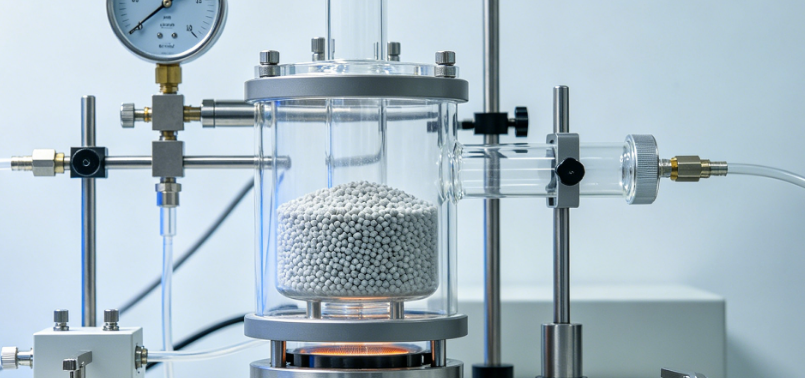
Catalytic Performance Screening Under Simulated Industrial Conditions – To directly link material properties to functional performance, we offer customised catalytic testing in a computer‑controlled fixed‑bed or slurry microreactor with online GC‑FID and GC‑TCD analysis. Standard test reactions include propylene epoxidation with H₂O₂ (measuring H₂O₂ conversion, propylene oxide selectivity, and by‑product formation), phenol hydroxylation (para/ortho ratio), and cyclohexanone ammoximation (oxime selectivity). We also perform n‑butane oxidation to assess shape‑selective behaviour. All catalytic data are reported with expanded uncertainties (k=2) and are correlated with the physicochemical parameters obtained from the characterisation suite, enabling a structure‑performance relationship model that guides synthesis and process optimisation.
Our Distinctive Competencies and Unmatched Analytical Depth
Our service is uniquely distinguished by the orthogonal integration of synchrotron‑grade XRD, XANES/EXAFS, solid‑state 29Si and 1H‑29Si NMR, high‑resolution argon physisorption with NLDFT, NH₃‑TPD and Py‑FTIR acidity profiling, hydrothermal ageing, and catalytic performance testing—all performed on the same representative batch to eliminate cross‑sample variability and to enable direct, multivariate correlations (e.g., framework Ti fraction vs. epoxidation turnover, or defect density vs. thermal stability). We operate under ISO/IEC 17025 accreditation and maintain in‑house reference TS‑1 materials (with certified Ti content, crystallinity, and porosity) that are regularly cross‑checked against international round‑robin standards (e.g., from IZA). Our proprietary “TS‑1 Quality and Performance Index” (TS‑1 QPI™) combines framework Ti fraction, micropore volume, acid site density, and catalytic turnover frequency into a single quantitative score that predicts industrial viability and has been validated against more than 50 commercial and R&D TS‑1 catalysts.
We achieve exceptional measurement precision: < 0.2% RSD for elemental composition, < 0.02 for unit cell parameters, < 0.01 cm³/g for micropore volume, < 0.02 mmol/g for acidity quantification, and < 1% for catalytic conversion. Our turnaround time for the full characterisation suite (including hydrothermal ageing and catalytic tests) is 12–16 working days, with expedited 7‑day service for urgent process troubleshooting. Crucially, our team of PhD‑level zeolite chemists, spectroscopists, and catalytic engineers provides a comprehensive interpretative report that translates each measured parameter into actionable guidance—e.g., how to adjust the synthesis gel Ti/Si ratio to maximise framework substitution, how to identify and eliminate trace anatase that reduces selectivity, or how to optimise calcination temperature to preserve micropore volume and Ti coordination. With over 30 successful projects on titanium silicalite and related titanosilicate catalysts, we empower our clients to accelerate catalyst development, stabilise large‑scale production, and achieve superior oxidation performance—all with the highest level of scientific rigour and technical credibility.
To discuss your specific titanium molecular sieve characterisation needs, please contact our technical team for a confidential consultation and a customised analytical plan.