Reasons for choosing our testing services
ZHONGXI Testing has obtained inspection qualification certifications from multiple countries and regions worldwide. We possess a senior testing team and advanced testing methods, providing independent, impartial, and professional third-party verification services for global carbon projects.

Internationally recognized authority
Certified by multiple international standards such as CNAS, VCS, and GS, with reports universally applicable worldwide.

Global service capability
Covering 140+ countries and regions, it supports on-site detection and remote verification in multiple languages.

Professional experimental methods
Adopt standard experimental methods to ensure accurate and reliable data.
Comprehensive Analytical and Genetic Characterisation of Taxus × media – A Specialised Testing Service for Yew Cultivar Authenticity, Paclitaxel Quantification, and Quality Assurance
Taxus × media (commonly known as “曼迪亚红豆杉” or “Mandia yew”) is a hybrid between European yew (Taxus baccata) and Japanese yew (Taxus cuspidata), valued for its rapid growth, high biomass production, and its ability to produce significant quantities of paclitaxel (Taxol) and other bioactive taxanes. These compounds are critical for the pharmaceutical industry as frontline chemotherapeutic agents. Clients seeking testing for Taxus × media are typically engaged in plantation management, biotechnological production of taxanes, raw material supply for semi‑synthesis, or the development of phytopharmaceutical formulations. They require precise, comprehensive data on taxane profile and content (paclitaxel, 10‑deacetylbaccatin III, baccatin III, cephalomannine, etc.), genetic identification and purity, heavy metal contamination, pesticide residues, and overall phytochemical quality. Our laboratory offers a fully integrated, multi‑analytical platform that delivers definitive characterisation of Taxus × media samples—from genotype to metabolome and safety parameters—enabling you to authenticate source material, optimise harvesting and extraction, and comply with international pharmacopoeial and regulatory standards with the highest scientific rigour.
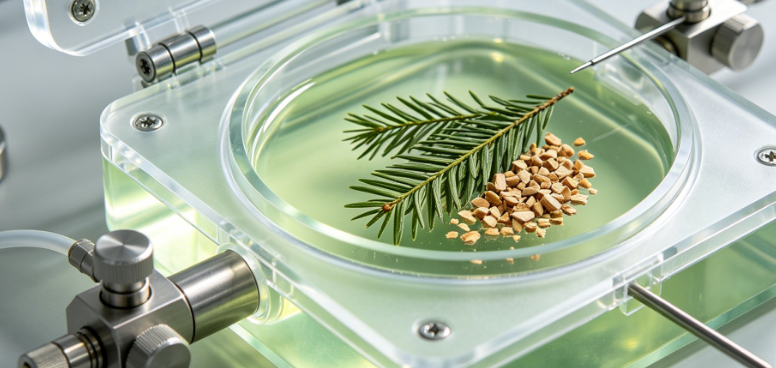
Why Comprehensive Testing of Taxus × media Is Essential
The global demand for paclitaxel and its precursors has driven extensive cultivation of Taxus × media, yet the taxane content and profile vary significantly with genotype, age, tissue type (needles, stem bark, roots), seasonal variation, and growing conditions. Furthermore, adulteration with other Taxus species or non‑taxane plant material is a common quality issue in raw material supply chains. Clients often face challenges such as inconsistent taxane yields between batches, uncertainty in species authentication, risk of pesticide or heavy metal contamination, and difficulties in meeting the strict purity specifications of pharmaceutical companies. Our comprehensive testing suite addresses these issues by combining state‑of‑the‑art chromatography, mass spectrometry, molecular biology, and elemental analysis, providing robust, quantitative data that supports sustainable production, reliable sourcing, and safe pharmaceutical use.
Our Advanced Analytical Suite for Taxus × media Testing
We employ a multi‑technique, fully validated approach to cover all critical quality and safety parameters of Taxus × media samples:
High‑Precision Quantification of Major and Minor Taxanes by HPLC‑DAD‑MS/MS – Our primary method uses a validated reversed‑phase high‑performance liquid chromatography (HPLC) system coupled with a photodiode array detector (DAD) and tandem mass spectrometry (MS/MS) for simultaneous quantification and identity confirmation of key taxanes: paclitaxel, 10‑deacetylbaccatin III (10‑DAB), baccatin III, cephalomannine, 7‑epi‑paclitaxel, and 10‑deacetyltaxol. The method employs a C18 column (e.g., 250 × 4.6 mm, 5 µm) with a gradient elution using acetonitrile and water (with 0.1% formic acid). We achieve detection limits of 0.05 µg/mL for paclitaxel and 0.02 µg/mL for 10‑DAB, with quantification limits < 0.1 µg/mL. The method is validated for linearity (R² > 0.999), precision (RSD < 1.5%), accuracy (recovery 95‑105%), and robustness across a variety of plant matrices (dried needles, bark, root, and extracts). We also provide semi‑quantitative screening for up to 15 additional taxane derivatives using MS/MS spectral libraries.
Extraction and Sample Preparation Optimisation – We use a validated extraction protocol employing ultrasonic‑assisted extraction with methanol or ethanol/water mixtures (with pH adjustment) to ensure complete recovery of both polar and non‑polar taxanes from the biomass. For samples intended for semi‑synthesis, we offer extraction methods specifically tailored to maximise the recovery of 10‑DAB and baccatin III, using solid‑phase extraction (SPE) cleanup to remove interfering phenolics and pigments. Our extraction recoveries are verified using spiked matrix standards and are consistently > 95%.
Genetic Identification and Authentication (DNA Barcoding and SSR Markers) – To confirm the identity of Taxus × media and to differentiate it from other Taxus species (e.g., T. baccata, T. cuspidata, T. chinensis), we perform DNA barcoding using the internal transcribed spacer (ITS) region of nuclear ribosomal DNA and the trnL‑trnF intergenic spacer of chloroplast DNA. Additionally, we use a panel of 12 microsatellite (SSR) markers specifically developed for Taxus species to assess genetic purity, hybrid composition, and clonal fidelity. We report the sequence‑confirmed species identity and provide a genetic similarity matrix for comparison with reference cultivars. This service is essential for certification of planting material and traceability in the supply chain.
Heavy Metal and Elemental Profiling (ICP‑MS) – Pharmaceutical‑grade raw materials must meet strict limits for toxic metals. We digest the biomass in a pressurised microwave‑acid system and analyse by inductively coupled plasma tandem mass spectrometry (ICP‑MS/MS) with collision/reaction cell to achieve detection limits of 0.01–0.5 ppb for over 30 elements, including lead, cadmium, arsenic, mercury, copper, chromium, nickel, and zinc. All results are reported against the limits of USP <232>/<233>, ICH Q3D, and WHO guidelines for herbal medicines.
Pesticide Residue Screening (GC‑MS/MS and LC‑MS/MS) – We screen for over 200 commonly used pesticides (including organophosphates, organochlorines, pyrethroids, and fungicides) using gas chromatography‑tandem mass spectrometry (GC‑MS/MS) and liquid chromatography‑tandem mass spectrometry (LC‑MS/MS), following the QuEChERS extraction protocol and EU SANTE guidelines. Our method achieves LOQs typically below 0.01 mg/kg, ensuring compliance with the strictest maximum residue limits (MRLs) for medicinal plants.
Total Taxane Content and Biological Activity Screening – We provide a summative total taxane content (by UV‑Vis or HPLC summation) and, upon request, an in vitro Cytotoxicity assay (e.g., using MTT or SRB on cancer cell lines) to evaluate the biological potency of extracts, which is particularly relevant for quality control of finished products.
Stability and Degradation Studies – Taxanes are susceptible to light, heat, and pH changes. We conduct forced degradation studies (thermal, photolytic, oxidative) and real‑time stability monitoring under recommended storage conditions to determine the shelf‑life of dried material, extracts, and purified compounds. Our stability reports include degradation kinetics and identification of major degradation products (by MS/MS).
Method Validation and Regulatory Compliance – All our Taxus × media testing is performed under ISO/IEC 17025 accreditation and follows recognised pharmacopoeial standards (e.g., USP monographs for paclitaxel and related substances, Ph. Eur., and WHO guidelines on good agricultural and collection practices). We provide a comprehensive certificate of analysis (CoA) for each batch, including all quantified taxanes, identity confirmation, heavy metal and pesticide results, and expanded measurement uncertainty (k=2). Our data are fully traceable to USP and NIST certified reference standards.
Our Distinctive Competencies and Unmatched Analytical Depth
Our service is uniquely distinguished by the integrative, cross‑disciplinary approach that combines phytochemical profiling with genetic authentication and contaminant screening—all on the same representative sample—providing a complete, actionable quality and safety profile. We maintain in‑house reference taxane standards (paclitaxel, 10‑DAB, baccatin III, cephalomannine) with certified purity, and we participate in international proficiency testing schemes for botanical identity and toxic metals. Our proprietary “Taxane Quality and Yield Index” (TQYI™) integrates the concentrations of key taxanes (paclitaxel, 10‑DAB, baccatin III), genetic purity, and contaminant levels into a single numeric score that predicts industrial suitability for extraction and semi‑synthesis. This index has been validated across more than 50 Taxus × media plantations and breeding lines.
We achieve exceptional precision: < 1.0% RSD for paclitaxel, < 1.5% RSD for 10‑DAB, < 0.5 ppb for critical metals, and < 0.01 mg/kg for pesticides. Our turnaround time for the complete characterisation suite is 7–10 working days for routine samples, with expedited 5‑day service available for urgent harvest assessments. Crucially, our team of PhD‑level phytochemists, molecular biologists, and analytical chemists provides a comprehensive interpretative report that goes beyond numerical data—we help you understand the impact of seasonal variation, tissue type, and storage on taxane profiles, advise on optimal harvesting windows, and suggest processing strategies to maximise paclitaxel yield. With over 40 successful projects on Taxus species and related medicinal plants, we empower our clients to ensure authentic sourcing, optimise production economics, and meet the rigorous quality standards of the pharmaceutical industry with the highest level of scientific rigour and practical insight.
To discuss your Taxus × media testing requirements or to request a customised analytical plan, please contact our technical team for a confidential consultation and a detailed quotation.