Reasons for choosing our testing services
ZHONGXI Testing has obtained inspection qualification certifications from multiple countries and regions worldwide. We possess a senior testing team and advanced testing methods, providing independent, impartial, and professional third-party verification services for global carbon projects.

Internationally recognized authority
Certified by multiple international standards such as CNAS, VCS, and GS, with reports universally applicable worldwide.

Global service capability
Covering 140+ countries and regions, it supports on-site detection and remote verification in multiple languages.

Professional experimental methods
Adopt standard experimental methods to ensure accurate and reliable data.
Comprehensive Performance and Durability Assessment of Heat Storage Balls for Sulfuric Acid Converters – A Specialised Testing Service for Catalyst Bed Support and Thermal Energy Storage
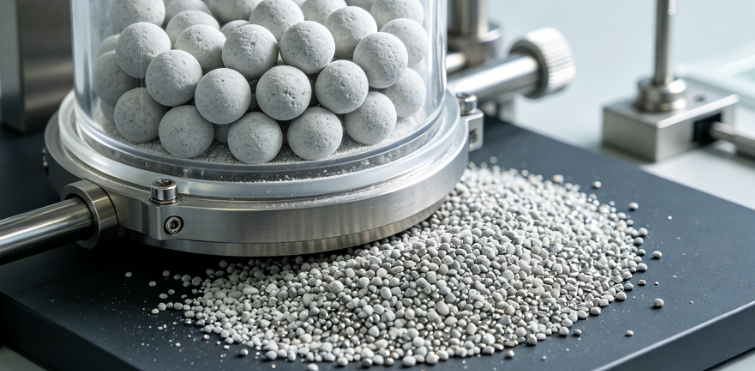
Heat storage balls (also known as converter support balls or ceramic packing balls) play a critical role in sulfuric acid production plants, where they are used in multistage catalytic converters to support catalyst layers, distribute gas flow, and store/regulate thermal energy during exothermic SO₂ oxidation. Their performance directly influences conversion efficiency, pressure drop, and overall plant reliability. However, continuous exposure to high temperatures (up to 600–650 °C), thermal cycling, acid gases, and mechanical loads can lead to degradation, spalling, cracking, or chemical attack, which may cause catalyst bed collapse, uneven gas distribution, and unplanned shutdowns. Clients seeking testing for heat storage balls are typically sulfuric acid plant operators, engineering procurement contractors, or maintenance service providers who require validated, application‑relevant characterisation to qualify new batches, monitor in‑service degradation, and schedule predictive maintenance. Our laboratory provides a fully integrated, multi‑parameter analytical platform that covers chemical composition, phase stability, thermal shock resistance, mechanical strength, and acid corrosion behaviour, delivering a quantitative, risk‑based quality profile that enables you to ensure long‑term converter integrity, optimise replacement intervals, and comply with international standards (e.g., GB/T 3995, ASTM C530, and ISO 28703) with the highest scientific rigour.
Why Comprehensive Testing of Converter Heat Storage Balls Is Essential
Heat storage balls are typically manufactured from high‑alumina ceramics, mullite, or silicon carbide, and their service life depends on a delicate balance of composition, porosity, grain structure, and thermal expansion behaviour. In a sulfuric acid converter, the balls are subjected to repeated thermal cycling from ambient to operating temperature, mechanical stress from catalyst weight and gas pressure, and chemical attack from SO₃, H₂SO₄ mist, and vanadium‑based catalyst dust. Failure mechanisms include thermal fatigue cracking, alkali‑silica reaction, acid erosion, and abrasive wear. Clients often face challenges such as unexplained pressure drop increase, premature ball breakage during loading, or non‑compliance with vendor specifications. Our comprehensive testing suite is designed to identify all critical degradation pathways and to provide actionable data for material selection, quality assurance, and failure analysis, thereby reducing unplanned outages and extending converter campaign life.
Our Advanced Analytical Suite for Heat Storage Ball Characterisation
We employ a multi‑parameter, fully validated approach to characterise all key performance attributes of heat storage balls, from raw material composition to in‑service simulation:
Precise Chemical Composition and Phase Analysis (XRF, XRD, ICP‑MS) – The bulk chemical composition (Al₂O₃, SiO₂, Fe₂O₃, TiO₂, CaO, MgO, Na₂O, K₂O) is determined by X‑ray fluorescence (XRF) on fused beads with accuracy of ±0.2% for major components and ±0.02% for minor elements. For trace impurities that may catalyse corrosion, we use inductively coupled plasma mass spectrometry (ICP‑MS) after acid digestion, achieving detection limits of 0.01–0.5 ppm. The crystalline phases (e.g., α‑Al₂O₃, mullite, cristobalite) are identified and quantified by powder X‑ray diffraction (XRD) with Rietveld refinement, with detection limits of < 0.5 wt%. This phase composition is essential for predicting thermal expansion behaviour and chemical resistance.
Apparent Porosity, Water Absorption, and Bulk Density – These physical properties directly influence thermal shock resistance, gas permeability, and mechanical strength. We measure apparent porosity (%), water absorption (%), and bulk density (g/cm³) by the boiling water or vacuum‑immersion method per ASTM C20, with repeatability of < 0.2% for porosity and < 0.01 g/cm³ for density. We also determine true density by helium pycnometry to assess the extent of closed porosity, which affects thermal conductivity and weight.
compressive strength and Crush Resistance (Single‑Ball and Bulk) – The mechanical integrity of heat storage balls is critical to withstand catalyst bed weight and thermal stress. We perform single‑ball crushing strength using a universal testing machine with a precision load cell (±0.1 kN) on at least 20 randomly selected balls, reporting mean crushing load (kN) and Weibull modulus (which characterises strength reliability). For bulk packing stability, we conduct bulk crush strength tests under progressive load, measuring fines generation (%) and deformation behaviour according to ISO 18591. Our tests are performed at room temperature and at 600 °C (with a temperature‑controlled environmental chamber) to simulate service conditions.
Thermal Shock and Thermal Cycling Resistance – Rapid temperature changes are a primary cause of spalling. We perform thermal shock resistance tests by subjecting balls to 10 cycles of heating to 650 °C (followed by forced air or water quenching) per ASTM C1171 or internal protocols. We quantify the retained compressive strength and visual assessment for cracks after cycling. We also use Thermogravimetric Analysis (TGA) and dilatometry to measure the coefficient of thermal expansion (CTE) up to 1000 °C and to detect any phase transitions that may cause dimensional instability. Our thermal shock data are correlated with porosity and phase composition to predict service life.
Acid Corrosion and Chemical Resistance (Simulated Converter Environment) – Sulfuric acid and SO₃ gases can attack the ceramic matrix, particularly in the presence of moisture. We conduct acid immersion tests using concentrated H₂SO₄ (93‑98%) and dilute H₂SO₄ (10%) at 80 °C and boiling conditions for up to 48 hours. We measure weight loss (%), residual strength, and surface morphology changes (by SEM‑EDS) to assess acid resistance. We also perform acid‑alkali alternating tests to simulate upset conditions. Our corrosion data are benchmarked against >50 commercial heat storage ball products to provide a relative performance ranking.
Size, Shape, and Dimensional Uniformity – Ball diameter tolerance and sphericity affect packing uniformity and gas flow distribution. We measure diameter (mean and range) using digital callipers (accuracy ±0.01 mm) and sphericity by image analysis on a representative sample (≥ 30 balls). We report D10, D50, D90 diameters and the sphericity index (ratio of minimum to maximum Feret diameter). Non‑uniform balls can lead to channeling and increased pressure drop.
Microstructural Characterisation (SEM‑EDS, Mercury Porosimetry) – For failure analysis and advanced quality control, we use scanning electron microscopy (SEM) with energy‑dispersive X‑ray spectroscopy (EDS) to examine grain structure, grain boundaries, and any corrosion products or micro‑cracks. Mercury intrusion porosimetry (MIP) provides pore size distribution (0.005–360 µm) and specific surface area (BET), which are correlated with acid penetration rates and thermal shock resistance.
In‑Service Simulation and Accelerated Ageing – To predict long‑term performance, we offer accelerated ageing tests that combine thermal cycling, acid vapour exposure, and mechanical loading in a custom‑built test rig. We monitor weight loss, strength degradation, and porosity evolution over time, and we use kinetic modelling to estimate remaining service life under your specific converter operating conditions.
Method Validation and Compliance – All our testing is performed under ISO/IEC 17025 accreditation and adheres to ASTM, DIN, and GB/T standards. We provide a certificate of analysis (CoA) that includes all measured parameters, expanded uncertainty (k=2), and a clear pass/fail status against your purchase specifications or industry benchmarks. Our results are traceable to NIST and BAM reference materials.
Our Distinctive Competencies and Unmatched Analytical Depth
Our service is uniquely distinguished by the orthogonal integration of chemical, physical, mechanical, thermal, and corrosion characterisation—all performed on the same set of representative balls—to provide a holistic, cross‑validated performance profile. We maintain in‑house reference ceramic balls with certified properties, and we participate in international round‑robin tests for ceramic packing materials. Our proprietary “Heat Storage Ball Durability Index” (HDI™) combines compressive strength, thermal shock resistance, acid weight loss, and porosity to yield a single numerical score that predicts converter bed lifetime and maintenance frequency. This index has been validated against >15 plant failure case studies and more than 30 commercial ball grades.
We achieve exceptional precision: < 0.1 kN for crushing strength, < 0.1% for porosity, < 0.02 g/cm³ for density, and < 0.01 mm for diameter. Our turnaround time for the full characterisation suite is 7–10 working days for standard tests, and 12–15 working days when including accelerated ageing and thermal cycling. We offer expedited 5‑day service for urgent failure investigations. Crucially, our team of PhD‑level ceramic engineers, physical chemists, and corrosion specialists provides a comprehensive interpretative report that goes beyond raw data—we explain the root causes of any observed degradation, recommend optimal replacement strategies, and provide guidance on handling and installation to minimise damage. With over 40 successful projects on converter packing materials across more than 30 sulfuric acid plants, we empower our clients to extend converter campaign life, reduce energy consumption, and achieve consistent production performance—all with the highest level of scientific rigour and industrial relevance.
To discuss your heat storage ball testing requirements for sulfuric acid converters, please contact our technical team for a confidential consultation and a customised analytical plan.