Reasons for choosing our testing services
ZHONGXI Testing has obtained inspection qualification certifications from multiple countries and regions worldwide. We possess a senior testing team and advanced testing methods, providing independent, impartial, and professional third-party verification services for global carbon projects.

Internationally recognized authority
Certified by multiple international standards such as CNAS, VCS, and GS, with reports universally applicable worldwide.

Global service capability
Covering 140+ countries and regions, it supports on-site detection and remote verification in multiple languages.

Professional experimental methods
Adopt standard experimental methods to ensure accurate and reliable data.
Professional Vitamin C (Ascorbic Acid) Content Analysis Service for Fruit Pulp
We understand that you are searching for vitamin C testing in fruit pulp because you need to verify nutritional labels, monitor post‑harvest degradation, compare varieties or growing conditions, or comply with food quality standards (e.g., Codex Alimentarius, national food composition databases). Our high‑resolution, stability‑optimised vitamin C quantification platform goes far beyond simple titration or dipstick methods. We deliver precise measurement of total vitamin C (ascorbic acid + dehydroascorbic acid), distinguish between the two forms, and prevent oxidation losses during sample handling – even in highly acidic, pigmented, or enzyme‑rich fruit matrices.
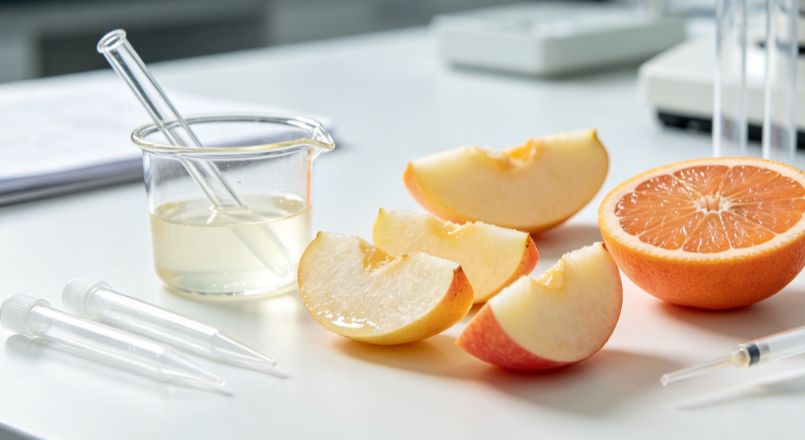
What We Measure – From Total Vitamin C to Redox Speciation
Our standard service quantifies total vitamin C (ascorbic acid + dehydroascorbic acid, mg/100g fresh pulp) using high‑performance liquid chromatography with ultraviolet detection (HPLC‑UV at 245 nm or 265 nm) after reduction of dehydroascorbic acid with dithiothreitol (DTT). But we go much deeper. We offer direct speciation of ascorbic acid vs. dehydroascorbic acid using a paired‑detector system or LC‑MS/MS in negative ion mode, providing the redox status of your sample – a critical indicator of freshness and processing impact. Using ultra‑high‑performance liquid chromatography coupled to tandem mass spectrometry (UHPLC‑MS/MS), we achieve a detection limit of 0.05 µg/g fresh weight and a linear range up to 5,000 µg/g. For samples with high oxidase activity (e.g., apple, avocado, banana), our metaphosphoric acid‑based stabilisation protocol is applied immediately upon sample homogenisation to prevent artificial loss of ascorbic acid.
Advanced Capabilities for Challenging Fruit Matrices
We accept any fruit pulp: citrus, berries, tropical fruits (mango, papaya, kiwi), pome fruits (apple, pear), stone fruits (peach, plum), and processed purees or juices. Our optimised extraction uses ice‑cold 3% metaphosphoric acid / 8% acetic acid / 1 mM EDTA to chelate metal ions that catalyse oxidation. For highly coloured pulps (e.g., blueberries, blackberries), we incorporate polyvinylpolypyrrolidone (PVPP) to remove phenolics and anthocyanins that interfere with UV detection. For samples containing ascorbate oxidase (e.g., cucumber, melon), we perform flash‑freezing with liquid nitrogen during sampling to instantly stop enzymatic activity. We also offer total vitamin C determination by potentiometric titration as a fast, low‑cost alternative for large batches of uniform samples, but HPLC remains our gold standard for accuracy.
What You Receive – Actionable Vitamin C Data
Your final report includes: ascorbic acid concentration (mg/100g), dehydroascorbic acid concentration (if requested), total vitamin C (sum), and the percentage of vitamin C remaining as the reduced form. We provide recovery data (spike recovery >96%), limits of detection and quantification for your specific fruit matrix, and relative standard deviation (RSD) of triplicate extractions. In stability studies (e.g., storage at 4°C, freezing, or thermal processing), we deliver degradation kinetics (first‑order rate constant, half‑life). For comparative variety trials or fertiliser effects, we include statistical analysis (ANOVA, Tukey's HSD) and bar charts with error bars. Upon request, we correlate vitamin C data with antioxidant activity (DPPH, FRAP) from the same sample extract.
Our Distinct Advantages in Fruit Pulp Vitamin C Testing
1. In‑field stabilisation kits: We provide pre‑weighed metaphosphoric acid vials and cooling packs to clients who collect their own samples – ensuring that vitamin C does not degrade during transport. 2. Ultra‑fast sample processing: Our lab team can homogenise, stabilise, and inject a batch of 20 samples within 45 minutes of arrival, minimising artefactual losses. 3. Speciation capability: Most labs only measure total vitamin C. We give you the ascorbic acid/dehydroascorbic acid ratio, which reflects biological activity and processing impact – essential for fresh‑cut fruit products. 4. High throughput: Using UHPLC systems with automated injection and column switching, we process up to 400 samples per week, delivering results in 2‑3 business days. 5. Regulatory alignment: Our methods conform to AOAC 967.21 (official vitamin C method), EN 14130:2003, and the Chinese National Standard GB 5009.86-2016. We issue a Certificate of Analysis suitable for food label claims, export certification, and research publication.
Why Choose Our Service Over General Food Testing Labs
Many routine labs use simple 2,6‑dichlorophenolindophenol (DCPIP) titration, which is inaccurate in coloured or cloudy fruit pulps and cannot measure dehydroascorbic acid. Others use HPLC but lack sample stabilisation, leading to significant under‑reporting. We give you true, protected, and fully characterised vitamin C content. Our team includes food chemists specialising in vitamin analysis and degradation kinetics. We provide one‑on‑one consultation to interpret your results – for example, advising whether a low ascorbic acid level is due to poor sample handling or genuine genetic low content. No hidden fees for speciation or stability modelling; we deliver a clear, reliable, and actionable report.
Ready to Quantify Vitamin C in Your Fruit Pulp with Confidence?
Whether you are a fruit grower, juice processor, quality control lab, or nutrition researcher, our vitamin C analysis service provides the accuracy, speciation, and oxidation protection you need. Contact us today to discuss your fruit species, sampling plan, and reporting requirements. We offer a free initial consultation, sample submission kits with stabilisation buffers, and a discounted pilot analysis for first‑time clients. Let us help you obtain the true vitamin C value of your fruit pulp – without artefactual loss.