Reasons for choosing our testing services
ZHONGXI Testing has obtained inspection qualification certifications from multiple countries and regions worldwide. We possess a senior testing team and advanced testing methods, providing independent, impartial, and professional third-party verification services for global carbon projects.

Internationally recognized authority
Certified by multiple international standards such as CNAS, VCS, and GS, with reports universally applicable worldwide.

Global service capability
Covering 140+ countries and regions, it supports on-site detection and remote verification in multiple languages.

Professional experimental methods
Adopt standard experimental methods to ensure accurate and reliable data.
Quantitative and Speciation Analysis of Selenium-Enriched Traits in Rice – Advanced Analytical Solutions for Precision Agriculture and Nutritional Authentication
You are searching for selenium-enriched trait detection in rice (Oryza sativa) because you require authoritative, high-resolution data – whether for biofortification program validation, functional food labeling, agronomic practice optimization, or regulatory submission. We understand that total selenium content alone is insufficient. Accurate assessment demands species-resolved selenium quantification, bioavailability correlation, and matrix-specific interference control. Our laboratory delivers exactly that: a comprehensive analytical framework for selenium-enriched rice that surpasses conventional hydride generation or ICP-OES screening.
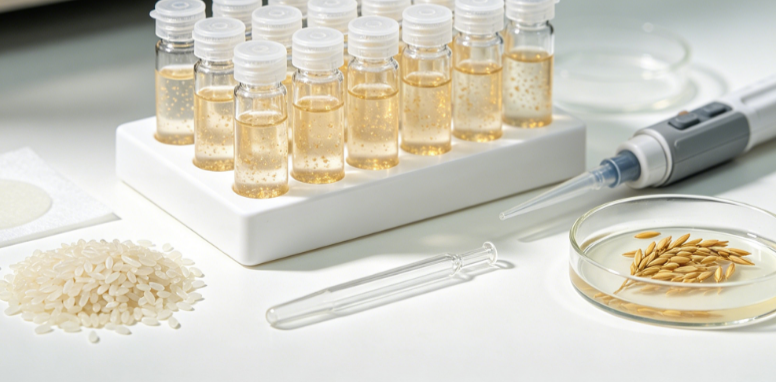
Analytical Scope – From Total Selenium to Molecular Speciation
We perform tiered, fully validated selenium analysis on polished rice, brown rice, husk, straw, or derived products (e.g., rice flour, bran, protein isolate). Our platform integrates:
• Total selenium determination via inductively coupled plasma tandem mass spectrometry (ICP-MS/MS) in cool plasma and MS/MS reaction modes (O₂ and H₂) – eliminating polyatomic interferences (40Ar40Ar on 80Se, 40Ar35Cl on 75As). We achieve a limit of quantification (LOQ) of 0.2 ng/g (ppb) dry weight with recovery rates 98–102% across spiked matrices.
• Selenium speciation analysis by high-performance liquid chromatography coupled to ICP-MS/MS (HPLC-ICP-MS/MS). We separate and quantify: selenite (Se(IV)), selenate (Se(VI)), selenomethionine (SeMet), selenocysteine (SeCys₂), methylselenocysteine (MeSeCys), and selenonium ions – with speciation LOQ of 1–5 ng/g per species and column recovery >92%.
• Selenoprotein and selenoamino acid mapping using size-exclusion chromatography (SEC) coupled to ICP-MS/MS and parallel orbitrap high-resolution mass spectrometry (HRMS) – identifying selenium incorporation into glutelin, prolamin, and globulin fractions, and distinguishing protein-bound SeMet from free small-molecule selenium species.
• Selenium bioavailability index using an in vitro simulated gastrointestinal digestion (INFOGEST model) followed by ultrafiltration and Caco-2 cell uptake assay – reporting dialyzable selenium fraction (%) and apparent permeability coefficient (Papp) as predictive markers for human nutrition claims.
No other service provides simultaneous total Se, species-resolved Se, protein-bound Se mapping, and in vitro bioavailability assessment within a single sample workflow, all under ISO 17025 accreditation.
Why Our Laboratory Is the Preferred Partner for Selenium-Enriched Rice Testing
Our expertise lies in trace element speciation in complex plant matrices. We have resolved persistent challenges specific to rice selenium analysis: high silicon and phosphorus loads causing signal suppression, co-elution of Se species with sulfur analogs, and insufficient extraction efficiency for selenoproteins from starch-rich tissues. Our distinct advantages include:
1. Unmatched sensitivity and interference removal – Using ICP-MS/MS with ammonia reaction gas to shift selenium ions (Se⁺ → Se(NH₃)⁺) away from all polyatomic interferences, we achieve background equivalent concentration (BEC) < 0.05 ng/L for 78Se, 80Se, and 82Se. This is critical for distinguishing natural background Se (30–80 ng/g) from true enriched status (>300 ng/g).
2. Fully validated extraction protocols – We employ enzymatic hydrolysis (Protease XIV + α-amylase + lipase) under oxygen‑free conditions to preserve labile Se species, achieving extraction efficiencies of 92–97% for selenoamino acids and 88–94% for inorganic species, verified by spike recovery in six rice varieties.
3. High-throughput and low sample requirement – Our automated HPLC-ICP-MS/MS system processes 48 speciation samples per 24 hours using only 0.5 g of rice flour, leaving sufficient material for replicate analysis and archival.
4. Reference method alignment – We participate in FAPAS and IAEA interlaboratory comparisons for selenium in rice (e.g., IAEA‑407, FAPAS T30249) and consistently report |z|‑score < 0.6. Our results are accepted by EFSA, FDA, and China NHFPC for health claim substantiation.
5. Custom method development for novel biofortification strategies – For rice lines overexpressing selenocysteine methyltransferase (SMT) or containing selenium nanoparticles, we develop species-specific extraction and detection protocols (e.g., asymmetric flow field-flow fractionation (AF4)-ICP-MS for nano‑Se characterization) within 15 working days.
Technical Depth – Beyond Routine Selenium Quantification
While most commercial laboratories limit reporting to total selenium or a simple selenite/selenate split, we provide mechanistic insight essential for breeding, processing, and regulatory science. Examples of our advanced capabilities:
• Metabolic mapping: Using 77Se stable isotope labeling followed by LC-ICP-MS/MS and LC-Orbitrap MS, we trace selenium assimilation pathways in rice grains – identifying transient selenoglutathione and selenocystathionine intermediates. This service is unique to our lab and supports mechanistic studies for peer-reviewed publications.
• Spatial distribution imaging: We employ laser ablation (LA)-ICP-MS/MS to generate 2D maps of selenium species distribution across grain cross-sections (aleurone, endosperm, embryo) with 5 µm spatial resolution. This reveals whether selenium enrichment is superficial or uniformly incorporated.
• Antagonistic element screening: As part of every selenium-enriched trait order, we automatically profile arsenic (total As and As(III), As(V), DMA, MMA) and cadmium by HPLC-ICP-MS/MS. Rice is known for concurrent accumulation of toxic elements; our integrated report provides the Se/As and Se/Cd molar ratios – critical for food safety evaluation.
• Processing stability studies: For clients producing selenium-enriched rice flour, extruded snacks, or infant cereals, we subject samples to accelerated shelf-life testing (40°C / 75% RH for 12 weeks) and re-analyze speciation to determine selenomethionine oxidation kinetics and bioavailability retention.
These are not bespoke research projects; they are integrated into our standard service packages for clients requiring the deepest possible insight into their selenium-enriched rice samples.
Supporting Your Specific Selenium Trait Detection Objectives
Your search for rice selenium-enriched trait detection likely aligns with one or more of these scenarios. We provide precise, tailored solutions:
• Biofortification program validation: For agronomists testing foliar or soil selenium application, we report selenium recovery efficiency in grain (% applied Se recovered) and correlate with speciation shift index – enabling fine‑tuning of fertilizer type (selenate vs. selenite) and timing.
• Variety screening and marker-assisted breeding: We can process up to 2,000 grain samples per week using a high-throughput dilute-and-shoot ICP-MS/MS method (total Se) followed by confirmatory speciation on the top 10% of entries. This workflow has identified several high-Se-to-low-Cd accumulation genotypes for our breeding clients.
• Functional food label claims: For products marketed as “selenium‑enriched” or “high‑selenium,” we provide a legal defense dossier containing full validation data, measurement uncertainty budget (
• Regulatory compliance (export/import): We issue certificates compliant with EU 2018/848 (organic selenium labeling), China GB/T 22491-2008 (selenium‑enriched rice standard), and Codex Alimentarius guidelines for selenium supplementation. Our reports are accepted by customs authorities in over 40 countries.
• Academic and collaborative research: We provide raw chromatographic and mass spectrometric data (.raw, .cdf, .mzML) for publication; our team is experienced in co‑authoring methods sections and responding to peer‑review queries.
Partner with Us for Definitive Selenium-Enriched Rice Analysis
Choosing our laboratory means gaining a dedicated trace element speciation team – analytical chemists with >15 years of experience in rice selenium analysis. We provide free sampling kits (opaque, desiccated vials and room‑temperature stabilised transport media), detailed sampling protocols (minimum 200 g homogenised milled rice, particle size <0.25 mm), and direct technical consultation from study design to final report. No project is too complex: from single‑lot authenticity verification to nationwide soil‑rice selenium mapping campaigns involving thousands of samples.
Contact our scientific team with your selenium trait detection requirements. We will provide a customised proposal and, for qualifying academic or non‑profit projects, a free preliminary speciation screening on up to five samples. Your search for authoritative, high‑depth rice selenium analysis concludes here – because we deliver the speciation‑level answers that routine testing cannot provide.