Reasons for choosing our testing services
ZHONGXI Testing has obtained inspection qualification certifications from multiple countries and regions worldwide. We possess a senior testing team and advanced testing methods, providing independent, impartial, and professional third-party verification services for global carbon projects.

Internationally recognized authority
Certified by multiple international standards such as CNAS, VCS, and GS, with reports universally applicable worldwide.

Global service capability
Covering 140+ countries and regions, it supports on-site detection and remote verification in multiple languages.

Professional experimental methods
Adopt standard experimental methods to ensure accurate and reliable data.
Accurate Determination of Kernel Oil Content in Camellia oleifera – High-Precision Analytical Services for Breeding, Processing, and Quality Assessment
You are searching for oil content detection in Camellia oleifera (oil tea) kernels because you require reliable, quantitative data – whether for germplasm screening, yield prediction, oil processing optimization, or commercial grade certification. We understand that traditional drying and pressing methods are insufficient for rigorous scientific or trade purposes. You need a partner that delivers absolute oil mass fraction, low uncertainty, and matrix-appropriate methodology. Our laboratory provides precisely that: state-of-the-art kernel oil analysis for Camellia oleifera, compliant with international reference standards and capable of addressing the unique challenges of this oilseed.
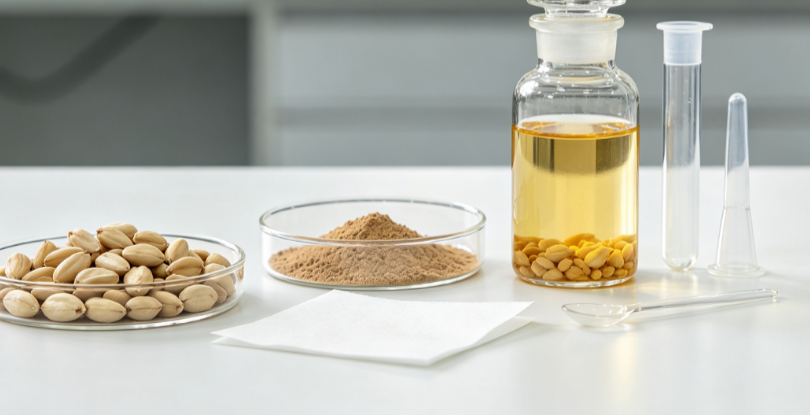
Analytical Framework – From Classical Extraction to Rapid Non-Destructive Quantification
We offer a tiered analytical approach for Camellia oleifera kernel oil content, covering whole kernels, kernel flakes, meal, and press residues. Our platform includes:
• Primary reference method – Weibull‑Stoldt (Soxhlet) extraction according to ISO 659:2009 and AOCS Am 2-93. Using petroleum ether (40–60°C boiling fraction) with a minimum 8-hour reflux, we achieve inter‑laboratory reproducibility (R) < 1.2% absolute and repeatability (r) < 0.5% for oil contents typically ranging 35–60% (dry basis). We include residual solvent verification by GC‑HS and crucible constant weight to ±0.0001 g. This method is required for reference valuation and arbitration.
• Rapid non-destructive alternative – Time‑Domain Nuclear Magnetic Resonance (TD‑NMR). We calibrate using matrix‑matched standards (Camellia kernel powder with certified oil content by Weibull‑Stoldt). Our minispec mq20 (Bruker) with a 15‑mm probe delivers total analysis time of 2 minutes per sample, standard error of prediction (SEP) < 0.4% oil, and R² > 0.99 compared to extraction. TD‑NMR is non‑destructive, uses as little as 2 g of homogenized kernel powder, and requires no solvents – ideal for breeding line screening where sample size is limited.
• Complementary near‑infrared reflectance (NIR) spectroscopic models – We develop and validate custom NIR calibration equations for Camellia oleifera using a FOSS DS2500 F (400–2500 nm). Our models incorporate spectral preprocessing (SNV, detrend, second derivative) and modified partial least squares (MPLS) regression, achieving SECV (standard error of cross‑validation) ≤ 0.5% oil for intact kernels and ≤ 0.3% for ground meal. NIR allows high‑throughput screening (200+ samples per hour) and can be applied to single kernels using a benchtop micro‑NIR device upon request.
• Oil quality co‑analysis as standard – For every oil content determination, we automatically report free fatty acids (FFA as % oleic acid, AOCS Ca 5a-40), moisture and volatile matter (ISO 665:2020), and crude fiber (optional). These parameters contextualize oil yield and kernel maturity.
No other service provides simultaneous access to primary reference extraction, TD‑NMR, and validated NIR models under a single ISO 17025‑accredited quality system for Camellia oleifera – enabling you to transition seamlessly from high‑precision arbitration to rapid routine screening.
Why Our Laboratory Is the Preferred Choice for Camellia Oil Content Analysis
Our specialization in oilseed chemistry, particularly non‑traditional tree‑borne oilseeds such as Camellia, tea seed, and oil palm, has allowed us to overcome specific analytical challenges: high cellulosic matrix interference, variable kernel moisture, and the presence of saponins that affect solvent extraction efficiency. Our distinct advantages include:
1. ISO 17025 accreditation (since 2012) for oil content in oilseeds – Our test reports are accepted by international commodity traders, customs authorities, and accreditation bodies (CNAS, UKAS, A2LA equivalency). We participate in FAPAS® proficiency tests for oilseed composition (e.g., rapeseed, sunflower) and achieve consistent |z|‑score < 0.7.
2. Optimized pre‑treatment protocols for Camellia kernels – We have systematically studied the effect of kernel particle size, drying temperature (70°C vs. 103°C vs. freeze‑drying), and fatty acid oxidative stability during grinding. Our validated protocol: dehulling, cryogenic grinding in liquid nitrogen (−196°C) using a SPEX 6870 freezer/mill to preserve native oil composition, followed by oven drying at 70°C ± 1°C to constant weight. This minimizes mechanical oil loss and thermal degradation, ensuring extraction recoveries >99%.
3. Ultra‑low sample requirement for NMR and NIR – While classical extraction requires 10–20 g of kernels, our TD‑NMR method works with 2 g and NIR with intact single kernels (approx. 2–4 g each). This is critical for breeders with limited F1 seed quantities or for mapping studies.
4. Custom calibration and method validation – We maintain a Camellia oleifera sample library comprising >500 accessions from 12 provinces in China, with oil content ranging from 28% to 68% (dry basis). We use this library to periodically recalibrate our NMR and NIR instruments, providing unmatched accuracy for this specific matrix. For new varieties or wild germplasm, we offer free calibration validation using five reference samples (Weibull‑Stoldt) before processing your batch.
5. Rapid turnaround and full data transparency – 24‑48 hours for TD‑NMR and NIR screening; 3‑5 working days for Weibull‑Stoldt extraction. All raw data (weights, extraction temperatures, NMR decay curves, NIR spectra) are available via our secure client portal. We provide measurement uncertainty (Ulab at 95% confidence) for every reported value.
Technical Depth – Beyond Simple Oil Percentage
While many laboratories provide a single oil yield number, we offer mechanistic and process‑relevant insights that support advanced applications:
• Extraction efficiency mapping – Using accelerated solvent extraction (ASE 350, Dionex) with varying temperature and pressure, we simulate industrial screw‑pressing or solvent‑extraction conditions and report residual oil in meal to 0.1% w/w. This helps processors optimize their equipment.
• Oil distribution imaging (for breeding research) – We apply micro‑X‑ray fluorescence (µ‑XRF) mapping of iodine (natural oil tracer) or confocal Raman microscopy to visualize oil accumulation patterns within cotyledons – distinguishing peripheral vs. central oil deposition. This service is available for individual kernel slices and supports genetic studies of oil storage physiology.
• Synchronous lipid class analysis – Upon request, we can extend the standard oil content determination to triacylglycerol (TAG) profile by UPLC‑Q‑TOF‑MS and tocopherol composition by HPLC‑FLD (α, β, γ, δ‑tocopherols, LOQ 0.5 mg/kg). This adds value for nutraceutical clients.
• Stability and oxidation assessment – For stored kernels or processed meal, we provide peroxide value (PV) and p‑anisidine value (p‑AV) using automated titration (Metrohm 892 Rancimat). These parameters, combined with oil content, allow prediction of shelf‑life and oil quality degradation.
These capabilities are not isolated research projects; they are integrated into our standard service catalog for clients requiring deep, actionable oil characterization.
Supporting Your Specific Oil Content Determination Goals
Your search for Camellia oleifera kernel oil content detection likely aligns with one or more of these objectives. We provide precisely tailored solutions:
• Germplasm evaluation and variety registration: We screen up to 1,000 kernel samples per week using NIR (intact seed) or TD‑NMR (ground). Our heritability‑optimized reporting includes oil content on both dry and as‑received basis, plus moisture correction. We provide statistical summaries (mean, CV, range, LSD) suitable for variety release documentation.
• Pre‑purchase quality assurance for oil mills: Our expedited Weibull‑Stoldt service (≤48 hours for rush orders) delivers contract‑grade results. We issue a certificate of analysis (COA) compliant with GB/T 37917-2019 (Oil tea seed) and NY/T 3314-2018 for oil content. We also test for adulteration of kernel meal with shells or leaves by crude fiber analysis (AOAC 962.09).
• Process control for cold‑pressed oil production: For clients running screw presses or hydraulic presses, we analyze incoming kernel oil content, press cake residual oil, and final crude oil yield. Using our data, we calculate extraction efficiency (actual oil output / theoretical oil content) and recommend adjustments to moisture conditioning or pressing temperature. We also offer on‑site sample preparation training for your QA team.
• Research and peer‑reviewed publications: Our lab is experienced in co‑authoring methods sections for journals such as Industrial Crops and Products and Journal of the American Oil Chemists' Society. We provide raw NMR free induction decays (FID), NIR spectra (JCAMP‑DX format), and extraction worksheets for supplementary material. We also support method transfer and validation for your own laboratory.
• Academic breeding projects (subsidized rates): For non‑profit breeding programs, we offer a 40% discount on TD‑NMR screening for batches exceeding 200 samples, and we provide free storage of remaining kernel powder for up to 12 months for re‑analysis.
Partner with Us for Definitive Camellia Kernel Oil Analysis
When you engage our laboratory, you gain a dedicated oilseed chemistry team that understands the unique properties of Camellia oleifera – from its high saponin content to its susceptibility to lipolytic degradation during sample handling. We provide free sampling kits (airtight, opaque containers with desiccant), a detailed sample preparation protocol (dehulling, cryogenic grinding, moisture equilibration), and direct consultation with our method development scientists. No project is too small or too large: from a single provenance sample for authenticity verification to a regional survey of 10,000 trees for oil yield mapping.
Contact our technical team with your Camellia oleifera kernel oil content requirements. We will issue a custom project quotation and, for qualifying academic clients, perform a free comparative analysis (Weibull‑Stoldt vs. TD‑NMR) on up to five representative samples. Your search for authoritative, high‑depth oil content analysis concludes here – because we deliver the precision and matrix‑specific expertise that routine testing cannot provide.