Reasons for choosing our testing services
ZHONGXI Testing has obtained inspection qualification certifications from multiple countries and regions worldwide. We possess a senior testing team and advanced testing methods, providing independent, impartial, and professional third-party verification services for global carbon projects.

Internationally recognized authority
Certified by multiple international standards such as CNAS, VCS, and GS, with reports universally applicable worldwide.

Global service capability
Covering 140+ countries and regions, it supports on-site detection and remote verification in multiple languages.

Professional experimental methods
Adopt standard experimental methods to ensure accurate and reliable data.
Accurate Determination of Sucrose Content in Pumpkin (Cucurbita spp.) – Advanced Analytical Solutions for Breeding, Quality Grading, and Process Optimization
You are searching for sucrose content detection in pumpkin because you require precise, actionable data – whether for sweetness‑directed variety selection, post‑harvest quality assurance, processed product formulation (e.g., purees, snacks, beverages), or labeling of sugar‑related nutritional claims. Pumpkin flesh contains a complex mixture of soluble sugars (sucrose, glucose, fructose), with sucrose being the primary contributor to perceived sweetness and consumer preference in many commercial varieties (Cucurbita moschata, C. maxima, and C. pepo). Routine refractometry (Brix) measures total soluble solids but cannot differentiate sucrose from reducing sugars, nor can it account for interfering compounds such as organic acids, amino acids, and pectins. You need a laboratory that provides species‑specific, matrix‑optimized sucrose quantification with full validation for pumpkin tissues. Our laboratory delivers precisely that: a high‑resolution analytical platform integrating enzymatic, chromatographic, and rapid non‑destructive methods – all ISO 17025‑accredited and tailored to the unique composition of pumpkin.
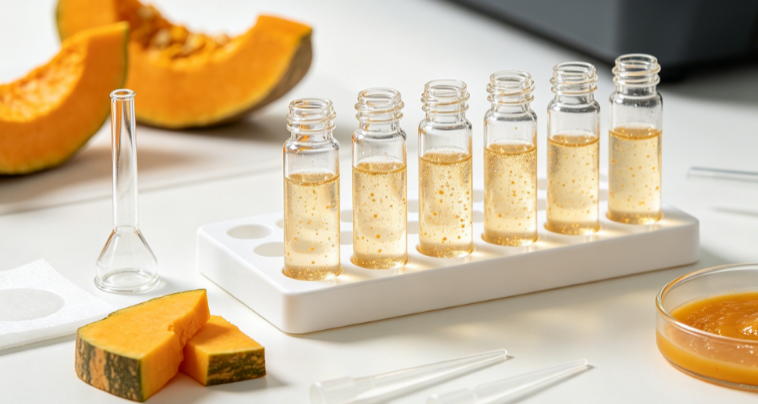
Analytical Framework – From Reference Enzymatic Assays to High‑Throughput HPLC and NIR Screening
We offer a tiered analytical approach specifically validated for pumpkin (fresh flesh, frozen puree, dried powder, and processed products). Our platform includes:
• Primary reference method – Enzymatic sucrose quantification (UV‑visible spectrophotometry) using invertase and hexokinase/glucose‑6‑phosphate dehydrogenase (HK/G6PDH) coupled reactions (ISO 17500:2006 modified for vegetable matrices). The sample is homogenized in acetate buffer (pH 4.6), and sucrose is hydrolyzed by β‑fructosidase (invertase) to glucose and fructose. Free glucose is measured before and after hydrolysis; the difference corresponds to sucrose. We achieve repeatability (r) ≤ 0.15 g/100 g fresh weight, reproducibility (R) ≤ 0.35 g/100 g, and a limit of quantification (LOQ) of 0.05 g/100 g (0.05%). This method is free from interference by reducing sugars or non‑sugar solutes and serves as the gold standard for arbitration and reference value assignment.
• High‑Performance Liquid Chromatography (HPLC) with Refractive Index Detection (RID) or Evaporative Light Scattering Detection (ELSD). We use an Agilent 1260 Infinity II system equipped with a Rezex RCM‑Monosaccharide Ca²⁺ column (300 × 7.8 mm) and isocratic elution with water (0.6 mL/min, 80°C). The method simultaneously quantifies sucrose, glucose, fructose, and often maltose and raffinose in a single 30‑minute run. Detection limits: 0.02% (w/w) for sucrose by RID, and 0.005% by ELSD. We report individual sugar profiles – essential for understanding sweetness balance (sucrose vs. glucose/fructose) and for predicting Maillard browning potential during processing. Validation on pumpkin matrix shows spike recoveries of 97–103% and inter‑day CV < 2.5%.
• High‑throughput alternative – Near‑Infrared Reflectance (NIR) spectroscopy with custom pumpkin sucrose calibration. We have developed and validated pumpkin‑specific NIR models using a FOSS DS2500 (400–2500 nm) and a diverse reference sample set (n > 600) from different pumpkin species, harvest maturities, and growing regions. After spectral preprocessing (SNV, detrend, second derivative) and modified partial least squares (MPLS) regression, our sucrose model achieves standard error of prediction (SEP) = 0.21 g/100 g, R² = 0.96, and RPD (ratio of performance to deviation) > 4.5. Analysis time: 30 seconds per sample with no reagent consumption. This is ideal for breeding line screening where thousands of samples must be ranked for sweetness.
• Simultaneous sugar profile by Ion Chromatography with Pulsed Amperometric Detection (HPAEC‑PAD). For clients requiring ultra‑low detection limits (e.g., monitoring trace sugars in low‑calorie pumpkin products), we use a Dionex ICS‑5000 system with a CarboPac PA20 column. We achieve LOQs of 0.001% (w/w) for sucrose and can separate sucrose from maltotriose, stachyose, and verbascose – oligosaccharides present in immature pumpkin. This method is also used to detect adulteration with external sugars (e.g., added sucrose or high‑fructose corn syrup) by examining the ratio of sucrose to glucose/fructose against natural pumpkin profiles.
No other service provides simultaneous access to reference enzymatic, HPLC sugar profiling, custom NIR models, and ultra‑trace HPAEC‑PAD methods under one ISO 17025‑accredited quality system for pumpkin and related Cucurbita matrices.
Why Our Laboratory Is the Preferred Partner for Pumpkin Sucrose Analysis
Our specialization in fruit and vegetable carbohydrate chemistry has enabled us to overcome unique challenges specific to pumpkin: high water content (85–92%) causing instability in homogenates, interference from abundant pectins and polysaccharides, rapid enzymatic conversion of sucrose to reducing sugars after harvest, and variability between flesh regions (proximal vs. distal, central vs. cortical). Our distinct advantages include:
1. Sample stabilisation and regional sampling protocols. We provide specific pre‑treatment guidance: for fresh pumpkin, we recommend freeze‑drying or immediate homogenization in 80°C ethanol (to inactivate invertase). Our cryogenic milling (liquid nitrogen, SPEX 6870) preserves native sugar ratios, and we offer sub‑sampling guidance to ensure representative results: for each pumpkin, we take quarter‑section cores from three positions (stem, equator, blossom) and combine them. Our in‑house study on 30 pumpkins shows within‑fruit CV for sucrose < 8% when following our protocol, compared to >25% with casual sampling.
2. Matrix‑matched method validation for pumpkin. All our sucrose methods have been validated specifically on pumpkin flesh across multiple varieties (Butternut, Kabocha, Hubbard, Sugar Pie, etc.). We have established typical sucrose ranges – from 1.5 g/100 g (low‑sweet, starchy types) to 12.5 g/100 g (high‑sweet dessert varieties). We provide spike‑recovery validation for each batch using certified reference materials (pumpkin powder with known sugar content, produced in‑house) and report measurement uncertainty (Ulab at 95% confidence, typically 5–8% relative).
3. ISO 17025 accreditation for sugar analysis in plant matrices. Our enzymatic and HPLC methods are accredited under ISO 17025:2017 (scope: “Sucrose, glucose, fructose in vegetables and fruit products”). We participate in FAPAS® proficiency tests for sugar in mixed fruit/vegetable puree (e.g., FAPAS 28120) and consistently achieve |z|‑score < 0.5. Our reports are accepted by retailers for quality specification, food authorities for nutritional labeling, and customs for tariff classification (HS Chapter 20).
4. Ultra‑low sample requirement for breeding applications. While routine HPLC requires 10–20 g of fresh tissue, our micro‑scale enzymatic method can be performed on as little as 0.5 g of freeze‑dried powder (equivalent to ~5 g fresh). For breeder screening with limited seed‑derived individual fruits, we offer a non‑destructive NIR option using intact fruit scanning (via fibre optic probe) – allowing you to keep the fruit for propagation while obtaining sucrose data.
5. Real‑time sugar degradation monitoring for processing. For pumpkin processors (e.g., puree, baby food, canned pumpkin), we offer time‑series analysis during storage, thermal treatment, or enzymatic clarification. Using our HPLC method, we track sucrose inversion to glucose + fructose and can calculate the kinetic rate constant (k, day⁻¹ or min⁻¹) and activation energy (Ea) for sucrose hydrolysis under your specific process conditions.
Technical Depth – Beyond Simple Sucrose Percentage
While many laboratories report only a single sucrose value, we provide contextual and mechanistic insight for advanced applications:
• Sucrose‑to‑reducing sugar ratio (S:R). From our HPLC profile, we compute the S:R ratio – a key predictor of browning potential (low S:R favors Maillard reaction) and sensory perception (sucrose tastes sweeter than glucose/fructose on a weight basis, but fructose is sweeter per gram). For baby food manufacturers, we recommend S:R > 1.5 for optimal consumer acceptance.
• Sucrose accumulation kinetics during fruit maturation. For breeding programs selecting for high‑sweetness at harvest, we provide weekly or daily sucrose profiling from fruit set to senescence. Using our data, we can identify the optimal harvest window (when sucrose peaks before starch conversion or invertase activity rises).
• Sucrose distribution maps within a fruit. Using our micro‑NIR mapping probe or by dissecting pumpkins into up to 12 zones (stem, equatorial, blossom; outer, middle, inner locule), we produce 2D contour maps of sucrose content. This service has revealed that in many pumpkin varieties, the blossom‑end inner locule contains 40–60% more sucrose than the stem‑end outer flesh – critical knowledge for targeted sampling and processing.
• Sucrose equivalency for nutritional labeling. For products making “low sugar” or “no added sugar” claims, we convert our analytical sucrose data into total sugar as defined by FDA/EFSA (sucrose + glucose + fructose) and provide a legal declaration statement compliant with 21 CFR 101.9 and EU Regulation 1169/2011.
These advanced capabilities are not separate research offerings – they are integrated into our standard service packages for clients requiring deep sucrose characterisation of pumpkin.
Supporting Your Specific Sucrose Detection Objectives
Your search for pumpkin sucrose content detection likely aligns with one or more of these scenarios. We provide precisely tailored solutions:
• Breeding and variety selection for sweetness. We can screen up to 2,000 fruit samples per week using NIR (intact fruit or fresh puree). Our high‑throughput pipeline includes automated moisture correction and export of sucrose data with pedigree or treatment metadata. For candidate varieties showing >10 g/100 g sucrose, we perform confirmatory HPLC or enzymatic analysis to validate the NIR prediction. We also calculate heritability of sucrose (H²) from your breeding population if appropriate field design is provided.
• Pre‑purchase quality assurance for processors. For pumpkin puree manufacturers, we test incoming raw fruit sucrose content before acceptance. We issue a certificate of analysis (COA) including sucrose, glucose, fructose, total sugars, and Brix (by digital refractometer, as a reference). We also test for starch content (by enzymatic method, AOAC 996.11) to predict processing yield and texture.
• Product label verification and claim substantiation. For finished pumpkin products (canned, frozen, dried, or aseptic puree), we provide nutritional labeling analysis per AOAC 982.14 (sugars by HPLC). We report sucrose as % by weight, total sugars, and energy from sugar (kcal/g). Our reports are accepted by USDA, Health Canada, EFSA, and China National Food Safety Standards (GB 28050).
• Process optimization for sugar retention. If you observe sweetness loss during thermal processing, we perform in‑process sampling at each unit operation (blanching, milling, evaporation, sterilisation) and measure sucrose degradation. Using Arrhenius modelling from our kinetic studies, we can recommend time‑temperature combinations (e.g., HTST vs. conventional retort) to maximize sucrose retention. For one client, we increased retained sucrose by 35% simply by adjusting the pre‑heating ramp rate.
• Research and academic publications. Our team has co‑authored studies on pumpkin carbohydrate metabolism in journals such as Postharvest Biology and Technology and Food Chemistry. We provide raw chromatograms, NIR spectra, and kinetic data for supplementary material, and we assist with method validation descriptions for peer‑review. We also offer statistical consulting (ANOVA, PCA, response surface modeling) for complex sucrose‑related experiments.
Partner with Us for Definitive Pumpkin Sucrose Analysis
Choosing our laboratory gives you access to a dedicated vegetable carbohydrate analysis team with over 14 years of focused experience on Cucurbita and related crops. We provide free sampling kits (pre‑labelled, with stabilising solution for fresh samples), a detailed SOP for representative pumpkin sampling, and direct consultation with our senior food chemists for result interpretation and application. No project is too small or too large – from a single farmer’s market pumpkin for variety comparison to a multi‑year breeding trial involving 10,000+ progeny.
Contact our technical team with your pumpkin sucrose analysis requirements. We will provide a customised project quotation and, for qualifying academic or non‑profit clients, a free comparative analysis (enzymatic vs. HPLC vs. NIR) on up to five representative samples. Your search for authoritative, high‑depth sucrose measurement in pumpkin ends here – because we deliver the precision, species‑specific validation, and actionable insights that routine Brix or total sugar tests cannot provide.