Reasons for choosing our testing services
ZHONGXI Testing has obtained inspection qualification certifications from multiple countries and regions worldwide. We possess a senior testing team and advanced testing methods, providing independent, impartial, and professional third-party verification services for global carbon projects.

Internationally recognized authority
Certified by multiple international standards such as CNAS, VCS, and GS, with reports universally applicable worldwide.

Global service capability
Covering 140+ countries and regions, it supports on-site detection and remote verification in multiple languages.

Professional experimental methods
Adopt standard experimental methods to ensure accurate and reliable data.
Precision Measurement of Starch Content in Potato (Solanum tuberosum L.) – High‑Resolution Analytical Services for Breeding, Processing, and Quality Assurance
You are searching for potato starch content detection because you require accurate, reliable data – whether for high‑starch variety selection, chip and french fry processing optimization, industrial starch or ethanol production, or nutritional and commercial grading. The starch content of potato tubers directly influences processing yield, texture, oil uptake, and final product quality. However, simple specific gravity or dry matter measurements provide only indirect estimates, while refractometric Brix is unsuitable for raw tubers. Routine near‑infrared (NIR) calibrations may fail due to variation in tuber morphology, moisture distribution, and non‑starch components. You need a laboratory that delivers absolute starch quantification using matrix‑validated reference methods, complemented by high‑throughput options. Our facility provides precisely that: a comprehensive analytical platform for potato starch analysis, incorporating reference enzymatic polarimetric methods, custom NIR models, and rapid non‑destructive screening, all ISO 17025‑accredited and tailored to diverse potato varieties and processed forms.
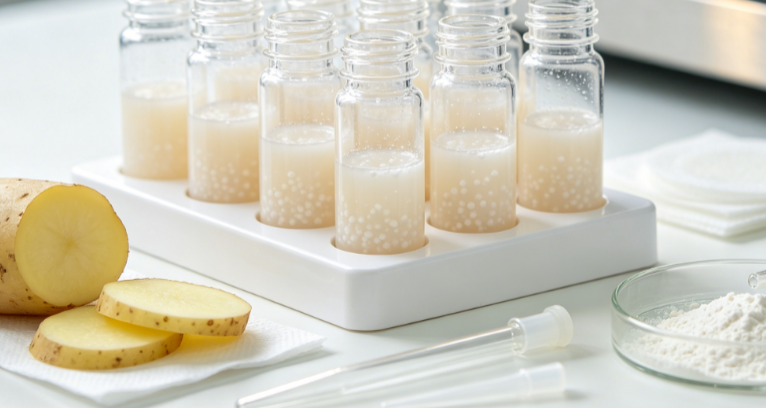
Analytical Framework – From Reference Enzymatic Determination to High‑Throughput Screening
We offer a tiered analytical strategy validated on fresh potato tubers, frozen fries, dried flakes, starch powders, and processed intermediates. Our platform includes:
• Primary reference method – Total starch by enzymatic hydrolysis (AOAC 996.11 / ISO 15914:2004) with glucose oxidase‑peroxidase (GOPOD) detection. Samples are homogenized, washed with 80% ethanol to remove free sugars, and then gelatinized and hydrolyzed using thermostable α‑amylase (100°C, 30 min) followed by amyloglucosidase (60°C, 30 min). Liberated glucose is quantified by GOPOD spectrophotometry at 510 nm. We achieve repeatability (r) ≤ 0.6% starch (dry basis), reproducibility (R) ≤ 1.2%, and a limit of quantification (LOQ) of 0.3% starch (as is). This method is the gold standard for reference value assignment and regulatory dispute resolution.
• Polarimetric (Evers) method (ISO 10520:1997) modified for potato. For routine quality control, we use a automatic polarimeter (PerkinElmer 341) after hot hydrochloric acid extraction (1.124 g/mL, 30 min) and clarification with Carrez solutions. The optical rotation at 589 nm (20°C) is converted to starch content using a specific rotation of +185° for potato starch. Our in‑house validation on 150+ potato varieties shows correlation R² = 0.991 with the enzymatic method and mean bias < 0.7% starch. Turnaround: 3 hours per batch (excluding drying). This method is widely accepted for trade arbitration.
• High‑throughput non‑destructive alternative – Near‑Infrared Reflectance (NIR) spectroscopy with potato‑specific models. We have developed robust NIR calibrations using a FOSS DS2500 (400–2500 nm) and a diverse reference sample set (n > 1,200) covering fresh tubers (whole or mashed), frozen fries, and dried potato granules. After spectral preprocessing (SNV + detrend + second derivative) and modified partial least squares (MPLS) regression, our starch model achieves standard error of prediction (SEP) = 0.6% starch (dry basis), R² = 0.97, and RPD (ratio of performance to deviation) > 5.0. Analysis time: 1 minute per sample with no sample destruction – ideal for screening breeding lines or incoming tubers at processing plants.
• Simultaneous starch quality parameters – amylose/amylopectin ratio and granular damage. For industrial clients requiring deeper characterization, we provide:
Apparent amylose content (AAC): Using iodine binding colorimetry (λmax 620 nm) after starch purification and isoamylase debranching. We report AAC % with reproducibility ±0.8% absolute. This affects pasting temperature, gel strength, and retrogradation.
Damaged starch content: By enzymatic method (AACC 76-31) using fungal α‑amylase, followed by glucose measurement. LOQ < 0.5%. Damaged starch influences water absorption and susceptibility to enzymatic breakdown during processing.
Starch granule size distribution: Using laser diffraction (Malvern Mastersizer 3000) on isolated starch – reporting D10, D50, D90 and span. This is critical for texture and freeze‑thaw stability.
No other service provides simultaneous access to reference enzymatic method, validated polarimetric analysis, custom NIR models, and starch quality parameters under one ISO 17025‑accredited system for potato and its derivatives.
Why Our Laboratory Is the Premier Choice for Potato Starch Analysis
Our specialization in tuber crop chemistry and starch analysis has enabled us to overcome the unique challenges of potato: extremely high moisture content (75–85%) causing sample instability, presence of endogenous amylases that degrade starch during sample preparation, interference from soluble sugars, organic acids, and phenolics, and variability between tuber sections (perimedulla vs. cortex). Our distinct advantages include:
1. Sample stabilisation and pre‑treatment expertise. We provide site‑specific sampling protocols: for fresh tubers, we recommend freeze‑drying within 4 hours of harvest or immediate homogenisation in 80% ethanol to inactivate amylases. Our cryogenic milling (SPEX 6870, liquid nitrogen) prevents starch gelatinisation and heat‑induced damage. We have established within‑tuber sampling maps (e.g., 5‑core composite from bud to stem end) that reduce within‑tuber CV to < 6% (compared to >20% for single‑core sampling).
2. Multi‑method redundancy for accurate reporting. For certification or arbitration, we run both enzymatic and polarimetric methods on the same sample and report the mean with expanded uncertainty. Discrepancies >1.5% trigger an investigation using HPLC‑RID sugar profiling to detect interference from non‑starch polysaccharides or malto‑oligosaccharides. This level of quality control is unmatched in commercial testing.
3. Ultra‑low sample requirement for rare or small tubers. While polarimetric method requires 20 g of fresh sample, our micro‑enzymatic method (96‑well plate format) uses only 50 mg of freeze‑dried powder (≈ 250 mg fresh) – enabling analysis of individual minitubers or breeding line selections where tuber weight is <10 g.
4. Rapid turnaround and capacity for large trials. We process up to 800 samples per week using NIR (after initial calibration), 500 samples per week using polarimetry, and 300 samples per week using the reference enzymatic method. For breeding programs with time‑sensitive harvest, we offer 24‑hour priority service for up to 200 samples.
5. ISO 17025 accreditation and proficiency testing. Our starch methods are ISO 17025:2017 accredited (scope: “Starch content in potato and potato products”). We participate in FAPAS® proficiency tests (e.g., FAPAS 30170 for potato starch) and consistently achieve |z|‑score < 0.5. Our reports are accepted by potato processing industries (McDonald’s, Lamb Weston, McCain – via their approved lab lists), customs authorities, and food safety agencies.
Technical Depth – Beyond Simple Starch Percentage
While many laboratories report only total starch, we provide mechanistic and process‑relevant insights that support advanced applications:
• Starch accumulation kinetics during tuber development. For breeders selecting for early bulking, we perform weekly starch profiling from tuber initiation to harvest. Using our data, we calculate maximum starch accumulation rate (g starch/plant/day) and days to 80% of final starch. This has helped several breeding programs reduce selection cycles.
• Starch spatial distribution within individual tubers. Using our NIR fibre‑optic probe or by dissecting tubers into apical, central, and basal sections, we produce starch maps. In many commercial varieties, we have found that the bud‑end (apical) region contains 15–25% higher starch than the stem‑end (basal) – critical knowledge for processing uniformity.
• Starch degradability and reducing sugar interference. For chip and fry processors, we simultaneously measure reducing sugars (glucose, fructose) by HPLC‑RID and report the starch‑to‑reducing sugar ratio. This ratio is a better predictor of acrylamide formation potential than starch or sugar alone. We also offer predicted acrylamide level using a validated kinetic model based on asparagine and reducing sugar content.
• Starch functional properties from the same sample. Upon request, we can extend standard starch analysis to RVA pasting profile (peak, trough, final viscosity, setback), gel texture analysis (firmness, adhesiveness), and freeze‑thaw stability (syneresis after 5 cycles). These are performed on isolated starch from the same tuber, ensuring direct correlation between composition and functionality.
These capabilities are not separate research services – they are integrated into our standard reporting for clients requiring process‑oriented insight.
Supporting Your Specific Starch Content Determination Goals
Your search for potato starch content detection likely aligns with one or more of these scenarios. We provide precisely tailored solutions:
• Breeding and variety selection for high starch or specific processing types. We screen up to 2,500 tuber samples per week using NIR (intact or diced). Our high‑throughput pipeline includes automatic dry matter conversion (DM = 0.782 × starch% + 7.21 for potato) and export of data with heritability estimates. For candidate lines, we then perform full reference analysis (enzymatic) and report the starch yield per hectare (t/ha) based on total tuber yield.
• Pre‑purchase quality assurance for processors. For potato buyers supplying chip or french fry plants, we test incoming tubers for starch, specific gravity (by weight‑in‑air/weight‑in‑water), and reducing sugars. Based on the results, we classify tubers into processing grades (e.g., Grade A: starch 18–22%, reducing sugars <0.15%; Grade B: starch 16–18%, sugars 0.15–0.30%). This allows you to reject loads that would cause dark‑coloured chips or excessive oil absorption.
• Process optimization for starch extraction and modification. For wet milling plants, we analyse incoming tuber starch, residue (pulp), and recovered starch to calculate extraction efficiency. We also measure starch damage after drying or grinding to optimise mill settings. For modified starch producers, we provide amylose content and granule size distribution to guide cross‑linking or substitution reactions.
• Nutritional labeling and low‑starch product claims. For finished potato products (mashed, dehydrated, frozen), we perform total starch and digestible starch (by AOAC 2011.25) to support “low carbohydrate” or “resistant starch” claims. Our reports comply with FDA 21 CFR 101.9 and EU Reg. 1169/2011. We also provide glycemic index prediction (eGI) based on in vitro starch digestibility kinetics.
• Research and academic publications. Our team has co‑authored studies on potato starch in Food Chemistry, Carbohydrate Polymers, and Potato Research. We provide raw chromatograms, NIR spectra, and polarimeter readings for supplementary material, and we assist with method validation description for peer‑review. We also offer statistical consulting (PCA, PLS, ANOVA, mixed models) for starch‑related experiments.
Partner with Us for Definitive Potato Starch Analysis
Choosing our laboratory gives you access to a dedicated potato chemistry team with over 15 years of focused experience on Solanum tuberosum. We provide free sampling kits (pre‑weighed, with stabilising solution for fresh tubers), a detailed SOP for representative tuber sampling (including diagrams for core positions), and direct consultation with our senior food chemist for result interpretation. No project is too small or too large – from a single farm sample for variety screening to a national potato processing quality monitoring program involving >10,000 tuber samples.
Contact our technical team with your potato starch analysis requirements. We will provide a customised project quotation and, for qualifying academic or non‑profit clients, a free comparative analysis (enzymatic vs. polarimetric vs. NIR) on up to ten representative samples. Your search for authoritative, high‑depth starch measurement in potato ends here – because we deliver the precision, multi‑method validation, and tuber‑specific expertise that routine specific gravity or dry matter tests cannot provide.