Reasons for choosing our testing services
ZHONGXI Testing has obtained inspection qualification certifications from multiple countries and regions worldwide. We possess a senior testing team and advanced testing methods, providing independent, impartial, and professional third-party verification services for global carbon projects.

Internationally recognized authority
Certified by multiple international standards such as CNAS, VCS, and GS, with reports universally applicable worldwide.

Global service capability
Covering 140+ countries and regions, it supports on-site detection and remote verification in multiple languages.

Professional experimental methods
Adopt standard experimental methods to ensure accurate and reliable data.
Precise Quantification of Citric Acid in Wild Jujube (Ziziphus jujuba var. spinosa) – Advanced Analytical Solutions for Organic Acid Profiling and Quality Authentication
You are searching for citric acid detection in sour jujube (wild jujube, Ziziphus jujuba var. spinosa) because this organic acid is a key determinant of fruit acidity, flavor quality, processing suitability, and potential health benefits (e.g., antioxidant activity, mineral absorption enhancement). Wild jujube fruits typically contain a complex mixture of organic acids (citric, malic, succinic, quinic, and tartaric acids) with citric acid often being the predominant acid, contributing up to 70–80% of total titratable acidity. However, simple titration methods measure total acidity without species‑specific resolution, and refractometry or pH alone cannot quantify citric acid reliably due to interfering buffering components (e.g., pectins, polysaccharides). You require a laboratory that delivers absolute, matrix‑optimized citric acid quantification using validated chromatographic or enzymatic reference methods. Our facility provides precisely that: a comprehensive analytical platform for citric acid and full organic acid profiling in wild jujube and its derived products (juice, concentrate, extract, dried fruit), all ISO 17025‑accredited and validated for this challenging, high‑pectin matrix.
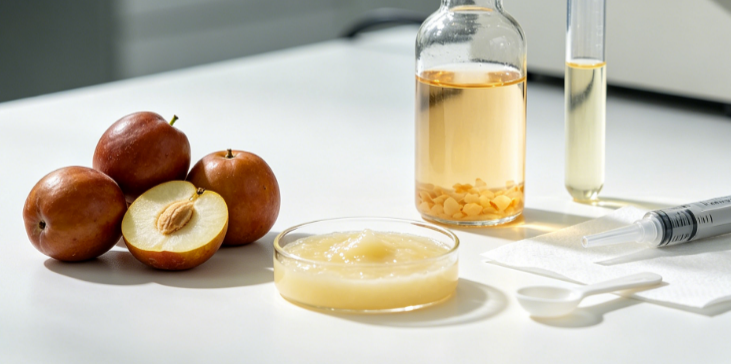
Analytical Framework – From Reference Enzymatic Assays to High‑Resolution Ion‑Exclusion Chromatography
We offer a tiered analytical strategy specifically validated for wild jujube pulp, peel, seed‑free powder, and processed products. Our platform includes:
• Primary reference method – Enzymatic citric acid determination (citrate lyase based, ISO 15914:2004 modification for fruit matrices). Using a Roche/Cat. No. 10139076035 enzymatic assay kit, we convert citric acid to oxaloacetate and acetate via citrate lyase, then reduce oxaloacetate to malate using malate dehydrogenase (MDH) with concomitant NADH oxidation measured at 340 nm. The method is specific for citric acid with no interference from other organic acids. We achieve repeatability (r) ≤ 0.02 g/100 g fresh weight, reproducibility (R) ≤ 0.05 g/100 g, and a limit of quantification (LOQ) of 0.005 g/100 g (50 mg/kg). This serves as our gold standard for arbitration and reference value assignment. The method is particularly suitable for wild jujube samples that exhibit high pectin content, as the sample preparation includes a deproteinization and clarification step.
• High‑performance ion‑exclusion chromatography (HPLC‑RID) for simultaneous organic acid profiling. We use an Agilent 1260 Infinity II system equipped with a Rezex ROA‑Organic Acid H⁺ column (300 × 7.8 mm, 8 µm) and isocratic elution with 0.005 M H₂SO₄ (0.5 mL/min, 60°C). This method separates and quantifies citric, malic, quinic, succinic, tartaric, fumaric, and oxalic acids in a single 30‑minute run. Detection is by refractive index (RID) or diode array (DAD) at 210 nm. For citric acid, we achieve LOQ of 0.01 g/100 g and linearity from 0.01 to 5.0 g/100 g. Validation on wild jujube extracts shows spike recoveries of 96–103% and inter‑day CV < 2.8%. This method is essential for understanding the full acid composition, particularly the citric/malic acid ratio – a key variety differentiation parameter in wild jujube germplasm.
• High‑throughput alternative – Ultra‑high performance liquid chromatography (UHPLC) with MS detection (UHPLC‑MS/MS) for ultra‑trace citric acid and isomer distinction. For clients requiring detection limits below 0.001% (e.g., for low‑acid processed products or metabolic studies), we use a Waters ACQUITY UPLC coupled to a Sciex QTRAP 6500+ in negative ion MRM mode (citric acid transition m/z 191 → 87, 191 → 111). Separation on a HILIC column (2.1 × 100 mm, 1.7 µm) with 20 mM ammonium formate/acetonitrile gradient. LOQ: 0.0002 g/100 g (2 mg/kg). This method also distinguishes citric acid from isocitric acid (critical for authenticity assessment, as some adulterants add isocitrate to mimic acidity).
• Sample preparation optimized for high‑pectin, high‑viscosity wild jujube. Wild jujube pulp contains up to 8–12% pectin and high levels of viscous polysaccharides that can clog columns and suppress enzymatic reactions. Our validated protocol includes: homogenization in 0.1% metaphosphoric acid (to precipitate proteins and stabilize organic acids), followed by centrifugation (12,000 × g, 10 min, 4°C), solid‑phase extraction (SPE) using a strong anion exchange (SAX) cartridge for HPLC methods, or ultrafiltration (10 kDa MWCO) for enzymatic assays. We verify removal of interfering substances by spiking recovery and chromatographic peak shape assessment.
No other service provides simultaneous access to reference enzymatic citric acid determination, full organic acid profiling by HPLC‑RID, ultra‑trace UHPLC‑MS/MS, and matrix‑optimized sample preparation for wild jujube under one ISO 17025‑accredited quality system.
Why Our Laboratory Is the Preferred Partner for Citric Acid Analysis in Wild Jujube
Our specialization in organic acid analysis in small fruits and underutilized crops has enabled us to solve specific challenges of wild jujube: extremely high pectin and mucilage content causing sample gelling and column clogging, presence of interfering UV‑absorbing phenolics at 210 nm, co‑elution of citric acid with other organic acids on conventional columns, and instability of citric acid during prolonged extraction (conversion to cis‑aconitic acid). Our distinct advantages include:
1. Wild jujube‑specific validation and reference data. We have analyzed over 500 wild jujube accessions from 8 provinces in China, establishing typical citric acid ranges: 1.2–3.8 g/100 g fresh weight (12–38 g/kg), compared to 0.3–0.8 g/100 g in common jujube (Z. jujuba). Our in‑house database includes citric/malic acid ratios, citric/quinic acid ratios, and the effect of harvest maturity on acid composition. For a new client, we can immediately compare your results to this reference database to identify atypical samples or potential adulteration.
2. High recovery and robustness for viscous matrices. Our combined SPE‑ultrafiltration sample preparation protocol consistently achieves citric acid recoveries of 95–104% even for pureed, unclarified wild jujube pulp. We use internal standard (tricarballylic acid) for HPLC methods to correct for any matrix‑induced retention time shifts or volume errors. This level of quality control is essential for accurate comparison across different processing conditions (e.g., drying, juicing).
3. Multi‑method cross‑validation for each batch. For regulatory or high‑value submissions, we analyze the same sample using both enzymatic and HPLC methods. If the results disagree by more than 8%, we perform UHPLC‑MS/MS to resolve interference and provide a final consensus value with expanded uncertainty. This triple‑method redundancy is unique in commercial testing and ensures total confidence in reported results.
4. ISO 17025 accreditation and proficiency testing. Our citric acid methods (enzymatic and HPLC) are ISO 17025:2017 accredited (scope: “Organic acids in fruit, fruit products, and botanicals”). We participate in FAPAS® proficiency tests for organic acids in fruit juice (e.g., FAPAS 28209) and consistently achieve |z|‑score < 0.4. Our reports are accepted by food authorities, herbal supplement regulators, and international traders.
5. Low detection limits and wide dynamic range. Our UHPLC‑MS/MS method detects citric acid down to 2 mg/kg (0.0002%) – essential for fermented wild jujube products where citric acid is metabolized. The linear range (0.002–5000 mg/L) covers from trace levels to concentrated jujube extracts without dilution.
Technical Depth – Beyond Simple Citric Acid Concentration
While many laboratories report only citric acid percentage, we provide process‑relevant and metabolic insight for advanced applications:
• Full organic acid profile and citric acid dominance index. We report not only citric acid but also malic, quinic, succinic, tartaric, and fumaric acids. We calculate the Citric/Malic (C/M) ratio – a key trait in wild jujube that influences sourness perception and potential for use in sour flavoring. Typical C/M ratio > 3 in wild jujube vs. < 1 in table jujube. We also compute total organic acid content (sum of all quantified acids) and correlate with titratable acidity measured by NaOH titration.
• Citric acid degradation kinetics during processing and storage. For producers of wild jujube juice, concentrate, or powder, we perform accelerated stability studies (40°C/75% RH; 60°C dry heat) and monitor citric acid loss over time. We then calculate zero‑order or first‑order degradation rate constants (k) and half‑life (t₁/₂) at standard storage conditions. For one client, we found that wild jujube powder retained 92% of initial citric acid after 12 months at 25°C, but only 56% after 6 months at 40°C, guiding their packaging and warehousing decisions.
• Detection of adulteration or mislabeling. Wild jujube products (juice, extract) are sometimes adulterated with common jujube or synthetic citric acid. Using our full organic acid profile, we look for marker acids – for example, common jujube contains higher malic and succinic acid relative to citric. Synthetic citric acid addition can be detected by stable carbon isotope ratio (δ¹³C) analysis (natural vs. synthetic citric acid from fermentation of glucose). We offer IRMS‑δ¹³C as an optional confirmatory test, with typical values: natural citric acid from wild jujube δ¹³C ≈ −24 to −26‰, synthetic citric acid from corn fermentation δ¹³C ≈ −10 to −12‰.
• Correlation with bioactivity (antioxidant and metal‑chelating). Citric acid contributes to wild jujube’s antioxidant capacity via iron/copper chelation and pH‑dependent radical scavenging. For each sample, we can optionally measure FRAP (ferric reducing antioxidant power), DPPH radical scavenging, and metal‑chelating activity (Fe²⁺ chelation). Then using multivariate analysis (e.g., PLSR), we quantify the contribution of citric acid vs. total phenolics to overall antioxidant activity – valuable for functional food claims.
These advanced capabilities are integrated into our standard service packages for clients requiring deep compositional and functional insight.
Supporting Your Specific Citric Acid Detection Goals
Your search for citric acid detection in wild jujube likely aligns with one or more of these scenarios. We provide precisely tailored solutions:
• Germplasm screening and breeding for high‑citric acid varieties. For jujube breeders aiming to select lines with intense sourness (for processing or traditional medicine), we screen up to 1,500 fruit samples per week using our HPLC‑RID method (30 min runtime, automated injection). We report citric acid content on fresh weight and dry weight basis, plus the full organic acid profile. We calculate broad‑sense heritability for citric acid content from your field design and provide ranking lists for selection.
• Quality assurance for wild jujube products (juice, concentrate, powder). For manufacturers, we test incoming raw fruit, intermediate puree, and finished product. Our certificate of analysis (COA) includes citric acid, malic acid, total organic acids, Brix, titratable acidity, and pH. We also test for adulteration with cheaper acids (e.g., malic or tartaric acid) by comparing the full profile against our wild jujube reference database. For export to EU or North America, we include a statement of conformity to food additive regulations (citric acid naturally present, not added).
• Process validation for organic acid retention. If you are developing a novel extraction or drying process (e.g., freeze‑drying vs. hot air drying), we perform comparative analysis with citric acid as the key marker. Using our degradation kinetic data, we recommend optimal process parameters (temperature, time, pH) to maximize citric acid retention. We also evaluate the effect of pectinase treatment on citric acid yield – for juice clarification, pectinase may increase or decrease filterable citric acid depending on conditions.
• Nutritional and functional labeling. For products carrying claims related to “sourness”, “digestive aid”, or “natural acidity”, we provide validated citric acid data and a scientific literature summary on the established health benefits of dietary citric acid (e.g., enhanced mineral absorption, urinary citrate excretion). We also compute citrate load (mg per serving) and compare to reference values (e.g., 200 mg citrate per orange).
• Research and academic publications. Our team has published on organic acid metabolism in Ziziphus species. We provide raw chromatograms, calibration curves, spike‑recovery data, and method validation reports for supplementary files. We also assist with statistical analysis (ANOVA, PCA, correlation matrices, hierarchical clustering) for germplasm or treatment studies.
Partner with Us for Definitive Citric Acid Analysis in Wild Jujube
Choosing our laboratory gives you access to a dedicated organic acid analysis team with over 12 years of experience on Ziziphus and related fruit matrices. We provide free sampling kits (amber glass vials with preservative for fresh fruit, pre‑weighed bags for dried samples), a detailed protocol for representative sampling (including removal of pits, homogenization, and stabilization with metaphosphoric acid), and direct consultation with our senior analytical chemist for result interpretation. No project is too small or too large – from a single wild jujube tree selection to a national survey of wild jujube products in the marketplace.
Contact our technical team with your citric acid detection requirements. We will provide a customised project quotation and, for qualifying academic or non‑profit clients, a free comparative analysis (enzymatic vs. HPLC) on up to five representative samples. Your search for authoritative, high‑depth citric acid measurement in wild jujube ends here – because we deliver the speciation, stability insight, and matrix‑specific expertise that routine titration or generic HPLC methods cannot provide.