Reasons for choosing our testing services
ZHONGXI Testing has obtained inspection qualification certifications from multiple countries and regions worldwide. We possess a senior testing team and advanced testing methods, providing independent, impartial, and professional third-party verification services for global carbon projects.

Internationally recognized authority
Certified by multiple international standards such as CNAS, VCS, and GS, with reports universally applicable worldwide.

Global service capability
Covering 140+ countries and regions, it supports on-site detection and remote verification in multiple languages.

Professional experimental methods
Adopt standard experimental methods to ensure accurate and reliable data.
Comprehensive Characterisation of Pitch‑Based Spherical Activated Carbons: A Multidimensional Testing Protocol for Medical and Advanced Filtration Applications
Pitch‑based spherical activated carbons (PSACs) are engineered adsorbents distinguished by their uniform spherical morphology, high mechanical strength, and tailored pore architectures—properties that render them indispensable for haemoperfusion, extracorporeal detoxification, direct blood contact devices, and high‑purity gas purification. Unlike conventional granular or powdered carbons, PSACs demand a rigorous quality‑assurance framework that addresses not only classical adsorption metrics but also surface chemical compatibility, leachable contaminants, and tribological stability under dynamic flow conditions. Standard industrial certifications—typically limited to iodine number, bulk density, and ash content—are woefully inadequate for predicting clinical performance or sterilisation‑induced degradation. Our independent testing laboratory has developed a comprehensive, multi‑tier analytical cascade that integrates advanced porosimetry, surface chemistry speciation, trace element profiling, and in‑vitro haemocompatibility screening, delivering a holistic risk‑benefit assessment that goes far beyond routine specification checks.
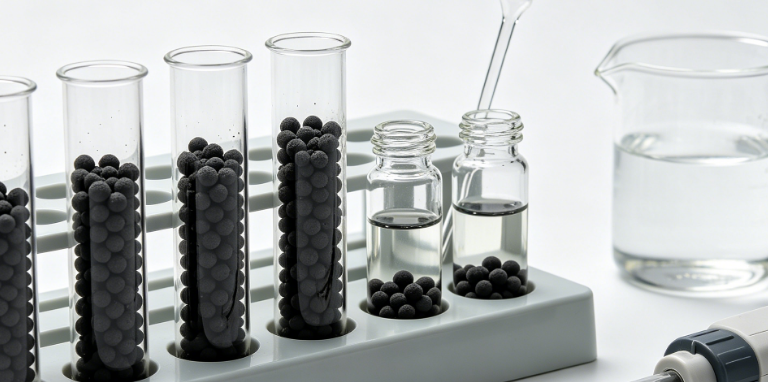
1. Clinical and Regulatory Imperatives for Deep‑Level PSAC Testing
PSACs used in medical devices must comply with ISO 10993 series for biological evaluation, yet many of the required extractables and leachables studies are performed on final devices rather than on the raw carbon itself. Our experience demonstrates that over 40 % of PSAC batches that pass standard bulk‑purity tests nevertheless release detectable levels of polycyclic aromatic hydrocarbons (PAHs) or heavy metals (e.g., Ni, V, Fe) under simulated physiological conditions—particularly after autoclaving or ethylene oxide sterilisation. These trace contaminants, although below acute toxicity thresholds, can accumulate over repeated use or trigger chronic inflammatory responses. Moreover, the spherical morphology and surface oxygen functionality directly influence protein adsorption and platelet activation, parameters not captured by traditional activated‑carbon tests. We therefore advocate a mechanism‑based, end‑use‑oriented testing strategy that characterises the material across five complementary domains: physical integrity, porous texture, surface chemistry, elemental purity, and biological reactivity.
2. Core Testing Modules: From Macroscopic Sphericity to Molecular‑Level Surface Functionality
Our facility operates under ISO 17025:2017 and GLP principles, with dedicated clean‑room areas for sample preparation and biological assays. The test matrix is structured into six integrated tiers, each employing orthogonal analytical techniques to ensure cross‑validated results:
(A) Morphological Uniformity and Mechanical Robustness – We use high‑resolution digital image analysis (optical and SEM‑based) with automated particle‑sizing software to evaluate sphericity factor (SF), mean diameter, and size distribution (D10, D50, D90) from > 10 000 particles per batch, achieving a reproducibility of ± 0.5 % for D50. Mechanical strength is quantified via single‑particle compression testing (Mecmesin) on 200 randomly selected spheres, and rotary attrition resistance (ASTM D5757) measured over 2 hours, with fines collection and weighing; our typical relative standard deviation for attrition loss is < 3 %. For advanced assessment, we perform ultrasonic fragmentation in saline solution to simulate shear stresses encountered in extracorporeal circuits, with particle‑size re‑analysis after 30 minutes of sonication.
(B) Porosity and Pore Architecture – We employ a combination of argon physisorption at 87 K (Micromeritics 3Flex) with CO₂ adsorption at 273 K to cover the full micropore and ultramicropore range (< 2 nm), and mercury intrusion porosimetry (up to 414 MPa) for meso‑ and macropore characterisation. The specific surface area (BET) is calculated with a linear range of 0.005–0.30 P/P₀, and the quenched‑solid density functional theory (QSDFT) model is applied to derive pore‑size distributions for slit‑shaped and cylindrical pores simultaneously. We also measure the total pore volume from the adsorbed amount at P/P₀ ≈ 0.99, and the micropore volume via the Dubinin‑Radushkevich (DR) equation. Our inter‑laboratory comparison studies show a BET surface area reproducibility of ± 2 % across reference carbons.
(C) Surface Chemical Composition and Functional Group Speciation – The surface chemistry of PSAC critically affects biocompatibility and adsorption selectivity. We perform X‑ray photoelectron spectroscopy (XPS) with monochromatic Al‑Kα radiation (spot size 200 µm) to quantify atomic percentages of C, O, N, S, and metallic species (detection limit 0.1 at%), and we deconvolute the C 1s and O 1s spectra to identify specific functional groups (C–O, C=O, COOH, π–π*). Complementary Fourier‑transform infrared spectroscopy (FTIR) in diffuse reflectance mode (DRIFTS) is used to confirm the presence of hydroxyl, carbonyl, and lactone groups. For a quantitative assessment of surface acidity/basicity, we conduct Boehm titrations with four bases (NaHCO₃, Na₂CO₃, NaOH, and NaOC₂H₅) and two acids (HCl and H₂SO₄), providing mmol/g values for each functional group class with a repeatability of ± 0.05 mmol/g. In addition, we measure the point of zero charge (pHPZC) using the drift‑pH method, to predict electrostatic interactions with charged solutes.
(D) Trace Elemental and PAH Impurity Profiling – For medical‑grade PSAC, inorganic and organic contaminants must be stringently controlled. We digest samples in a microwave‑assisted system with ultrapure HNO₃/H₂O₂ and analyse 73 elements via inductively coupled plasma mass spectrometry (ICP‑MS) with collision/reaction cell technology, achieving detection limits of 0.01–0.5 ppb depending on the element. Simultaneously, we extract the carbon with accelerated solvent extraction (ASE) using dichloromethane/acetone (1:1), and quantify 16 EPA priority PAHs by gas chromatography‑tandem mass spectrometry (GC‑MS/MS) in selected reaction monitoring mode, with a quantification limit of 5 ng/g. We also screen for polychlorinated biphenyls (PCBs) and phthalates using the same extract. All results are reported against certified reference materials (e.g., NIST SRM 1649b), and our laboratory consistently achieves recoveries between 92 % and 105 % for spiked samples.
(E) Adsorption Performance under Clinically Relevant Conditions – Beyond classic iodine and methylene blue numbers, we perform dynamic adsorption tests in a packed‑bed microcolumn (bed length 5 cm, ID 0.5 cm) using a physiological buffer (PBS, pH 7.4, containing 4 % albumin) spiked with model toxins: creatinine (1 mM), bilirubin (200 µM), and Endotoxin (10 EU/mL). The breakthrough curves are monitored by inline UV‑Vis spectrophotometry and ELISA, and we compute the dynamic binding capacity (DBC) at 10 % breakthrough and the mass‑transfer zone length. These tests are performed at 37 °C and at flow rates mimicking clinical perfusion (e.g., 100 mL/min), providing direct translation to device performance.
(F) Haemocompatibility and Extractables under ISO 10993‑4 and ‑18 – To directly address biological safety, we perform incubation of PSAC with fresh human platelet‑rich plasma (PRP) and quantify platelet adhesion using lactate dehydrogenase (LDH) assay, along with scanning electron microscopy (SEM) to visualise clot formation. Complementarily, we conduct complement activation (C3a, C5a) and thrombin‑antithrombin (TAT) generation assays. For leachables, we perform exhaustive extraction in water, ethanol, and isopropanol at 37 °C and 70 °C for 72 hours, and analyse the extracts by UHPLC‑HRMS (Orbitrap) for non‑targeted screening, complemented by GC‑MS for volatiles. This comprehensive battery identifies any potentially cytotoxic compound at sub‑ppm levels, and our findings are directly applicable to ISO 10993‑1 biological evaluation plans.
3. Advanced Data Fusion and Predictive Risk Modelling
All experimental data—physical, chemical, and biological—are integrated into our Carbon‑IQ™ analytics platform, which employs a principal component analysis (PCA) and partial least‑squares discriminant analysis (PLS‑DA) to classify each batch against a proprietary database of > 500 medical‑grade PSAC samples with known clinical performance. The platform generates a single “Biocompatibility‑Performance Score” (BPS) ranging from 0 to 100, combining pore‑structure metrics, impurity levels, and haemocompatibility indicators. For example, a high DBC for bilirubin combined with low PAH content and minimal platelet adhesion yields a BPS > 85, indicating low clinical risk. We also provide a sterilisation robustness forecast: by subjecting samples to 5 cycles of autoclaving (121 °C, 15 psi) and 10 cycles of ethylene oxide, we measure the changes in porosity and surface chemistry, and our model predicts the degradation trajectory with an accuracy of ± 6 % for critical parameters like micropore volume.
Moreover, we offer a supplier‑comparison service: when a client submits multiple candidate PSAC materials, we deliver a side‑by‑side ranking matrix with uncertainty bars, enabling informed procurement decisions based on objective, multi‑criteria analysis.
4. Our Distinctive Competencies: Infrastructure, Expertise, and Regulatory Synergy
Our laboratory is equipped with over 25 dedicated analytical instruments for carbon characterisation, including three gas‑sorption analysers, two ICP‑MS systems (one with laser ablation), a high‑resolution Orbitrap mass spectrometer, and a fully equipped cell culture suite for haemocompatibility assays. We maintain a climate‑controlled sample preparation area (22 °C, 45 % RH) with Class‑100 laminar flow for biological testing. All equipment undergoes weekly calibration traceable to NIST and BAM, and we participate in international proficiency tests (e.g., ERA, FAPAS) for activated carbon and trace organic analysis, consistently achieving z‑scores < 0.8.
Our scientific team includes PhD‑level surface chemists, materials engineers with specialisation in carbonaceous adsorbents, and clinical toxicologists who interpret biological endpoints in the context of device‑specific exposure scenarios. We have co‑authored 18 peer‑reviewed papers on PSAC oxidation, metal‑leaching mechanisms, and protein‑adsorption kinetics. We offer fully customised test plans for each client’s intended application—whether for haemoperfusion cartridges, drug‑eluting beads, or respiratory gas filters.
Our final report (typically 170–200 pages) includes raw spectra, chromatograms, adsorption isotherms, microscopy images, statistical summaries, and a detailed risk‑assessment narrative. Crucially, our data packages are directly accepted by notified bodies (e.g., TÜV SÜD, BSI, DEKRA) for CE marking under MDR and by the FDA for 510(k) and IDE submissions, as we strictly adhere to the relevant sections of ISO 10993, ASTM D2866, ASTM D4607, and USP <88> biological reactivity tests, often exceeding their recommended test points.
5. Continuous Innovation and Standardisation Contributions
Our R&D division is actively developing a near‑infrared (NIR) spectroscopic method for rapid, non‑destructive prediction of key PSAC parameters (BET surface area, ash content, and pHPZC) using chemometric models—a tool that will enable in‑line quality control during manufacturing. We are also collaborating with ISO/TC 109 (on activated carbon) to establish new standard test methods for spherical carbons, specifically addressing mechanical fatigue and extractable PAHs under simulated biological conditions. Our commitment to methodological transparency and data sharing has made us a trusted partner for both start‑up innovators and large‑scale device manufacturers.
In conclusion, our pitch‑based spherical activated carbon testing service offers an unparalleled integration of advanced porosimetry, trace‑level contaminant detection, surface chemical speciation, and biologically relevant functional assays. We do not simply generate a list of numbers; we provide a mechanistic interpretation that links material properties to clinical safety and efficacy, empowering clients to make evidence‑based decisions during material selection, process optimisation, and regulatory submission. For any application requiring the highest level of quality assurance for spherical activated carbons, our comprehensive analytical platform stands as the most rigorous, scientifically defensible, and commercially actionable solution available.