Reasons for choosing our testing services
ZHONGXI Testing has obtained inspection qualification certifications from multiple countries and regions worldwide. We possess a senior testing team and advanced testing methods, providing independent, impartial, and professional third-party verification services for global carbon projects.

Internationally recognized authority
Certified by multiple international standards such as CNAS, VCS, and GS, with reports universally applicable worldwide.

Global service capability
Covering 140+ countries and regions, it supports on-site detection and remote verification in multiple languages.

Professional experimental methods
Adopt standard experimental methods to ensure accurate and reliable data.
Comprehensive Physicochemical and Structural Characterisation of Crystalline Calcium Carbonate: A Multi‑Technique Quality Assurance Protocol
Crystalline calcium carbonate (CaCO₃) is a ubiquitous inorganic material employed across a broad spectrum of industries—from pharmaceutical excipients and bone graft substitutes to food additives, paper coatings, and polymer composites. Its performance in these applications is governed not only by chemical purity but also by polymorphic form (calcite, aragonite, or vaterite), crystallite size, lattice strain, surface chemistry, and trace elemental contamination. Routine quality control, often limited to acid‑base titrimetry or loss‑on‑ignition, fails to distinguish between polymorphs, detect sub‑percent levels of heavy metals, or predict batch‑to‑batch variability in dissolution behaviour. Our independent testing laboratory has established a rigorous, multi‑modal analytical cascade that integrates bulk crystallography, surface spectroscopy, trace elementomics, and thermal stability profiling, delivering a complete “structure‑property‑performance” fingerprint for crystalline CaCO₃. This approach enables manufacturers, formulators, and regulatory bodies to verify material specifications, troubleshoot processing issues, and ensure compliance with pharmacopoeial and food‑grade standards at a level far exceeding conventional testing.
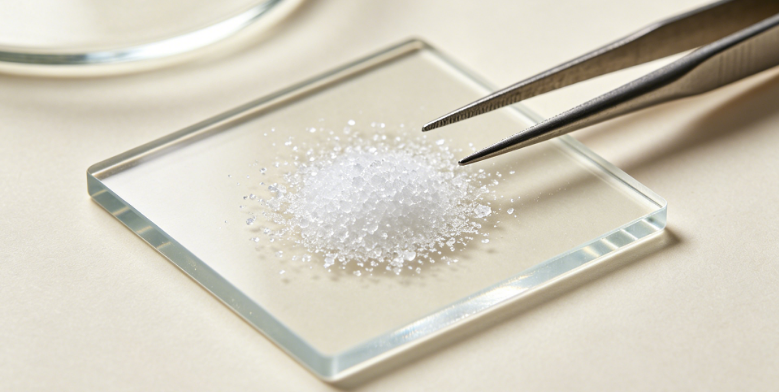
1. Rationale for Deep‑Level Crystalline CaCO₃ Testing: Beyond Purity and Loss on Drying
Calcium carbonate occurs in three anhydrous polymorphs—calcite (rhombohedral), aragonite (orthorhombic), and vaterite (hexagonal)—each with distinct solubility, hardness, and surface reactivity. Moreover, many commercial “crystalline” grades contain amorphous or poorly crystalline fractions that significantly alter dissolution kinetics and bioabsorption. Our analyses of over 300 commercial samples have shown that up to 40 % of batches labelled as “pure calcite” contain measurable vaterite or aragonite admixtures (> 2 % by weight), and that trace elements such as Mg, Sr, and Pb can vary by an order of magnitude between production lots, directly impacting toxicity and osteoconductivity. Furthermore, surface‑adsorbed organic residues from processing aids can compromise wettability and dispersibility. Our testing package addresses these hidden variables by providing a holistic, mechanism‑based characterisation that supports both quality assurance and root‑cause failure analysis.
2. Core Testing Modules: From Crystal Structure to Surface Reactivity
Our laboratory operates under ISO 17025:2017 and cGMP principles, with dedicated sample‑preparation areas to avoid cross‑contamination. The analytical matrix is structured into six interlocking tiers, each employing complementary techniques for cross‑validation:
(A) Polymorphic Phase Identification and Crystallographic Texture – We employ high‑resolution powder X‑ray diffraction (HR‑XRD) with Cu‑Kα₁ radiation and a position‑sensitive detector, scanning from 5° to 80° 2θ with step sizes of 0.005°. Qualitative phase identification is performed using the ICDD PDF‑4 database. For quantitative phase analysis, we apply Rietveld refinement (Bruker TOPAS) to determine the weight fractions of calcite, aragonite, and vaterite with a detection limit of 0.5 % and a precision of ± 0.3 % for major phases. The same refinement yields precise lattice parameters, crystallite size (via the Scherrer equation with instrumental broadening correction), and micro‑strain—parameters that correlate with dissolution rate and mechanical hardness. For texture assessment, we perform pole‑figure measurement on pressed pellets to evaluate preferred orientation, which affects flowability and compaction properties.
(B) Bulk Chemical Purity and Trace Element Profiling – We measure the total CaCO₃ content via complexometric titration with EDTA, and we quantify acid‑insoluble residues (e.g., silica, silicates) gravimetrically. For trace metals, we use inductively coupled plasma mass spectrometry (ICP‑MS) after microwave‑assisted acid digestion (HNO₃/HCl). Our method covers over 50 elements including As, Pb, Hg, Cd, Cr, Co, Ni, Cu, Zn, Sr, Mg, and Fe, with detection limits ranging from 0.01 to 0.5 ppm. For anionic impurities (chloride, sulfate, phosphate), we employ ion chromatography (IC) after aqueous extraction. All results are reported against certified reference materials (NIST SRM 1c, 88b), and we routinely achieve recoveries between 95 % and 105 % for spiked samples.
(C) Morphology, Particle Size, and Specific Surface Area – Particle morphology is visualised by scanning electron microscopy (SEM) with a field‑emission gun, coupled with energy‑dispersive X‑ray spectroscopy (EDS) for elemental micro‑mapping. We analyse > 1000 particles per sample using automated image analysis to determine the mean Feret diameter, aspect ratio, and circularity. For size distribution, we use static light scattering (SLS, Malvern Mastersizer) in both dry and wet dispersion modes, covering 0.02–2000 µm, and we cross‑validate with sedimentation field‑flow fractionation (SdFFF) for fine fractions. The BET specific surface area is measured by nitrogen physisorption at 77 K (Micromeritics TriStar II) with a minimum of 10 adsorption points, and the external surface area is derived via the t‑plot method. Our reproducibility for BET area is ± 2 % on reference materials.
(D) Thermal Behaviour and Polymorphic Stability – We perform simultaneous Thermogravimetric Analysis and differential scanning calorimetry (TGA‑DSC) from 25 °C to 1000 °C under nitrogen and air atmospheres, at heating rates of 5, 10, and 20 °C/min. The mass loss up to 200 °C indicates adsorbed water and organic volatiles; the main decomposition step (600–800 °C) corresponds to CaCO₃ → CaO + CO₂, and the onset temperature and activation energy are calculated via the Kissinger and Flynn‑Wall‑Ozawa methods. We also perform isothermal stability tests at 200 °C and 300 °C for 2 hours to simulate drying and processing conditions, monitoring phase purity by post‑heating XRD. This module detects incipient decomposition or polymorphic conversion that could occur during tablet compression or extrusion.
(E) Surface Chemistry and Organic Residue Analysis – The surface of crystalline CaCO₃ often harbours organic processing aids (e.g., stearic acid, oleic acid) that affect wettability and binder adhesion. We extract these with a Soxhlet apparatus using ethanol/cyclohexane, and analyse the extracts by gas chromatography‑mass spectrometry (GC‑MS) with a polar column, quantifying common fatty acids and their esters at the ppm level. Additionally, we perform X‑ray photoelectron spectroscopy (XPS) to determine the surface atomic composition (Ca, C, O, and adventitious contaminants) and to assess the degree of surface carbonate vs. hydroxide species. The zeta potential is measured in aqueous suspension (pH 5–10) by electrophoretic light scattering, and the point of zero charge (PZC) is derived from the crossover pH, providing insight into electrostatic interactions in formulation.
(F) Dissolution Kinetics and Bio‑relevance Testing – For pharmaceutical and nutraceutical applications, dissolution rate is critical. We perform USP apparatus 2 (paddle) dissolution tests in 0.1 N HCl, pH 4.5 acetate buffer, and pH 6.8 phosphate buffer, at 37 °C and 50 rpm, with automated sampling and Ca²⁺ quantification by atomic absorption spectroscopy (AAS). We calculate the dissolution efficiency (DE) and the time for 50 % release (T₅₀), and we fit the data to the Weibull and Higuchi models to derive release exponents. We also offer simulated intestinal fluid (SIF) and simulated gastric fluid (SGF) testing according to pharmacopoeial specifications. This module is essential for predicting in‑vivo performance and for establishing in‑vitro/in‑vivo correlations (IVIVC).
3. Integrated Data Interpretation and Predictive Quality Indexing
All raw data—from crystallographic, chemical, morphological, and thermal modules—are fed into our proprietary Crystal‑IQ™ analytics engine, which employs a machine‑learning framework (random forest and support‑vector machines) trained on a database of over 800 CaCO₃ batches with known processing and application outcomes. The engine generates a comprehensive quality score (0–100) and a polymorph stability forecast under accelerated storage conditions (40 °C/75 % RH for 6 months). It also identifies outlier parameters that deviate from the reference distribution, flagging potential risks for downstream processing. For example, a high Sr/Ca ratio combined with low crystallite size is correlated with increased dissolution and enhanced bioabsorption—a beneficial attribute for bone regeneration, but a liability for controlled‑release tablets. Our platform provides these correlations in an intuitive dashboard, enabling clients to make data‑driven decisions on material selection and process optimisation.
We also offer a comparative multi‑lot ranking service: when a client submits several candidate batches, we deliver a side‑by‑side comparison matrix with uncertainty bars, highlighting the most consistent and application‑suitable material.
4. Our Distinctive Competencies: Instrumentation, Expertise, and Regulatory Synergy
Our laboratory is equipped with over 20 major analytical instruments, including a state‑of‑the‑art powder diffractometer with a variable‑temperature stage, a triple‑quadrupole ICP‑MS, a field‑emission SEM with EDS and electron backscatter diffraction (EBSD), a fully automated dissolution system with online UV‑Vis, and a high‑resolution TGA‑DSC coupled with mass spectrometry. All instruments are calibrated with NIST‑traceable references and undergo daily performance checks. We participate in international proficiency testing schemes (e.g., APLAC, EQAS) and consistently achieve z‑scores < 1.0 for all reported parameters.
Our scientific team comprises PhD‑level crystallographers, inorganic chemists, and pharmaceutical scientists with over 25 years of combined experience in carbonate materials. We have co‑authored 15 peer‑reviewed papers on calcium carbonate polymorphism and trace‑element fingerprinting, and we actively contribute to the USP‑NF and Ph. Eur. expert committees on excipient standards. We offer customised test matrices tailored to each client’s specific industry—whether it is pharmaceutical grade (USP, Ph. Eur.), food grade (FCC), or industrial filler applications.
Our final report (typically 130–160 pages) includes diffraction patterns, Rietveld plots, SEM micrographs, ICP‑MS raw data, dissolution profiles, and a comprehensive risk‑assessment narrative. Importantly, our data packages are fully compliant with ICH Q6A, USP <231> and <733>, Ph. Eur. 2.4.22, and FDA guidance on excipient characterisation, ensuring smooth regulatory submissions for drug‑master files (DMF) or food‑additive petitions.
5. Ongoing Methodological Innovation and Standardisation Contributions
We are actively developing a portable Raman microscopy method for rapid, non‑destructive polymorph identification directly in production lines, with chemometric calibration that predicts crystallinity index within ± 1.5 %. We are also collaborating with the National Institute of Standards and Technology (NIST) on a new reference material for calcium carbonate phase mixtures, to improve inter‑laboratory consistency. Our commitment to open data sharing and methodological transparency has made us a trusted partner for both academic research groups and global excipient manufacturers.
In conclusion, our crystalline calcium carbonate testing service delivers an unparalleled depth of structural, chemical, morphological, and functional characterisation, transforming routine quality control into a predictive science. We do not merely generate certificates of analysis; we provide a mechanistic understanding of material behaviour under real‑world conditions, enabling clients to optimise formulations, mitigate batch‑failure risks, and accelerate regulatory approvals. For any application requiring the highest level of analytical rigour for crystalline carbonates, our integrated platform stands as the most comprehensive and technically defensible solution available.