Reasons for choosing our testing services
ZHONGXI Testing has obtained inspection qualification certifications from multiple countries and regions worldwide. We possess a senior testing team and advanced testing methods, providing independent, impartial, and professional third-party verification services for global carbon projects.

Internationally recognized authority
Certified by multiple international standards such as CNAS, VCS, and GS, with reports universally applicable worldwide.

Global service capability
Covering 140+ countries and regions, it supports on-site detection and remote verification in multiple languages.

Professional experimental methods
Adopt standard experimental methods to ensure accurate and reliable data.
Comprehensive Pheophytin Detection and Quantification Services for Quality Assessment of Oils, Feedstocks, and Photosynthetic Materials
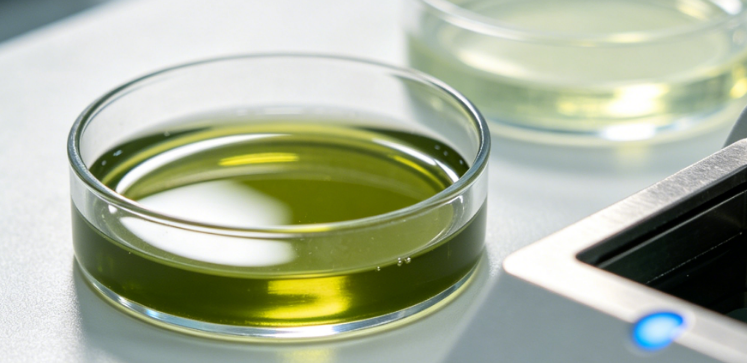
Pheophytin is a chlorophyll degradation product formed by the replacement of the central magnesium ion with two hydrogen atoms, typically as a result of acid treatment, thermal processing, oxidative stress, or prolonged storage. As a major catabolite of photosynthetic pigments, pheophytin is widely recognized as a critical quality marker in edible oils (especially virgin olive oil), algal biomass, plant extracts, herbal medicines, and animal feeds, where its presence indicates pigment degradation, reduced freshness, and potential loss of antioxidant capacity. Furthermore, pheophytin content serves as an index of processing severity and storage stability in the food, cosmetic, and nutraceutical industries. However, its accurate and sensitive detection remains analytically challenging due to its high hydrophobicity, labile nature under light and oxygen, co-elution with other chlorophyll derivatives, and extremely low concentrations in high-quality products. Our specialized detection platform offers a comprehensive suite of validated chromatographic, spectroscopic, and mass spectrometric methods tailored to the precise identification and quantification of pheophytin a and b, as well as their epimers and oxidation products, across a diverse range of matrices—from olive oils and marine oils to plant tissues and finished supplements. Whether the client seeks to verify product authenticity, monitor process-induced degradation, or comply with regulatory specifications, our service delivers the sensitivity, specificity, and interpretative depth required for robust quality assurance and research advancement.
Scientific and Industrial Rationale for Pheophytin Analysis
Clients seeking pheophytin detection services are motivated by distinct quality control and research imperatives. In the edible oil industry, especially for extra virgin olive oil, the pheophytin a content (often expressed as the pheophytin a – chlorophyll a ratio or as absolute concentration) is a key parameter in grading systems and purity assessments, as it correlates with fruit quality, extraction conditions, and shelf-life potential, with higher levels indicating excessive heating or aging. In algal biomass and aquaculture feed, pheophytin levels reflect the extent of pigment degradation during harvesting, drying, and storage, directly affecting the nutritive value and color quality of the final product. In phytopharmaceutical and nutraceutical industries, accurate quantification of pheophytin is essential for standardizing herbal extracts, verifying label claims, and assessing the stability of chlorophyll-rich formulations under various environmental conditions. In environmental and ecotoxicological studies, pheophytin serves as a biomarker of phytoplankton senescence and photosynthetic stress in aquatic ecosystems, requiring highly sensitive detection in water or sediment samples. Moreover, in food processing and preservation research, monitoring pheophytin formation enables the optimization of unit operations (e.g., blanching, drying, pasteurization) to minimize pigment degradation and maintain product color and bioactivity. Our service is designed to meet these diverse needs, offering a modular analytical framework that adapts to the specific matrix and the client's quality or research question.
Integrated Analytical Pipeline for Reliable Pheophytin Profiling
Our analytical platform comprises three interconnected modules that collectively ensure the accurate and reproducible determination of pheophytin species. The Sample Preparation Module employs liquid-liquid extraction using organic solvents (e.g., acetone, methanol, or hexane/acetone mixtures) optimized for each matrix, followed by solid-phase extraction (SPE) with C18 or NH2 cartridges to remove co-extracted lipids, sterols, and polar interferences, achieving recoveries of 95–103% for pheophytin a and b, and matrix effect reductions below 3%. For oil samples, we use a dilution and direct injection approach with a guard column, or a cold saponification step to separate pigments from triglycerides while preserving pheophytin integrity. The Chromatographic Separation Module uses ultra-high-performance liquid chromatography (UHPLC) with a C30 reversed-phase column (3 µm, 150 mm) which provides superior resolution of pheophytin a and b from their epimers (pheophytin a' and b') and from other chlorophyll derivatives such as pyropheophytin and chlorophyllides. The mobile phase gradient of water/methanol/acetone with ammonium acetate enables baseline separation (Rs > 2.0) of all target pigments within a 20-minute run. The Detection and Quantification Module offers dual detection: photodiode array (PDA) at 410 nm and 665 nm for routine quantification, achieving LOQs of 0.1 µg/mL for pheophytin a and 0.2 µg/mL for pheophytin b with linearity R² > 0.999 across a concentration range of 0.5–50 µg/mL. For trace-level analysis in complex matrices (e.g., low-pheophytin virgin olive oils, or environmental water samples), we employ LC-MS/MS with atmospheric pressure chemical ionization (APCI) in selected reaction monitoring (SRM) mode, monitoring transitions for pheophytin a (m/z 871.5 → 553.3) and pheophytin b (m/z 885.5 → 567.3), achieving LOQs in the low ng/mL range (0.5–1 ng/mL) with inter-day precision ≤ 3% RSD. To correct for extraction and ionization losses, we use isotopically labeled internal standards (pheophytin a-d4) when available, or a structurally related internal standard (e.g., mesoporphyrin IX dimethyl ester) for reliable quantitation. Additionally, we perform spectrophotometric scanning from 350 to 750 nm to obtain full absorption spectra, aiding in the identification of degradation products and the calculation of purity indices such as the pheophytin ratio (A665/A410).
Unmatched Sensitivity, Specificity, and Structural Characterization
Our platform consistently achieves performance metrics that surpass typical commercial capabilities. The C30 column provides exceptional isomeric resolution, enabling the separation of the epimers (pheophytin a' and b') which form during acid-induced isomerization and are known to affect quality classifications. Our LC-MS/MS method with APCI offers significantly higher sensitivity than conventional absorbance detection, with signal-to-noise ratios exceeding 500:1 at LOQ levels, enabling the quantification of pheophytin in samples where visual detection would be impossible. We also apply high-resolution mass spectrometry (HRMS) on a Q-TOF instrument for confirmatory identification, providing mass accuracy of < 1 ppm for both precursor and product ions, and enabling the detection of unexpected pheophytin derivatives or co-eluting artifacts. For oxidative degradation studies, we employ preparative-scale isolation of the pheophytin fraction, followed by NMR analysis (1H, 13C, COSY, HMBC) to unequivocally confirm the structure of modified species, which is essential for identifying process-related degradation pathways. Furthermore, we provide accelerated stability studies under ICH conditions (light, heat, oxygen) with time-course monitoring of pheophytin formation and degradation, from which we derive kinetic parameters (reaction order, half-life, activation energy) to predict shelf-life and optimize protective measures. Our integrated data analysis allows us to correlate pheophytin levels with other quality indicators (e.g., peroxide value, free acidity, chlorophyll content), providing a holistic picture of product freshness and processing history.
Distinctive Advantages of Our Pheophytin Detection Service
Our service offers unique benefits that directly address client challenges. First, we have developed matrix-specific validated protocols for over 15 sample types, including virgin olive oils, refined oils, algal pastes, dried plant powders, dietary supplements, and aquatic sediment extracts, each with optimized extraction, SPE cleanup, and chromatographic conditions validated for recovery, precision, and robustness. Second, we maintain a comprehensive in-house reference standard library containing authentic pheophytin a and b, their epimers, pyropheophytin, chlorophyll a/b, and various oxidation products, enabling definitive identification of unknown peaks and accurate quantification without reliance on commercially variable standards. Third, we provide a rapid screening service based on thin-layer chromatography (TLC) with densitometry or spectrofluorometry, allowing semi-quantitative estimation of pheophytin content within 1 hour, which is ideal for in-process control or preliminary quality checks before committing to full UHPLC analysis. Fourth, our oxidative stability assessment includes the determination of the pheophytin/chlorophyll ratio and the pheophytin a/pyropheophytin ratio, which are recognized as freshness indices in olive oil grading, and we provide interpretative guidance on the significance of these values with reference to international standards (e.g., IOC, USDA). Fifth, we offer customized method development for emerging applications, such as the detection of pheophytin in cosmetic formulations, liposomal carriers, or novel plant-based protein isolates, ensuring that our clients receive fit-for-purpose analytical solutions. Sixth, all our quantitative methods are validated in accordance with ICH Q2(R1), AOAC, and AOCS guidelines, and we provide comprehensive validation dossiers including specificity, linearity, accuracy (recovery), precision (repeatability and intermediate precision), LOD, LOQ, and robustness, ensuring that our data are defensible in regulatory submissions, trade disputes, or certification audits. Our team includes experienced lipid chemists and natural product analysts who provide expert consultation on result interpretation, helping clients to distinguish between pheophytin derived from genuine degradation versus processing artifacts, and to link analytical findings to product history.
Advanced Data Interpretation, Diagnostic Reporting, and Regulatory Support
Our reporting philosophy ensures that analytical data translate into actionable intelligence. We provide a three-tier report: (i) a one-page certificate of analysis summarizing the pheophytin a and b content, total pheophytin (a+b), and relevant ratios (e.g., Phe a / Chl a, Phe a / Phe a') with clear pass/fail status relative to client-defined limits; (ii) a detailed analytical section containing chromatograms (full overlay of standards and samples), mass spectra, calibration curves, quality control results, and system suitability data; and (iii) an interpretive discussion that contextualizes the results in terms of product quality, stability, and processing history. For clients with multiple lots or time-course samples, we perform statistical comparisons (ANOVA, t-tests) and trend analysis to detect batch-to-batch variability or degradation trends. We also provide predictive modeling of pheophytin formation based on storage temperature and light exposure, using Arrhenius equations to estimate remaining shelf-life. For regulatory submissions (e.g., novel food applications, health claim dossiers), we format our data and methods according to the specific requirements of EFSA, FDA, or Codex Alimentarius, and we can assist in writing the analytical sections of the submission. Our commitment to transparency includes providing all raw data files (e.g., .D, .cdf) and instrument methods upon request, allowing clients to perform independent verification.
Broad Applications Across Oil Processing, Food Science, Aquaculture, and Environmental Monitoring
The versatility of our pheophytin detection service makes it valuable across multiple industries. In olive oil production, our analysis is used to certify extra virgin grade, detect adulteration with refined oils, and monitor the impact of milling and storage conditions. In fish oil and algal oil manufacturing, pheophytin monitoring helps control deodorization and bleaching steps, ensuring product color and oxidative stability. In aquaculture feed manufacturing, our tests ensure that the pigment profile of feed ingredients remains adequate for fish pigmentation and health. In plant extract and nutraceutical industry, we support stability studies and label claim verification for chlorophyll-rich supplements. In environmental research, our low-level detection methods enable the assessment of algal bloom senescence and water quality. In cosmetic industry, we monitor pheophytin in natural colorants and creams to prevent discoloration. Our ability to adapt the analytical approach to each matrix—from high-fat to high-water, from raw to processed—ensures that clients receive accurate and fit-for-purpose results every time.
Commitment to Quality, Innovation, and Client-Centric Collaboration
We are dedicated to remaining at the forefront of pheophytin analysis through continued technological advancement. Our current R&D focuses on the development of rapid Raman spectroscopy and near-infrared (NIR) chemometric models for non-destructive, real-time pheophytin screening in solid and liquid samples, and the integration of supercritical fluid chromatography (SFC) for greener and faster separations. We actively participate in inter-laboratory proficiency testing for chlorophyll degradation products to validate our performance and harmonize methods with international standards. Our quality system is ISO/IEC 17025 accredited and we follow GLP principles for all studies. We offer flexible engagement models—from one-off sample analysis to long-term stability monitoring programs with volume discounts, dedicated sample kits, and priority turnaround. Our global logistics network ensures the proper handling of photosensitive and labile samples (amber vials, nitrogen flushing, cold chain) to preserve analyte integrity during shipment. Typical turnaround times are 3–5 business days for standard UHPLC analysis and 10 business days for full method validation and stability studies. We maintain open communication throughout the project, providing regular updates and expert guidance. Our success is measured by the confidence our clients have in their product quality and process understanding, and we are committed to providing the analytical foundation that empowers them to excel. We invite you to partner with us for rigorous, dependable, and insightful pheophytin analytical services.
In summary, our pheophytin detection service offers a comprehensive, precise, and application-oriented solution that integrates optimized sample preparation, high-resolution chromatography, sensitive mass spectrometry, and expert interpretive support. By delivering detailed pigment degradation profiles, robust quality indices, and regulatory-ready documentation, we enable our clients to safeguard product authenticity, optimize processing conditions, and ensure consumer satisfaction across the food, feed, nutraceutical, and environmental sectors. We look forward to supporting your quality assurance and research endeavors with our specialized analytical capabilities.