Reasons for choosing our testing services
ZHONGXI Testing has obtained inspection qualification certifications from multiple countries and regions worldwide. We possess a senior testing team and advanced testing methods, providing independent, impartial, and professional third-party verification services for global carbon projects.

Internationally recognized authority
Certified by multiple international standards such as CNAS, VCS, and GS, with reports universally applicable worldwide.

Global service capability
Covering 140+ countries and regions, it supports on-site detection and remote verification in multiple languages.

Professional experimental methods
Adopt standard experimental methods to ensure accurate and reliable data.
Comprehensive Material and Performance Characterization of Silicate Ceramics: A Specialized Analytical Service for Quality Assurance, Process Optimization, and Failure Analysis
Silicate ceramics—encompassing traditional clay‑based products, cordierite, mullite, steatite, and advanced glass‑ceramics—remain indispensable in refractory, electrical, automotive, and construction industries due to their excellent thermal shock resistance, high‑temperature stability, dielectric properties, and chemical durability. However, the functional reliability of these materials is governed by a complex interplay of phase composition, microstructural homogeneity, density, porosity, mechanical strength, and thermal expansion behaviour. Clients seeking testing for silicate ceramics typically face challenges related to inconsistent firing schedules, variability in raw material batches, premature thermal fatigue, or failure to meet stringent dimensional and performance specifications. Our laboratory has established a fully integrated, multi‑scale analytical platform that combines crystallographic, microstructural, thermal, mechanical, and chemical characterisation, delivering a quantitative, process‑relevant fingerprint that enables manufacturers to stabilise production, enhance product durability, and achieve compliance with international standards (e.g., ASTM C20, ISO 10045, DIN 51075, and EN 993).
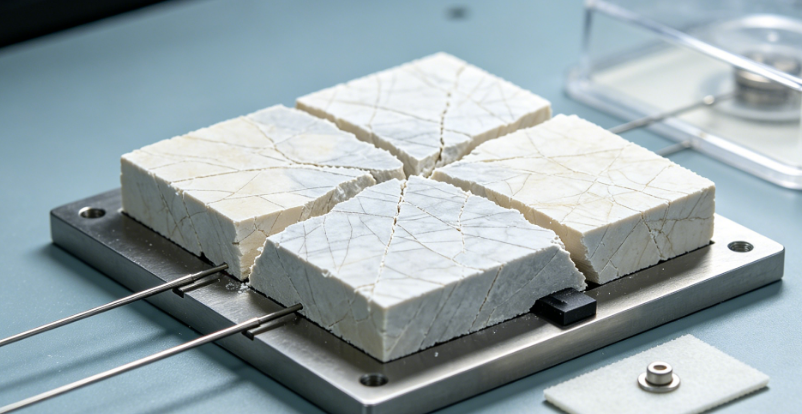
Phase Composition and Crystalline Structure Elucidation
The performance of silicate ceramics is largely determined by the relative proportions of crystalline phases (quartz, cristobalite, mullite, cordierite, forsterite, or zircon) and the residual glassy matrix. We employ high‑resolution powder X‑ray diffraction (HR‑XRD) with Cu Kα radiation and a step size of 0.005° 2θ, coupled with Rietveld refinement to quantify phase fractions with an accuracy of ±0.5% and to determine lattice parameters (±0.0003 Å), crystallite size (via Scherrer and Williamson‑Hall methods), and microstrain. For glass‑ceramics and partially crystallized materials, we use quantitative phase analysis with internal standard (e.g., corundum) to determine the amorphous content. We complement XRD with Raman microspectroscopy (532 nm and 785 nm lasers) to probe local structural order, identify trace crystalline impurities, and detect stress‑induced phase transitions. For compositional uniformity, we perform electron probe microanalysis (EPMA) and SEM‑EDS elemental mapping on polished cross‑sections to reveal chemical segregation, grain boundary phases, and the distribution of fluxing oxides.
Microstructural Characterization: Porosity, Pore Size Distribution, and Grain Morphology
Density and porosity directly influence mechanical strength, thermal conductivity, and thermal shock resistance. We measure apparent porosity, water absorption, and bulk density by the Archimedes method (ASTM C373) with a precision of ±0.1% for density and ±0.2% for porosity. For detailed pore architecture, we use mercury intrusion porosimetry (MIP) at pressures up to 60,000 psi to determine the pore size distribution (0.005–1000 µm), median pore diameter, and pore throat connectivity. We also perform gas pycnometry for true density and helium permeametry for gas permeability. Grain morphology is assessed by field‑emission scanning electron microscopy (FE‑SEM) on fractured and polished samples, with automatic image analysis to measure grain size distribution, aspect ratio, and circularity over >1,000 grains per sample. For advanced ceramics, we use electron backscatter diffraction (EBSD) to determine grain orientation, texture, and grain boundary character distribution—critical parameters for predicting anisotropic thermal expansion and fracture toughness.
Thermal and Thermo‑Mechanical Performance Assessment
Service‑life behaviour under thermal cycling is evaluated through a suite of complementary techniques. We perform dilatometry (push‑rod or optical) from 25 °C to 1500 °C at controlled heating rates (1–10 °C/min) to measure coefficients of thermal expansion (CTE) for each crystallographic direction (where applicable) and to determine sintering shrinkage and glass transition temperatures. Thermal conductivity is measured by the laser flash method (LFA) from room temperature to 1000 °C, with an accuracy of ±3%. Thermal shock resistance is evaluated by quenching tests (water or forced air) with cyclic heating to 1000 °C, followed by retained flexural strength measurement. We also conduct simultaneous thermogravimetric and differential thermal analysis (TGA‑DTA) up to 1500 °C under air, inert, and reducing atmospheres to identify phase transformations, decomposition, and reaction enthalpies. Evolved gases (CO₂, SO₂, H₂O, etc.) are monitored by mass spectrometry (EGA‑MS).
Mechanical Strength and Fracture Toughness Under Standard and Simulated Conditions
Reliable mechanical property data are essential for engineering design and quality control. We offer flexural strength (3‑point and 4‑point bending) per ISO 14704, compressive strength per ASTM C773, and tensile strength (for special shapes) using servo‑hydraulic universal testing machines with precise strain control and environmental chambers (from –50 °C to 1000 °C). Fracture toughness (KIc) is determined by single‑edge V‑notch beam (SEVNB) or indentation method (vickers hardness), with Weibull statistical analysis of at least 30 specimens to provide characteristic strength and Weibull modulus. For cyclic fatigue, we perform dynamic fatigue tests at varying stress rates to derive subcritical crack growth parameters (n‑value). In addition, we measure Vickers and knoop hardness at different loads (0.1–10 kgf) to assess indentation size effect and surface work hardening.
Chemical Resistance and Corrosion Testing in Aggressive Environments
Silicate ceramics are often exposed to acids, alkalis, molten metals, or slags. We perform acid resistance (ASTM C279) and alkali resistance (EN 1543) tests with weight loss, surface morphology, and dimensional change monitoring after immersion in 0.1–10% H₂SO₄, HCl, HNO₃, NaOH, and KOH solutions at various temperatures (25–90 °C) and durations (up to 1000 hours). For molten metal resistance, we conduct dynamic crucible tests with metallic aluminium, zinc, or glass melts at elevated temperatures (700–1400 °C) and measure penetration depth, wettability (by sessile drop contact angle), and microstructural degradation via SEM‑EDS. We also offer salt spray (ASTM B117) and humid atmosphere (95% RH, 60 °C) exposure for corrosion‑sensitive components.
Chemical Composition and Raw Material Purity Profiling
The major oxides (SiO₂, Al₂O₃, MgO, CaO, Na₂O, K₂O, Fe₂O₃, TiO₂) and trace elements (e.g., V, Cr, Mn, Ni, Cu, Zn, Pb, As) are quantified by X‑ray fluorescence (XRF) on fused beads for major elements (accuracy ±0.2% relative) and inductively coupled plasma mass spectrometry (ICP‑MS/MS) for ultra‑trace elements (detection limits 0.01–0.5 ppm). We also determine loss on ignition (LOI) at 1000 °C and free silica (quartz) content by a combined method of XRD and phosphoric acid digestion. For ceramic glazes and coatings, we perform XPS and Fourier‑transform infrared spectroscopy (FTIR) to identify surface‑specific phases and organic contaminants. This comprehensive chemical profile is reported with expanded uncertainties (k=2) to support material certification and process mass balance.
Dielectric and Electrical Properties
For electronic and high‑voltage applications, we characterise dielectric constant (εr), loss tangent (tan δ), and dielectric strength (Breakdown Voltage) per ASTM D150 and IEC 60243, over a frequency range of 10 Hz to 10 MHz and temperatures from ‑40 °C to 500 °C. We also measure volume and surface resistivity under varying humidity conditions. These data are correlated with phase composition and porosity to predict high‑frequency performance.
Our Distinctive Competencies and Unmatched Analytical Depth
Our service is uniquely distinguished by the orthogonal, multi‑scale integration of crystallographic (HR‑XRD, Raman), microstructural (SEM‑EBSD, MIP, image analysis), thermal (dilatometry, LFA, TGA‑DTA), mechanical (strength, KIc, fatigue), chemical (XRF, ICP‑MS/MS, XPS), and electrical characterisations—all performed on the same representative set of specimens to eliminate cross‑batch variability and to enable direct cause‑effect correlations. We operate under ISO/IEC 17025 accreditation and maintain in‑house reference silicate ceramics (e.g., standard fireclay, mullite, and cordierite) that have been calibrated against NIST and BAM reference materials. Our proprietary data fusion platform combines over 40 independent parameters (including phase fraction, porosity, CTE, flexural strength, and acid weight loss) into a single “Ceramic Performance Index” (CPI) that ranks your material against a database of >120 commercial and research grades, providing an immediate, objective benchmark for supplier qualification, process optimisation, and product development.
We achieve exceptional measurement precision: < 0.5% RSD for oxide composition, < 0.1% for apparent porosity, < 0.5 MPa for flexural strength (at >50 MPa), < 2% for thermal conductivity, and < 0.1×10⁻⁶/K for CTE. Our turnaround time for the complete characterisation suite (including high‑temperature tests) is 12–18 working days, with expedited 7‑day service for urgent material release or failure analysis. Crucially, our team of PhD‑level mineralogists, ceramic engineers, and physical chemists provides a comprehensive interpretative report that translates each parameter into actionable insights—e.g., how a slight increase in glassy phase reduces thermal shock resistance, how pore interconnectivity affects gas permeability, or how the presence of a specific impurity accelerates high‑temperature creep. With over 70 successful projects on silicate‑based materials, we empower our clients to reduce production defects, improve firing consistency, and achieve robust performance in demanding applications such as kiln furniture, automotive exhaust systems, and high‑voltage insulators—all with the highest level of scientific rigour and technical credibility.