Reasons for choosing our testing services
ZHONGXI Testing has obtained inspection qualification certifications from multiple countries and regions worldwide. We possess a senior testing team and advanced testing methods, providing independent, impartial, and professional third-party verification services for global carbon projects.

Internationally recognized authority
Certified by multiple international standards such as CNAS, VCS, and GS, with reports universally applicable worldwide.

Global service capability
Covering 140+ countries and regions, it supports on-site detection and remote verification in multiple languages.

Professional experimental methods
Adopt standard experimental methods to ensure accurate and reliable data.
Comprehensive Characterization and Performance Testing of Magnesium‑Based Hydrogen Storage Materials – A Specialized Analytical Service for Clean Energy Applications
Magnesium‑based hydrogen storage materials (e.g., MgH₂, Mg₂NiH₄, and Mg‑based nanocomposites) are among the most promising candidates for solid‑state hydrogen storage due to their high gravimetric and volumetric capacity, low cost, and abundant availability. However, their practical application is hindered by slow kinetics, high desorption temperatures, and limited cycle stability. The optimisation of these materials requires a thorough understanding of their hydrogenation/dehydrogenation thermodynamics, kinetics, microstructural evolution, phase composition, surface chemistry, and long‑term cycling behaviour. Clients seeking testing for magnesium‑based hydrogen storage materials are typically engaged in advanced energy R&D, automotive fuel system development, or large‑scale stationary storage projects, and they require rigorous, application‑oriented characterisation to validate material performance, optimise synthesis parameters, and ensure compliance with performance benchmarks. Our laboratory provides a fully integrated, multi‑technique analytical platform that delivers a definitive, quantitative fingerprint of magnesium‑based hydrides, enabling you to accelerate material development, improve hydrogen uptake/release kinetics, and achieve reliable operation in real‑world energy systems.
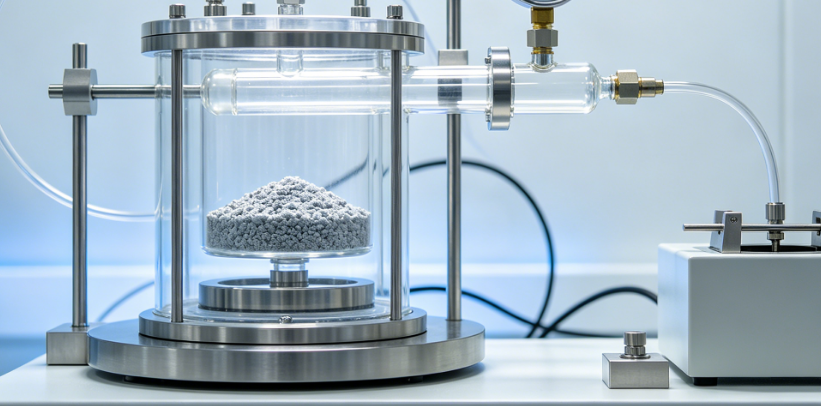
Why Comprehensive Testing of Magnesium‑Based Hydrogen Storage Materials Is Essential
The performance of magnesium‑based hydrides is critically dependent on particle size, catalytic additives, defect density, surface oxide layers, and the presence of secondary phases. Even minor variations in synthesis conditions—such as ball‑milling time, atmosphere control, or dopant concentration—can lead to significant changes in hydrogen absorption/desorption temperatures, plateau pressures, and cycling degradation. Clients often face challenges such as unexpectedly slow absorption kinetics, irreversible capacity loss after cycling, or poor reproducibility between batches. Our comprehensive characterisation suite is designed to identify the root causes of these issues and to provide actionable insights for process optimisation, quality assurance, and scale‑up, thereby reducing development timelines and ensuring that your material meets the stringent requirements of hydrogen storage applications.
Our Advanced Analytical Suite for Magnesium‑Based Hydrogen Storage Materials
We employ a multi‑scale, orthogonal set of techniques to profile every critical aspect of your magnesium hydride samples, from bulk composition and crystalline structure to thermodynamic behaviour, kinetics, and long‑term stability:
High‑Pressure PCT and Thermodynamic Characterisation – The fundamental storage performance is assessed by measuring Pressure‑Composition‑Temperature (PCT) isotherms using a fully automated, high‑accuracy Sieverts apparatus capable of operating at pressures up to 200 bar and temperatures from 30 °C to 500 °C. We determine gravimetric capacity (wt% H₂), plateau pressures, hysteresis, and van’t Hoff plots to extract enthalpy (ΔH) and entropy (ΔS) of hydride formation/decomposition with a precision of ±0.1 kJ/mol H₂. We also perform isothermal and isobaric kinetic measurements to derive reaction rate constants and apparent activation energies using Johnson‑Mehl‑Avrami (JMA) and other model‑fitting approaches. All PCT data are reported with expanded uncertainties (k=2) and are traceable to certified reference hydrides, ensuring reliable benchmarking against DOE and international targets.
Kinetic and Cycling Stability Assessment – Slow kinetics and capacity fading are the primary barriers to Mg‑based hydride deployment. We conduct accelerated cycling tests (up to 1000 absorption/desorption cycles) under controlled conditions, with automated gas flow and pressure regulation to simulate real‑world operation. We monitor capacity retention, plateau pressure drift, and reaction onset temperatures at regular intervals. For detailed mechanistic insight, we perform in situ kinetic measurements using a temperature‑programmed desorption (TPD) system coupled with a mass spectrometer to identify multiple hydrogen desorption steps and to quantify the fraction of strongly bound hydrogen. We also evaluate the effect of oxygen or moisture contamination by introducing controlled impurities, providing a robustness assessment for practical applications. Our cycling stability reports include degradation models and predictive lifetime curves to guide material selection and system design.
Structural and Phase Evolution by In Situ XRD – The phase transitions during hydrogenation/dehydrogenation are monitored by in situ high‑temperature X‑ray diffraction (HT‑XRD) with Cu Kα radiation and a controlled atmosphere chamber (H₂ or vacuum). We track the lattice parameter changes, the formation of intermediate phases (e.g., Mg₂NiH₄, Mg₂FeH₆), and the appearance of MgO or other impurity phases in real time during heating/cooling ramps and isothermal holds. We apply Rietveld refinement to quantify the relative phase fractions with an accuracy of ±0.3 wt% and to detect minor secondary phases down to 0.2 wt%. This in situ capability provides direct correlation between structural evolution and thermodynamic/kinetic behaviour, enabling you to optimise synthesis and processing conditions to stabilise desired phases.
Microstructural and Morphological Characterisation – The particle size, surface area, and morphology of magnesium hydride strongly influence hydrogen diffusion and reaction kinetics. We use high‑resolution scanning electron microscopy (FE‑SEM) with energy‑dispersive X‑ray spectroscopy (EDS) mapping to image particle shape, agglomeration state, and elemental distribution with sub‑nanometre resolution. Transmission electron microscopy (TEM) with selected area electron diffraction (SAED) provides lattice imaging, crystallite size, and the presence of amorphous layers or oxide films on the particle surfaces. We also measure BET specific surface area by nitrogen physisorption (for non‑air‑sensitive samples) or by argon physisorption with reproducibility < 0.5%. For air‑sensitive materials, we use a glovebox‑compatible sample transfer system to avoid oxidation prior to analysis. Additionally, we perform laser diffraction particle size analysis to obtain D10, D50, D90 with repeatability < 1% RSD, enabling correlation between milling conditions and kinetic performance.
Surface Chemistry and Catalytic Additive Distribution – The surface composition and the spatial distribution of catalyst additives (e.g., Ni, Ti, Fe, or rare‑earth oxides) are critical to hydrogen dissociation/recombination. We employ X‑ray photoelectron spectroscopy (XPS) with depth profiling (Ar⁺ cluster sputtering) to obtain Mg 1s, O 1s, C 1s, and metal additive core‑level spectra. Deconvolution of the Mg 1s and O 1s peaks quantifies the relative fractions of MgH₂, MgO, Mg(OH)₂, and metallic Mg with a precision of ±2%. We also use time‑of‑flight secondary ion mass spectrometry (ToF‑SIMS) with 3D imaging to map the distribution of catalytic species on the particle surface and to detect trace contaminants (e.g., Fe, Cu, Cl) at sub‑ppm levels. This surface chemical mapping is essential for evaluating the effectiveness of doping and for diagnosing deactivation mechanisms.
Thermal Analysis and Hydrogen Desorption Profiling – The thermal stability and desorption characteristics are assessed by simultaneous Thermogravimetric Analysis and differential scanning calorimetry (TGA‑DSC) under a constant flow of argon or hydrogen, with heating rates from 0.5 to 20 °C/min. We determine the desorption onset temperature, peak temperature, and total hydrogen release (by mass loss) with precision of ±0.1 mg. Coupled evolved gas analysis‑mass spectrometry (EGA‑MS) monitors the release of H₂, H₂O, and any volatile hydrocarbons, providing a complete desorption profile. For kinetic deconvolution, we apply isoconversional methods (Kissinger, Ozawa, Friedman) to extract activation energies as a function of conversion, revealing multi‑step mechanisms. We also perform DSC scans under different hydrogen pressures to measure the enthalpy of hydride formation/decomposition with an accuracy of ±0.5 kJ/mol H₂.
Trace Elemental Impurity Profiling – Even trace amounts of transition metals or non‑metals can poison catalytic sites or promote sintering. We digest the sample in a pressurised microwave system using high‑purity acids and analyse by inductively coupled plasma tandem mass spectrometry (ICP‑MS/MS) with collision/reaction cell, achieving detection limits of 0.01–0.5 ppb for over 50 elements (including Fe, Ni, Cu, Co, Ti, V, Cr, Mn, Zn, Al, Si, Na, K, Ca, and toxic elements). We also determine oxygen, carbon, nitrogen, and hydrogen (non‑hydride) by inert gas fusion (IGF) with infrared and thermal conductivity detection, with detection limits of 0.001%. All impurity results are reported with expanded uncertainties (k=2) and are traceable to NIST reference materials, providing a complete purity and contamination profile.
Our Distinctive Competencies and Unmatched Analytical Depth
Our service is uniquely distinguished by the orthogonal integration of high‑pressure PCT, in situ HT‑XRD, kinetic modelling, surface analysis (XPS/ToF‑SIMS), thermal analysis (TGA‑DSC‑EGA‑MS), and ultra‑trace elemental profiling (ICP‑MS/MS) — all performed on the same representative batch to eliminate cross‑sample variability and to enable direct, multivariate correlations (e.g., impurity level vs. cycle stability, or crystallite size vs. activation energy). We operate under ISO/IEC 17025 accreditation and maintain in‑house reference magnesium hydride materials (with certified capacity, kinetics, and purity) that are regularly cross‑checked with NIST and other international standards. Our proprietary “Mg‑Hydride Performance Index” (MHPI™) combines gravimetric capacity, desorption activation energy, cycle retention, and impurity sum into a single numerical score that predicts material viability for automotive and stationary storage applications. This index has been validated against more than 30 commercial and R&D Mg‑based hydride compositions.
We achieve exceptional measurement precision: < 0.05 wt% H₂ for capacity, < 0.2 kJ/mol for enthalpy, < 0.5 °C for desorption temperature, < 0.3 wt% for phase fraction, and < 0.5 ppb for critical impurities. Our turnaround time for the full characterisation suite (including cycling and in situ studies) is 12–16 working days, with expedited 6‑day service for urgent troubleshooting. Crucially, our team of PhD‑level materials scientists, thermodynamicists, and surface chemists provides a comprehensive interpretative report that translates each measured parameter into actionable guidance—e.g., how to adjust the catalyst loading to minimise the activation energy, how to detect premature oxidation from a shift in the XPS Mg 1s peak, or how to interpret the PCT plateau slope in terms of compositional inhomogeneity. With over 25 successful projects on magnesium‑based hydrides and related systems, we empower our clients to accelerate material optimisation, de‑risk scale‑up, and achieve reliable hydrogen storage performance—all with the highest level of scientific rigour and technical credibility.
To discuss your specific magnesium‑based hydrogen storage material characterisation requirements, please contact our technical team for a confidential consultation and a customised analytical plan.