Reasons for choosing our testing services
ZHONGXI Testing has obtained inspection qualification certifications from multiple countries and regions worldwide. We possess a senior testing team and advanced testing methods, providing independent, impartial, and professional third-party verification services for global carbon projects.

Internationally recognized authority
Certified by multiple international standards such as CNAS, VCS, and GS, with reports universally applicable worldwide.

Global service capability
Covering 140+ countries and regions, it supports on-site detection and remote verification in multiple languages.

Professional experimental methods
Adopt standard experimental methods to ensure accurate and reliable data.
Comprehensive Analytical Characterisation of Stannous Chloride – A Specialised Testing Service for High‑Purity SnCl₂ and Tin‑Based Chemicals
Stannous chloride (SnCl₂) is a versatile reducing agent and precursor extensively used in electroless plating, mordant dyeing, tin‑based catalysts, and as a stabiliser in polymer manufacturing. Its performance and reliability are critically dependent on precise assay (Sn²⁺ content), the presence of tin(IV) species (Sn⁴⁺), free acid (HCl) level, moisture content, and trace metal impurities (particularly lead, arsenic, antimony, and iron). Clients seeking testing for stannous chloride are typically engaged in electroplating bath management, electronic chemical production, or pharmaceutical intermediate synthesis, and they require rigorous quality assurance to ensure consistent reduction potential, prevent unwanted oxidation, and comply with stringent purity specifications (e.g., ACS, USP, or custom industrial standards). Our laboratory provides a fully integrated, multi‑technique analytical platform that delivers a definitive, application‑oriented characterisation of stannous chloride, enabling you to control product quality, troubleshoot process deviations, and meet the highest regulatory and performance requirements.
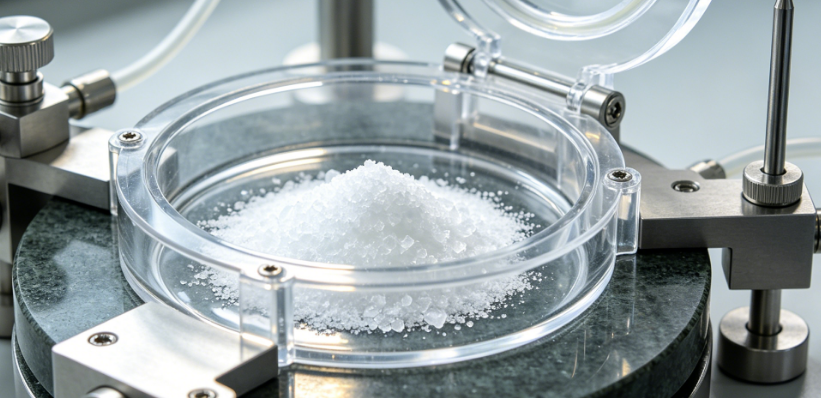
Why Comprehensive Testing of Stannous Chloride Is Indispensable
Stannous chloride is inherently unstable against aerial oxidation, readily converting to stannic chloride (SnCl₄) or basic oxychlorides, which drastically alters its reducing capacity and solution behaviour. Additionally, the presence of free acid (HCl) affects both the stability and the plating performance of SnCl₂ baths. Clients often face challenges such as inconsistent plating thickness, premature bath decomposition, or unexpected precipitation. Moreover, toxic impurities—especially arsenic and lead—are strictly regulated in food‑contact and pharmaceutical applications. Our comprehensive characterisation suite is designed to identify and quantify all critical parameters, providing actionable insights for quality control, process optimisation, and regulatory compliance.
Our Advanced Analytical Suite for Stannous Chloride Characterisation
We employ a multi‑scale, orthogonal set of techniques to profile every critical aspect of your stannous chloride samples, from bulk stoichiometry and purity to solution behaviour and stability:
High‑Precision Sn²⁺ Assay and Speciation (Sn²⁺ vs. Sn⁴⁺) – The defining quality attribute is the stannous ion content. We determine total reducing power by a validated iodometric titration with potassium iodate (KIO₃) or iodine, using potentiometric endpoint detection (platinum electrode) to achieve repeatability of < 0.2% RSD and an expanded uncertainty (k=2) of < 0.3% relative. To distinguish Sn²⁺ from Sn⁴⁺, we apply a selective complexometric titration with EDTA after masking Sn⁴⁺ (or by difference after total tin determination by ICP‑OES). For direct speciation, we use high‑performance liquid chromatography coupled with inductively coupled plasma mass spectrometry (HPLC‑ICP‑MS) to separate and quantify Sn²⁺ and Sn⁴⁺ species with detection limits of 0.05 mg/L and reproducibility < 1.5% RSD. This speciation is essential for evaluating the degree of oxidation and for predicting the reducing capacity in application.
Precise Stoichiometric and Trace Elemental Profiling – Total tin, free acid, and impurity levels are fundamental for conformity. We measure total tin (as Sn) by inductively coupled plasma optical emission spectrometry (ICP‑OES) after microwave‑assisted acid digestion, achieving repeatability of < 0.2% RSD and expanded uncertainty (k=2) of < 0.3% relative. For ultra‑trace impurities (Pb, As, Sb, Fe, Cu, Zn, Ni, Cd, Hg) at sub‑ppm and ppb levels, we employ inductively coupled plasma tandem mass spectrometry (ICP‑MS/MS) with collision/reaction cell technology (O₂, NH₃, H₂) to eliminate polyatomic interferences (e.g., 40Ar35Cl⁺ on 75As, 40Ar16O⁺ on 56Fe) and achieve detection limits of 0.01–0.5 ppb for over 50 elements. Free acid (HCl) is determined by potentiometric titration with standardised NaOH to the methyl orange or phenolphthalein endpoint, with precision of ±0.01%. We also measure anions (chloride, sulfate, nitrate) by ion chromatography (IC) with suppressed conductivity, and moisture content by Karl Fischer coulometric titration (with a detection limit of 10 ppm) and by loss on drying at 105 °C. All results are reported with expanded uncertainties (k=2) and are traceable to NIST reference materials, providing a complete purity and stoichiometric balance sheet.
Crystalline Phase Purity and Hydrate Characterisation – Stannous chloride commonly exists as the anhydrous (SnCl₂) or dihydrate (SnCl₂·2H₂O) form, and the presence of hydroxy chlorides or stannic oxide residues affects solubility and reactivity. We use powder X‑ray diffraction (XRD) with Cu Kα radiation over a 2θ range of 5‑70° with a step size of 0.005°, and apply Rietveld refinement to quantify the relative fractions of anhydrous, dihydrate, and any impurity phases (e.g., SnO₂, Sn(OH)Cl) with an accuracy of ±0.3 wt% and a detection limit of < 0.5 wt%. We also use Raman microspectroscopy (532 nm and 785 nm excitation) to confirm the characteristic vibrational modes of Sn‑Cl and Sn‑O, providing a rapid fingerprint for phase purity.
Solution Stability and Hydrolysis Behaviour – Stannous chloride solutions are prone to hydrolysis and oxidation, forming insoluble stannous oxychlorides. We perform accelerated stability tests on aqueous solutions (at typical concentrations of 5‑50% w/w) by monitoring pH, turbidity, and Sn²⁺/Sn⁴⁺ ratio over time under various temperatures (25 °C, 40 °C, 60 °C) and atmospheric conditions (air, nitrogen). We use dynamic light scattering (DLS) to detect the onset of colloid formation and filtration/gravimetric analysis to quantify precipitates. We also evaluate the effect of common stabilisers (e.g., hydrochloric acid, tin granules) on extending solution life, providing tailored recommendations for bath maintenance.
Thermal Stability and Decomposition Behaviour – Anhydrous SnCl₂ melts at about 247 °C but can volatilise or disproportionate upon further heating. We conduct simultaneous Thermogravimetric Analysis and differential scanning calorimetry (TGA‑DSC) from 30 °C to 600 °C under nitrogen and air at heating rates of 2, 5, and 10 °C/min. We identify melting, dehydration, and oxidation/decomposition steps with mass resolution of 0.01 mg and temperature precision of ±0.5 °C. Coupled evolved gas analysis‑mass spectrometry (EGA‑MS) detects the release of HCl, Cl₂, and Sn‑containing species, providing a complete thermal profile for drying and storage optimisation.
Moisture and Volatile Matter (Loss on Drying) – For solid SnCl₂, the water of crystallisation and adsorbed moisture must be accurately measured. We use Karl Fischer coulometric titration (for free and bound water) and loss on drying (LOD) at 105 °C and loss on ignition (LOI) at 500 °C, achieving repeatability of < 0.02% for LOD. We also determine total volatiles by TGA, distinguishing between water, HCl, and any organic residues.
Our Distinctive Competencies and Unmatched Analytical Depth
Our service is uniquely distinguished by the orthogonal integration of redox titration with speciation, ultra‑trace ICP‑MS/MS impurity profiling, XRD phase quantification, solution stability monitoring, and thermal analysis—all performed on the same representative sample to eliminate cross‑lot variability and to enable direct correlations (e.g., Sn²⁺/Sn⁴⁺ ratio vs. solution turbidity, or impurity level vs. thermal stability). We operate under ISO/IEC 17025 accreditation and maintain in‑house reference stannous chloride standards (certified for purity and Sn²⁺ content) that are regularly cross‑checked with NIST and other international reference materials. Our proprietary “Stannous Chloride Quality and Performance Index” (SCQI™) combines Sn²⁺ assay, impurity sum, free acid level, and moisture consistency into a single numerical score that predicts plating efficiency, chemical reactivity, and storage stability. This index has been validated against more than 30 commercial SnCl₂ samples from various suppliers.
We achieve exceptional measurement precision: < 0.2% RSD for Sn²⁺ assay, < 0.5 ppb for critical metals, < 0.02% for moisture, and < 0.3 wt% for phase quantification. Our turnaround time for the complete characterisation suite (including stability studies) is 10–14 working days, with expedited 5‑day service for urgent quality issues. Crucially, our team of PhD‑level inorganic chemists, electrochemists, and materials scientists provides a comprehensive interpretative report that translates each measured parameter into actionable guidance—e.g., how to adjust the acid concentration to minimise hydrolysis, how to detect trace iron contamination that accelerates oxidation, or how to select the appropriate hydrate form for specific synthetic routes. With over 20 successful projects on stannous chloride and related tin salts, we empower our clients to achieve consistent product quality, reduce bath failures, and meet the stringent requirements of electronics, chemical, and pharmaceutical industries—all with the highest level of scientific rigour and technical credibility.
To discuss your specific stannous chloride characterisation requirements, please contact our technical team for a confidential consultation and a customised analytical plan.