Reasons for choosing our testing services
ZHONGXI Testing has obtained inspection qualification certifications from multiple countries and regions worldwide. We possess a senior testing team and advanced testing methods, providing independent, impartial, and professional third-party verification services for global carbon projects.

Internationally recognized authority
Certified by multiple international standards such as CNAS, VCS, and GS, with reports universally applicable worldwide.

Global service capability
Covering 140+ countries and regions, it supports on-site detection and remote verification in multiple languages.

Professional experimental methods
Adopt standard experimental methods to ensure accurate and reliable data.
Comprehensive Analytical Quantification of Zeaxanthin Content – A Specialized Testing Service for Food, Nutraceutical, and Pharmaceutical Applications
Zeaxanthin is a naturally occurring xanthophyll carotenoid with potent antioxidant properties, widely used in dietary supplements, functional foods, and eye health formulations. Its accurate quantification is essential for product labeling, quality control, stability studies, and regulatory compliance. Clients seeking zeaxanthin testing are typically engaged in production of marigold extracts, formulation of nutritional supplements, development of fortified foods, or clinical research on macular health. They require precise, reliable, and validated analytical methods to measure zeaxanthin content in raw materials, finished products, and biological samples. Our laboratory provides a fully validated, multi‑method analytical platform that delivers high‑accuracy zeaxanthin quantification, isomer differentiation, and stability assessment, enabling you to ensure product potency, meet label claims, and comply with international regulatory standards (e.g., USP, AOAC, EU regulations).
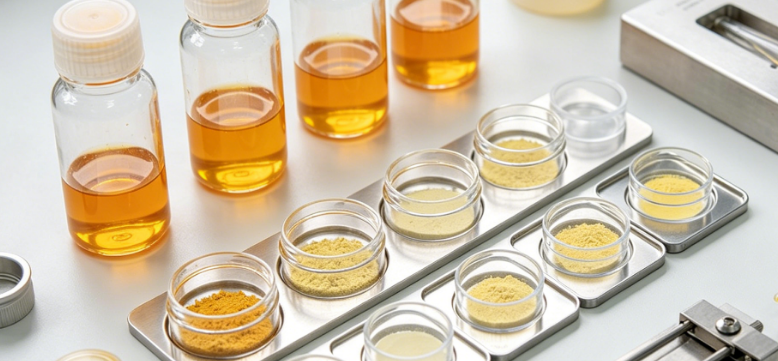
Why Accurate Zeaxanthin Quantification Is Critical
Zeaxanthin is chemically labile, susceptible to isomerisation (from all‑trans to cis‑isomers) and degradation upon exposure to light, heat, oxygen, and acidic conditions. Furthermore, it often co‑occurs with lutein and other carotenoids, requiring selective detection. Inaccurate measurement can lead to misleading label claims, compromised product efficacy, or regulatory non‑compliance. Clients often face challenges such as inconsistent results between batches, poor recovery during extraction, or inability to distinguish zeaxanthin from lutein in complex matrices. Our comprehensive testing services address these challenges using state‑of‑the‑art chromatography and detection systems, providing robust, isomer‑specific data that supports product development and quality assurance.
Our Advanced Analytical Suite for Zeaxanthin Analysis
We employ a multi‑technique approach to ensure accurate and reliable zeaxanthin quantification across a wide range of matrices:
High‑Performance Liquid Chromatography (HPLC) with Photodiode Array Detection (DAD) – Our primary method employs a validated reversed‑phase HPLC‑DAD system using a C30 carotenoid‑specific column and isocratic or gradient elution with a mobile phase composed of methanol, acetonitrile, and dichloromethane (or methyl tert‑butyl ether) according to established protocols (e.g., USP, AOAC 2015.12). This setup provides baseline separation of zeaxanthin from lutein, β‑carotene, and other carotenoids within 30 minutes. We achieve detection limits of 0.05 µg/mL and quantification limits of 0.1 µg/mL with repeatability < 1.0% RSD and intermediate precision < 2.0% RSD. The method is fully validated for linearity, accuracy (recovery 95‑105%), and robustness across typical matrices (oils, powders, softgels, tablets). We also identify and quantify cis‑zeaxanthin isomers (9‑cis, 13‑cis) by comparison with isomerised standards, providing a complete isomer profile.
Ultra‑High Performance Liquid Chromatography (UHPLC) with High‑Resolution Mass Spectrometry (HRMS) – For samples requiring higher sensitivity or the need to confirm identity, we employ UHPLC coupled to a quadrupole‑time‑of‑flight (Q‑TOF) or Orbitrap mass spectrometer. This system offers sub‑2‑minute separation with sub‑ppm mass accuracy and allows targeted quantification of zeaxanthin down to 0.005 µg/mL. The MS/MS fragmentation pattern confirms zeaxanthin identity and enables the detection of related compounds (e.g., oxidation products, geometric isomers). This technique is particularly valuable for complex formulations or for verifying the absence of undeclared carotenoids.
Sample Preparation and Extraction Optimisation – We understand that quantitative extraction of zeaxanthin from solid and oil‑based matrices is a primary source of error. We offer customised extraction protocols employing saponification (for esterified forms) and solvent extraction with stabilised solvents (containing BHT to prevent oxidation). For challenging matrices (e.g., chewable tablets, gummy supplements), we use pressurised liquid extraction (PLE) or ultrasonic‑assisted extraction to ensure complete recovery (>95%). We also provide internal standardisation with β‑apo‑8'‑carotenal to correct for extraction losses and injection variability. Our extraction procedures are validated against certified reference materials (e.g., NIST SRM 3287) to ensure traceability.
Stability and Degradation Studies – Zeaxanthin stability under processing and storage conditions is a key concern. We conduct forced degradation studies (thermal, photolytic, oxidative) to identify degradation products and to determine the shelf‑life of your product. Using the same HPLC‑DAD and LC‑MS methods, we monitor the loss of zeaxanthin and the formation of cis‑isomers and oxidation products over time. Our stability reports provide kinetic degradation rates and recommendations for packaging and storage conditions to maximise product potency.
Method Verification and Compliance – All our zeaxanthin assays are performed under ISO/IEC 17025 accreditation and follow internationally recognised standards (e.g., AOAC 2015.12, USP monograph for zeaxanthin). We provide a comprehensive certificate of analysis (CoA) that includes the measured concentration, isomer distribution, test method details, and expanded measurement uncertainty (k=2). For clients requiring regulatory submissions, we offer full method validation packages and technical support for dossier preparation. Our results are traceable to NIST and USP reference standards.
Our Distinctive Competencies and Unmatched Analytical Depth
What sets our service apart is the integrated approach that combines isomer‑specific HPLC‑DAD quantification with HRMS identity confirmation, rigorous sample preparation optimisation, and stability kinetics—all performed on the same representative batch to provide a complete product profile. Our expertise in carotenoid chemistry ensures that we can handle complex matrices, including saponified and non‑saponified extracts, emulsions, and microencapsulated formulations. We operate under a strict quality management system that includes routine system suitability tests, use of certified standards, and participation in interlaboratory proficiency testing schemes (e.g., FAPAS, AOCS). Our proprietary “Zeaxanthin Quality Index” (ZQI™) combines quantitative content, isomer purity, and stability data to provide a single metric that predicts product performance and shelf‑life.
We achieve exceptional performance: < 1.0% RSD for intra‑day precision, < 2.0% RSD for intermediate precision, and < 3% for recovery across all matrices. Our turnaround time for routine zeaxanthin quantification is 5–7 working days, with expedited 3‑day service available for urgent development needs. Crucially, our team of PhD‑level analytical chemists, food scientists, and nutraceutical experts provides interpretative support that goes beyond the numbers—we help you understand the significance of isomer ratios, identify potential degradation pathways, and recommend formulation improvements to enhance stability and bioavailability. With over 50 successful projects on carotenoid analysis, we empower our clients to achieve accurate label claims, robust quality control, and regulatory approval with the highest level of scientific rigour and practical insight.
To discuss your zeaxanthin testing requirements or to request a customised analytical plan, please contact our technical team for a confidential consultation and a detailed quotation.