Reasons for choosing our testing services
ZHONGXI Testing has obtained inspection qualification certifications from multiple countries and regions worldwide. We possess a senior testing team and advanced testing methods, providing independent, impartial, and professional third-party verification services for global carbon projects.
Internationally recognized authority
Certified by multiple international standards such as CNAS, VCS, and GS, with reports universally applicable worldwide.

Global service capability
Covering 140+ countries and regions, it supports on-site detection and remote verification in multiple languages.
Professional experimental methods
Adopt standard experimental methods to ensure accurate and reliable data.
Vacuum Outgassing Testing – Quantitative Characterization of Material Gas Release under High and Ultra‑High Vacuum
You are searching for vacuum outgassing testing because you need to qualify materials for spacecraft systems, ultra‑high vacuum (UHV) chambers, semiconductor fabrication equipment, particle accelerators, or cryogenic installations. Uncontrolled outgassing leads to contamination of sensitive optics, deposition on cold surfaces, alteration of vacuum pressure, and degradation of device performance. Routine material datasheets rarely provide the specific outgassing parameters required for mission‑critical design. You require a laboratory that performs standardised, high‑sensitivity outgassing measurements and can also deliver rate‑resolved species identification. Our laboratory delivers exactly that: a comprehensive vacuum outgassing testing platform compliant with ASTM E595, ECSS‑Q‑ST‑70‑02C, ISO 14615, and NASA‑SP‑R‑0022A, extended with real‑time mass spectrometric analysis to capture both total mass loss (TML) and collected volatile condensable materials (CVCM), as well as detailed chemical fingerprints of evolved gases.
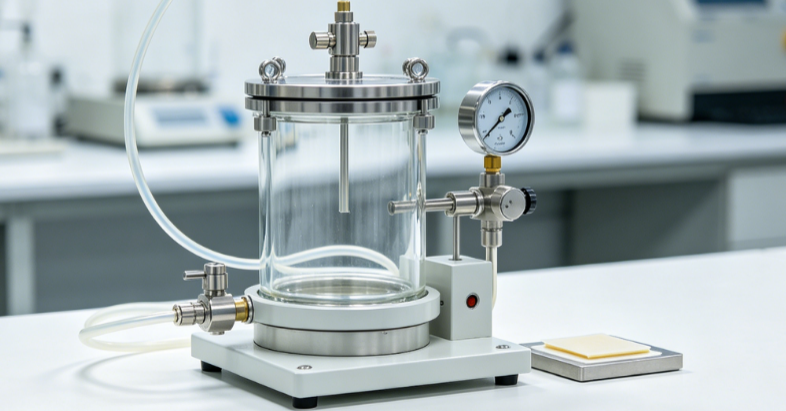
Analytical Scope – From Standard Screening to High‑Resolution Outgassing Kinetics
We offer a tiered testing approach covering all major outgassing regimes and material types (polymers, adhesives, lubricants, elastomers, composites, ceramics, metals). Our platform includes:
• Primary standard method – ASTM E595 (NASA reference) for TML, CVCM, and water vapour regain (WVR). We use a stainless steel vacuum chamber (base pressure ≤ 5×10⁻⁵ Pa) maintained at 125°C ± 1°C for 24 hours under a vacuum of ≤ 7×10⁻³ Pa. Sample mass is measured before and after testing using a microbalance (readability 0.01 mg). We report Total Mass Loss (TML, %) and Collected Volatile Condensable Material (CVCM, mg/cm²) using a collector plate held at 25°C ± 1°C. For space materials, we also measure Water Vapour Regain (WVR, %) after 24h exposure to 50% RH. Our typical measurement uncertainties: ±0.03% absolute for TML, ±0.02 mg/cm² for CVCM. This method is accepted by NASA, ESA, JAXA, and all major space agencies.
• Extended method – ECSS‑Q‑ST‑70‑02C (high temperature, extended duration). For applications requiring assessment at elevated temperatures (e.g., re‑entry vehicle materials, high‑power electronics), we perform outgassing at 150°C, 200°C, or 250°C for up to 72 hours. We additionally determine Recovered Mass Loss (RML) after controlled humidity exposure.
• Real‑time species‑resolved outgassing analysis – Temperature Programmed Desorption (TPD) coupled with Residual Gas Analyzer (RGA). We utilise a Hiden Analytical HAL 301 RC quadrupole mass spectrometer (mass range 1–300 amu, dual Faraday/SEV detector) attached to a custom UHV chamber (base pressure 1×10⁻⁸ Pa). The sample is heated from 25°C to 400°C (ramp rates 0.5–20°C/min) while continuously recording partial pressures for up to 128 mass channels simultaneously. We quantify desorption activation energies (Ed) for each evolved species using Redhead analysis or Arrhenius plots. Detection limits: 1×10⁻¹⁴ mbar for most volatiles (H₂O, H₂, N₂, O₂, CO, CO₂, hydrocarbons, siloxanes). This method is essential for identifying specific contaminants (e.g., phthalates, outgassing from adhesives, lubricant degradation products) and for predicting material behaviour under dynamic vacuum.
• Cryogenic outgassing test (for particle accelerator and space telescope applications). Using a liquid helium‑cooled shroud (15 K) inside our UHV chamber, we measure condensable gas accumulation on cold surfaces over 7 days. We report molecular column density (molecules/cm²) for H₂O, CO, CO₂, CH₄, and other species by calibrated RGA combined with quartz crystal microbalance (QCM) measurements. Sensitivity: 0.01 Hz equivalent to ~ 0.01 ng/cm².
• Pulsed‑gas permeation and diffusion outgassing (for elastomers and seals). For O‑rings and gaskets, we measure helium permeation rate (cm³·cm/(cm²·s·Pa)) using a mass spectrometer leak detector (Pfeiffer PrismaPro) in accumulation mode. We also determine diffusion coefficients (D) and solubility (S) via time‑lag analysis, allowing prediction of outgassing behaviour over decades.
No other testing facility offers simultaneous ASTM E595 screening, species‑resolved TPD‑RGA, cryogenic condensation measurement, and elastomer permeation analysis under a single quality system – providing both regulatory compliance and deep mechanistic insight.
Why Our Laboratory Is the Premier Choice for Vacuum Outgassing Testing
Our expertise in surface science, vacuum physics, and materials contamination control enables us to solve the most challenging outgassing problems. Our advantages include:
1. Unmatched detection sensitivity and dynamic range. Our RGA can detect partial pressures as low as 1×10⁻¹⁴ mbar, translating to outgassing rates < 1×10⁻¹² Pa·m³·s⁻¹·cm⁻² for typical polymers. We routinely measure outgassing rates of vacuum‑baked stainless steel (≤ 1×10⁻¹³ Pa·m³·s⁻¹·cm⁻²) and can differentiate between hydrogen desorption and water desorption with 0.1 amu resolution. This is critical for UHV applications where total pressure is dominated by H₂ after bakeout.
2. Large sample capacity and flexible geometries. Our main vacuum chamber accommodates samples up to 300 mm × 300 mm × 200 mm. For full‑size components (e.g., valves, feedthroughs, small mechanisms), we offer a custom test port (DN200 CF) that can be fitted directly to the chamber. We support flat samples, powders, fibrous materials, and complex assemblies with custom fixturing.
3. Thermal conditioning and in‑situ baking. Our chamber is equipped with a programmable heating stage (ambient to 450°C, ramp rate 0.1–30°C/min) and a cryogenic cooling option (down to −150°C). This allows simulation of thermal cycles (e.g., spacecraft spin‑up, satellite eclipses) while continuously monitoring outgassing transients.
4. ISO 17025 accreditation and space agency qualification. Our ASTM E595 and ECSS methods are ISO 17025:2017 accredited (since 2016). We are listed on the ESA Materials and Processes Technology Database (ECSS‑Q‑ST‑70‑02C) and our test reports are accepted for NASA GSFC, CNES, DLR, and ISRO materials submissions. We participate in round‑robin comparisons with other major outgassing labs (Jet Propulsion Laboratory, ESTEC, JAXA Tsukuba) with results consistently within ±10% of the mean.
5. Rapid turnaround for iterative material screening. Our accelerated TPD‑RGA screening can be completed in 3–6 hours compared to 24–72 hours for gravimetric methods. This is ideal for R&D teams comparing dozens of candidate materials. For final qualification, we perform the full ASTM E595 with 5‑working day turnaround and provide a comprehensive 8‑page report including raw mass loss data, collector images, and RGA spectra.
Technical Depth – Beyond Basic TML and CVCM
While many laboratories report only total mass loss and condensable amount, we provide actionable chemical and kinetic data to solve specific contamination problems:
• Identification of specific harmful contaminants. Using TPD‑RGA, we identify siloxanes (cyclic D₃‑D₆, m/z 207, 281, etc.) from diffusion pump backstreaming, plasticisers (phthalates, m/z 149, 167, 279) from PVC cables, amide slip agents (erucamide, oleamide) from polyolefins, and fluorinated compounds from lubricants. We provide a library‑matched identification and a semi‑quantitative estimate (ng/g of sample) for each compound.
• Outgassing rate as a function of temperature and time. For vacuum system designers, we measure specific outgassing rate Q (Pa·m³·s⁻¹·cm⁻²) at any desired pressure plateau (e.g., after 1h, 24h, 100h) using the “pressure rise” method (ISO 14615) and the “throughput” method (constant pressure, known orifice conductance). We report activation energy for desorption (kJ/mol) and pre‑exponential factor from Arrhenius fits – parameters that enable finite element vacuum modelling.
• Water absorption and desorption hysteresis. For polymers used in humid environments prior to vacuum, we measure water uptake (by Karl Fischer titration) and correlate with subsequent outgassing kinetics. We can also recommend baking protocols (temperature, duration, ramp rate) to minimise water‑related outgassing.
• Particle fallout and volatile/semi‑volatile synergy. For cleanrooms and space assemblies, we offer combined outgassing + particle generation testing: after thermal‑vacuum cycling, we collect and count particles (≥0.3 µm) on witness plates using a laser particle counter, linking volatile condensables to particulate contamination.
These advanced capabilities are not separate research projects – they are integrated into our standard service offering for clients requiring deep vacuum compatibility analysis.
Supporting Your Specific Vacuum Outgassing Testing Goals
Your search for vacuum outgassing testing likely aligns with one or more of these scenarios. We provide precisely tailored solutions:
• Space hardware qualification (ECSS, NASA, JAXA). For satellite and instrument developers, we perform full ASTM E595 + ECSS‑Q‑ST‑70‑02C (thermal vacuum outgassing) and issue a materials data sheet suitable for inclusion in your Contamination Control Plan. We also provide outgassing‑optimised material selection advice from our internal database of >2,500 tested materials.
• UHV system design and troubleshooting. If your vacuum system cannot reach expected base pressure, we analyse component outgassing signatures. For example, we identify hydrogen outgassing from stainless steel welds (m/z 2), water from porous ceramics (m/z 18, 17), or hydrocarbon back‑migration (m/z 43, 57, 71). We provide recommended bakeout recipes based on desorption kinetic data.
• Semiconductor and display manufacturing (FPD, OLED). For materials used inside PVD/CVD/ALD chambers, we measure outgassing up to 450°C and identify unscheduled contaminants (e.g., trace sulfur compounds, siloxanes, boron species) that cause wafer defects. We can test photoresists, wafer bonding adhesives, and vacuum chuck materials with detection limits below 1 ppb equivalent gas load.
• Particle accelerator and fusion reactor components. For beamline components that must achieve extreme low outgassing (≤ 1×10⁻¹² Pa·m³·s⁻¹·cm⁻²), we provide in‑situ bakeout validation and residual gas analysis during electron or photon irradiation (optional electron gun attachment). We also measure ion‑induced desorption yields (molecules/ion) upon request.
• Cryogenic system compatibility. For liquid helium, hydrogen, or nitrogen systems, we measure outgassing at 15 K, 77 K, and 4.2 K and identify freeze‑contaminants such as CO₂ (sublimes at ~195 K) and water (freezes at ~170 K). We provide quantitative data to predict heat load from condensed gases.
Partner with Us for Definitive Vacuum Outgassing Analysis
Choosing our laboratory gives you access to a dedicated vacuum contamination team – physicists and materials engineers with over 20 years of combined experience in UHV systems, space contamination, and surface analysis. We provide free sampling consultation (cleanliness requirements, packaging, shipping under inert atmosphere), a detailed test plan tailored to your application, and direct data interpretation sessions with our lead scientist. No project is too large or too small – from a single O‑ring to a full satellite structural panel.
Contact our technical team with your vacuum outgassing test requirements. We will provide a customised proposal and, for qualifying R&D clients, a free screening TPD‑RGA analysis (up to 5 species, 2h test) to demonstrate our capability. Your search for authoritative, high‑depth outgassing testing ends here – because we deliver the chemical and kinetic insight that simple mass loss measurements cannot provide.