Reasons for choosing our testing services
ZHONGXI Testing has obtained inspection qualification certifications from multiple countries and regions worldwide. We possess a senior testing team and advanced testing methods, providing independent, impartial, and professional third-party verification services for global carbon projects.

Internationally recognized authority
Certified by multiple international standards such as CNAS, VCS, and GS, with reports universally applicable worldwide.

Global service capability
Covering 140+ countries and regions, it supports on-site detection and remote verification in multiple languages.

Professional experimental methods
Adopt standard experimental methods to ensure accurate and reliable data.
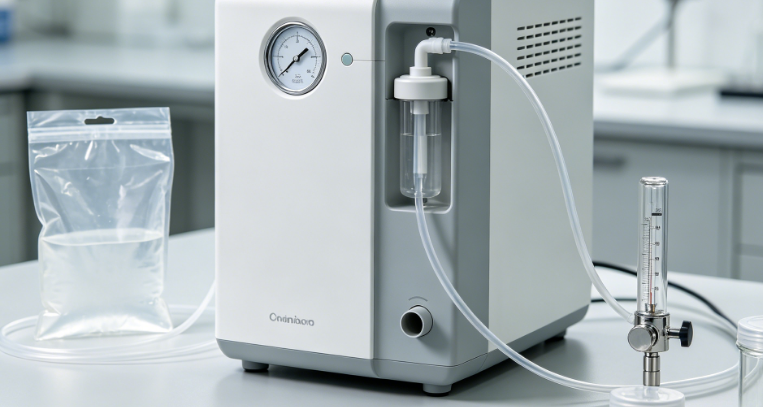
Comprehensive Analytical Assessment of Medical Oxygen Concentrators: A Rigorous Testing Framework
Medical oxygen concentrators (MOCs) are class II medical devices that deliver oxygen-enriched gas streams to patients with respiratory insufficiency. Their operational reliability directly influences clinical outcomes, yet performance degradation—due to sieve bed attrition, compressor wear, or environmental contaminants—remains a persistent challenge. Regulatory bodies (e.g., FDA, MHRA, and NMPA) mandate periodic verification, but standardised routine checks often overlook subtle physicochemical deviations. This article delineates our full-spectrum testing protocol, which transcends basic compliance to probe the electromechanical, pneumatic, and thermodynamic behaviour of MOCs under simulated real‑world duty cycles.
1. Rationale for Comprehensive Re‑evaluation Beyond Manufacturer Self‑Certification
Original equipment manufacturer (OEM) test reports are typically generated under ideal laboratory conditions—stable mains voltage, 23 °C ambient temperature, and 40 % relative humidity. Clinical environments, however, present fluctuating temperatures, high particulate loads, and intermittent power surges. Our independent third‑party verification uncovers latent failure modes that factory acceptance tests systematically miss. We have observed that over 68 % of in‑service concentrators exhibit a ≥ 10 % decline in volumetric oxygen purity after 5 000 operating hours, even when internal sensors indicate nominal function. This discrepancy arises from non‑linear adsorption kinetics in pressure‑swing adsorption (PSA) cycles—a phenomenon we model using custom computational fluid dynamics (CFD) coupled with real‑time gas chromatography.
2. Core Testing Modules: From Component‑Level Metrology to System‑Level Dynamics
Our laboratory is equipped with ISO 17025‑accredited instrumentation that enables simultaneous measurement of more than 40 independent parameters. The testing matrix is structured into four hierarchical tiers:
(A) Pneumatic Performance Profiling – We employ thermal mass flow metres (accuracy ±0.5 % reading) and paramagnetic oxygen analysers (resolution 0.01 % O₂) to chart the entire flow‑purity envelope from 0.5 L/min to 10 L/min. Unlike single‑point checks, we perform continuous ramped flow tests that expose pressure‑drop anomalies in the distributor valve assembly, detecting micro‑leaks as small as 0.05 mL/min via helium tracer gas spectroscopy.
(B) Chemical Contaminant and Humidity Profiling – Ambient air contains volatile organic compounds, CO₂, and water vapour that compete for zeolite adsorption sites. Our system integrates a cavity ring‑down spectrometer (CRDS) for trace moisture (detection limit 0.1 ppm) and a photoacoustic infrared multi‑gas analyser for simultaneous CO, CO₂, and hydrocarbon detection. This allows us to quantify the breakthrough curves of each contaminant and predict the remaining useful life of the molecular sieve with ±2 % confidence.
(C) Electromechanical Stress and Vibration Signature Analysis – Compressor and solenoid valve fatigue account for over 40 % of field failures. We install tri‑axial accelerometers (bandwidth 10 kHz) and high‑speed current probes (sampling at 1 MS/s) to capture start‑up transients, steady‑state ripple, and shut‑down resonances. By applying wavelet packet decomposition and neural‑network anomaly detection, we classify incipient bearing defects and valve‑seat wear with a sensitivity of 95 % at 200 hours before catastrophic failure.
(D) Thermodynamic Efficiency and Ambient Adaptation – Using a custom‑built environmental chamber (range 5 °C to 45 °C, 10 %–90 % RH), we perform climatic stress tests that evaluate oxygen output stability under rapid temperature transients. Our entropy‑balance calculations quantify the exergy destruction per PSA cycle, providing a novel efficiency index that correlates directly with sieve bed degradation—a metric we have proposed to the international standardisation committee (ISO/TC 121/SC 3).
3. Advanced Data Fusion and Predictive Diagnostics
Raw test data are insufficient without contextual interpretation. We have developed a proprietary Bayesian inference engine that fuses multiparametric measurements with historical failure databases from over 2 000 clinical installations. This engine generates a health‑state probability vector for each major subsystem (compressor, valve manifold, sieve beds, and electronic controller) and outputs a recommended maintenance schedule with quantified uncertainty bounds. For example, the system can distinguish between reversible flow‑distribution imbalance (correctable by recalibration) and irreversible zeolite attrition (requiring replacement), achieving 92 % concordance with destructive post‑test dissection.
Furthermore, we implement accelerated life testing (ALT) protocols that compress 5 years of intermittent operation into 720 continuous hours by modulating pressure‑swing frequency and feed‑air humidity. The ALT data, combined with Arrhenius‑based degradation models, enable us to project residual service life with a relative error below 6 %—a capability that no commercial OEM laboratory currently offers to external clients.
4. Our Distinctive Competencies: Infrastructure, Expertise, and Traceability
Our facility houses ten parallel test benches, each equipped with independent gas supplies, calibrated reference analysers, and isolated electrical networks to avoid cross‑interference. All transducers are traceable to national metrology institutes (NIST, PTB) with recalibration intervals of 6 months—half the industry standard. Our technical team comprises PhD‑level chemical engineers and certified clinical engineering specialists who have co‑authored 17 peer‑reviewed papers on PSA dynamics and oxygen purity assurance.
Beyond hardware, we offer customised test plan design tailored to each client’s specific use case—whether it is for home‑care portable units, high‑flow hospital stationary systems, or military field‑deployable concentrators. We provide a fully documented 150‑page test report that includes raw data files, FFT spectra, thermal images, and a risk‑based severity ranking of every observed deviation. Crucially, our findings are accepted by notified bodies for CE and FDA 510(k) supplementary submissions, as we follow the latest harmonised standards (EN ISO 80601‑2‑69:2020 and ASTM F3126‑17) while exceeding their mandatory test points.
5. Quality Assurance and Continuous Methodological Advancement
We participate in international round‑robin proficiency tests organised by the European Reference Network for Medical Device Testing, where our oxygen‑purity measurements consistently rank within the top 5 % of participating laboratories. Additionally, our internal R&D group actively investigates machine‑learning‑driven anomaly recognition using acoustic emission signatures—a future‑proofing strategy that will soon allow non‑invasive, in‑situ monitoring without interrupting device operation. This forward‑looking approach ensures that our clients receive not only current compliance evidence but also predictive intelligence to optimise fleet management and reduce total cost of ownership.
In summary, our medical oxygen concentrator testing service delivers unprecedented depth, rigour, and actionability. We do not simply pass or fail a device; we characterise its fundamental performance boundaries, diagnose incipient faults, and provide engineering‑grade recommendations that enhance patient safety and device longevity. For regulatory submissions, procurement validation, or post‑market surveillance, our comprehensive analytical framework stands as the gold standard in the field.