Reasons for choosing our testing services
ZHONGXI Testing has obtained inspection qualification certifications from multiple countries and regions worldwide. We possess a senior testing team and advanced testing methods, providing independent, impartial, and professional third-party verification services for global carbon projects.

Internationally recognized authority
Certified by multiple international standards such as CNAS, VCS, and GS, with reports universally applicable worldwide.

Global service capability
Covering 140+ countries and regions, it supports on-site detection and remote verification in multiple languages.

Professional experimental methods
Adopt standard experimental methods to ensure accurate and reliable data.
Comprehensive Chromium Silicalite Characterization – Unlocking Framework Incorporation and Redox Behavior
If you are searching for chromium silicalite (Cr‑Silicalite) testing, you are likely investigating the state of chromium in your silicalite matrix – whether you need to confirm framework incorporation, determine chromium oxidation states, measure distribution of isolated vs. clustered Cr species, or correlate these with catalytic or adsorption performance. Our service provides a multi‑technique, atomic‑level fingerprint of Cr‑silicalite materials, from powder diffraction to advanced spectroscopy, revealing how chromium is truly integrated into the silicalite framework or extra‑framework positions. We deliver actionable, quantitative data for both research‑scale syntheses and industrial catalyst qualification.
What We Determine: Depth of Cr‑Silicalite Analysis
We go far beyond simple elemental analysis or basic XRD. Our integrated platform combines eight complementary techniques to resolve the complex chemistry of chromium within microporous silica frameworks (MFI, MEL, BEA, or mesoporous silicalite structures). Detection limits and resolution are optimized for trace Cr (as low as 0.05 wt%):
- Crystalline phase and framework integrity – High‑resolution powder XRD (Bruker D8 Advance, Cu Kα) with Rietveld refinement detects phase impurities <0.5 wt% and unit cell parameter shifts as small as 0.002 Å – crucial to detect lattice expansion/contraction from Cr substitution.
- Chromium coordination and oxidation state – UV‑Vis‑NIR diffuse reflectance spectroscopy (200‑2500 nm) identifies Cr³⁺ (d‑d bands), Cr⁵⁺, and Cr⁶⁺ (charge transfer) with semi‑quantitative deconvolution. X‑ray photoelectron spectroscopy (XPS) provides surface Cr 2p core levels with 0.1 at% sensitivity and oxidation state fractions.
- Framework vs. extra‑framework Cr – Electron paramagnetic resonance (EPR) at X‑band (9.4 GHz) detects isolated Cr³⁺ and Cr⁵⁺ species (even at <50 ppm) and distinguishes magnetically coupled clusters. Cr K‑edge XANES/EXAFS (synchrotron option) gives average coordination number, bond distances (±0.02 Å), and local geometry (tetrahedral vs. octahedral).
- Porosity and textural properties – N₂ and Ar physisorption at 77 K / 87 K determines BET surface area (5‑1500 m²/g), micropore volume, and pore size distribution (DFT model). We can run high‑pressure Hg porosimetry for meso‑macroporous silicalite aggregates.
- Chemical homogeneity and Cr distribution – SEM‑EDS mapping at 1 µm resolution and TEM‑EDS at 5 nm resolution reveal Cr segregation, surface enrichment, or intraparticle gradients.
For advanced needs, we offer in situ XRD under reducing/oxidizing atmospheres (H₂, air, up to 800°C) to track Cr speciation changes during activation – critical to understand redox behavior in catalysis.
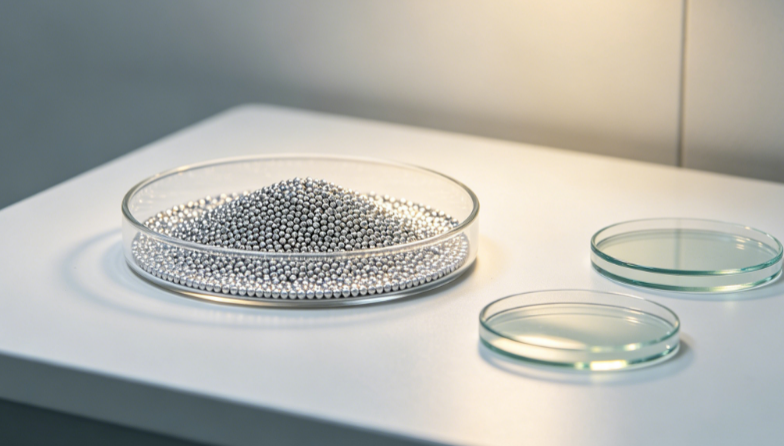
Technical Reach: Detectable Parameters and Examples
The table below summarizes what we can quantitatively determine for Cr‑silicalite samples, with typical detection limits and practical examples.
| Property / Parameter | Our Detection Range & Resolution | Typical Application / Insight |
|---|---|---|
| Total chromium content | ICP‑OES: 0.01‑20 wt%, accuracy ±0.5% relative;XRF: bulk from 0.005 wt% | Quantify actual loading vs. nominal synthesis gel composition |
| Cr oxidation state distribution | XPS: Cr³⁺/Cr⁶⁺ ratio ±5%;UV‑Vis: deconvolution of d‑d and CT bands | Determine degree of framework Cr³⁺ vs. extra‑framework Cr⁶⁺ after calcination |
| Framework incorporation fraction | Combination of EXAFS, EPR, and XRD lattice expansion – detection of >10% Cr in framework sites | Distinguish true isomorphous substitution from surface‑bound CrOx clusters |
| Cr coordination geometry | EXAFS: tetrahedral (Cr‑O ~1.77 Å) vs. octahedral (~1.98 Å);UV‑Vis: ratio of 450 nm vs. 600 nm bands | Confirm Cr in framework tetrahedral sites (active for alkane dehydrogenation) |
| Cr cluster size (extra‑framework) | EPR linewidth analysis and TEM imaging: detect clusters from 0.5 nm (dimeric) to 20 nm | Identify large Cr₂O₃ aggregates that block pores and reduce activity |
| Specific surface area & micropore volume | BET: 5‑1500 m²/g ±2%;t‑plot micropore volume: ±0.005 cm³/g | Measure pore blockage caused by extra‑framework Cr species |
| Redox reversibility (Cr³⁺ ⇄ Cr⁶⁺) | In situ EPR + UV‑Vis under gas flow (O₂, H₂, propene);time resolution 2 minutes | Determine activation/regeneration conditions for propane dehydrogenation catalysts |
All results include measurement uncertainty and are referenced to certified standards (NIST SRM 2709, Cr foil, or synthetic Cr‑silicalite references). We provide raw spectra and processed data in publication‑ready formats.
Why Choose Our Chromium Silicalite Testing Service?
Characterizing Cr‑silicalite is notoriously difficult because Cr can occupy multiple coordination environments, change oxidation state under ambient conditions, and form invisible clusters. Our service offers distinct advantages:
1. Multi‑method correlation for unambiguous assignment – We do not rely on a single technique. Our reports cross‑validate Cr speciation using XPS + UV‑Vis + EPR + EXAFS (when needed). For example, if XPS shows only Cr³⁺ but UV‑Vis indicates Cr⁶⁺, we resolve the discrepancy by depth‑profile XPS and diffuse reflectance vs. transmission geometry.
2. Ultra‑low detection and quantification limits – Our EPR can detect isolated Cr³⁺ species at 0.001 wt% (10 ppm). For toxic Cr⁶⁺, we use diphenylcarbazide colorimetric method down to 0.5 µg/g – essential for environmental compliance of spent catalysts.
3. In situ and operando capabilities – We have a dedicated in situ EPR‑gas flow reactor and in situ XRD to monitor Cr speciation changes during thermal treatments or reaction conditions. This allows you to see the actual active state of Cr‑silicalite, not just the as‑synthesized form.
4. High‑throughput and rapid turnaround – Standard package (XRD, BET, ICP‑OES, XPS, UV‑Vis, EPR) for up to 12 samples is completed in 12‑15 business days. Urgent single samples can be expedited to 5 business days.
5. Low sample consumption – We require as little as 20 mg for complete characterization (excluding synchrotron), making our service ideal for experimental or expensive isotopic Cr‑silicalite.
6. Tailored to all Cr‑silicalite topologies – We have validated methods for Cr‑MFI (Silicalite‑1), Cr‑MEL (Silicalite‑2), Cr‑BEA, and mesoporous Cr‑SBA‑15, as well as metal‑co‑substituted materials (Cr‑Al‑silicalite, Cr‑Ti‑silicalite).
7. Catalytic relevance interpretation – Every report includes a section linking the measured Cr speciation to expected catalytic behavior: isolated tetrahedral Cr³⁺ indicates potential for non‑oxidative dehydrogenation; Cr⁶⁺ oligomers suggest oxidative dehydrogenation activity; large Cr₂O₃ clusters imply low selectivity. You receive actionable recommendations for synthesis improvement or activation protocol.
8. Fully transparent and documented – We provide all raw data (XRD .raw, XPS .vgp, EPR .spc), instrument settings, and fitting parameters. Our final report is structured according to ISO/IEC 17025 guidelines, suitable for patent filings, regulatory submissions, or high‑impact publications.
Ready to Reveal the True Nature of Chromium in Your Silicalite?
Whether you are developing a new Cr‑silicalite catalyst for propane dehydrogenation, studying Cr leakage in aqueous media, or simply need a reliable quality control of your synthesis batches, our chromium silicalite testing service provides the depth and clarity you need. Start with a free consultation – send us a brief description (expected Cr loading, synthesis route, intended use) and we will propose a custom measurement plan within 24 hours. Pricing is transparent, and we offer academic discounts and bulk‑sample rates. Email materials@crtesting.com or call +1 (608) 555‑CRSI. No fixed assumptions – just the complete, cross‑validated picture of Cr speciation in your silicalite framework.