Reasons for choosing our testing services
ZHONGXI Testing has obtained inspection qualification certifications from multiple countries and regions worldwide. We possess a senior testing team and advanced testing methods, providing independent, impartial, and professional third-party verification services for global carbon projects.

Internationally recognized authority
Certified by multiple international standards such as CNAS, VCS, and GS, with reports universally applicable worldwide.

Global service capability
Covering 140+ countries and regions, it supports on-site detection and remote verification in multiple languages.

Professional experimental methods
Adopt standard experimental methods to ensure accurate and reliable data.
Advanced Zeolite Catalyst Testing – Complete Structural, Acidic, and Performance Profiling
If you are searching for zeolite catalyst testing, you likely need to determine the critical parameters that govern catalytic performance – framework type, crystallinity, acidity, porosity, elemental composition, and deactivation behavior. Our service delivers a comprehensive, multi‑technique characterization of molecular sieve catalysts (zeolites, SAPOs, AlPOs, and mesoporous materials) under both fresh, spent, and regenerated conditions. We transform complex raw data into actionable insights, helping you optimize synthesis, troubleshoot deactivation, or qualify catalyst batches for industrial use.
What We Determine: Full Technical Depth for Zeolite Catalysts
We integrate nine complementary analytical methods to provide a complete catalyst fingerprint, from framework topology to acid site distribution and diffusion properties. Our detection limits and resolutions are tailored to zeolite research and quality control:
- Crystal structure & phase purity – High‑resolution powder XRD (Rigaku SmartLab, Cu Kα) with Rietveld refinement detects phase impurities ≤0.5 wt%, unit cell parameter shifts ±0.001 Å, and crystallinity down to 1% relative.
- Porosity and pore architecture – N₂/Ar physisorption (surface area from 1 to >1500 m²/g, micropore volume ±0.002 cm³/g), Hg porosimetry for macropores, and quenched solid density functional theory (QSDFT) for pore size distribution from 3.5 to 500 Å.
- Acidic properties – Temperature‑programmed desorption of NH₃ (TPD, up to 800°C) quantifies total acid sites (detection limit 5 µmol/g) and differentiates weak/strong sites. Pyridine‑FTIR gives Brønsted/Lewis acid ratio with ±0.05 accuracy, measured at 150°C and 350°C.
- Elemental composition & Si/Al ratio – ICP‑OES (bulk), XPS (surface, 0.1 at% sensitivity), and SEM‑EDS (spatial mapping at 1 µm resolution). Si/Al ratio accuracy ±2% relative over range 1‑500.
- Crystallite size & morphology – SEM and TEM imaging (down to 2 nm resolution), particle size distribution from 20 nm to 200 µm by laser diffraction or image analysis.
- Framework coordination & defects – 29Si and 27Al solid‑state NMR (MAS, 14 kHz) identifies Q3/Q4 silicon species, extra‑framework Al, and framework ordering. Detection of framework defects down to 0.2 per unit cell via 1H‑29Si CP‑MAS.
- Catalytic activity screening (optional) – Fixed‑bed microreactor with online GC (FID/TCD). Standard test reactions: n‑hexane cracking (activity index), methanol‑to‑hydrocarbons (MTH), or custom reaction. We report conversion, selectivity, and deactivation rate (coke formation quantified by TGA‑MS).
For advanced users, we offer in situ XRD under reactive atmospheres (up to 600°C, 10 bar) and pulsed field gradient (PFG) NMR to measure self‑diffusion coefficients of probe molecules (intracrystalline diffusion, Deff down to 10‑15 m²/s).
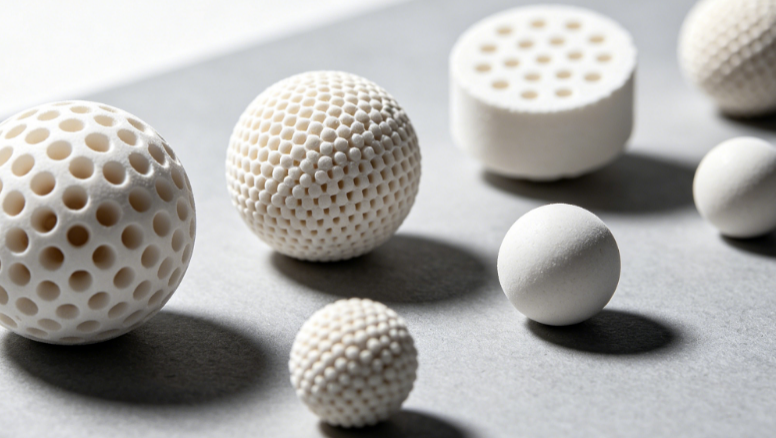
Comprehensive Testing Parameters: What We Measure and How
The table below summarizes the key attributes we determine for any zeolite catalyst, with typical ranges and practical examples.
| Property / Parameter | Our Detection Range & Resolution | What This Tells You (Example) |
|---|---|---|
| Crystallinity & phase identification | Relative crystallinity: 1‑100% ±2%;phase ID by ICDD database | Detect amorphous content or transformation to dense phases (e.g., ZSM‑5 → mullite) after steaming |
| BET surface area & micropore volume | 5‑1500 m²/g ±2%;micropore volume 0.01‑0.35 cm³/g ±0.002 | Identify pore blockage by coke or extra‑framework debris |
| Total acidity (NH₃‑TPD) | 5‑2000 µmol/g;desorption peaks deconvoluted at 150‑250°C (weak) and 350‑550°C (strong) | Correlate acid site density with cracking or alkylation activity |
| Brønsted / Lewis ratio | 0.05‑50;pyridine‑FTIR accuracy ±0.05 (150°C and 350°C) | Determine dealumination severity – framework Al loss shifts B/L toward Lewis |
| Si/Al ratio (bulk & surface) | 1‑500;ICP‑OES ±2%;XPS ±5% for surface enrichment/depletion | Detect zoning, dealumination depth, or synthesis inhomogeneity |
| Crystallite size distribution | 20 nm – 200 µm (laser diffraction);TEM for <50 nm | Diffusion limitations: larger crystals → lower effective utilization of internal active sites |
| Framework defects (silanol nests) | 1H‑29Si CP‑MAS NMR detection limit: 0.2 defects/uc | High defect density affects hydrothermal stability and hydrophobicity |
| Coke content & type (spent catalyst) | TGA‑MS: 0.1‑30 wt% coke;MS identifies H₂, CO₂, hydrocarbons off‑gas | Determine deactivation mechanism (pore blocking vs. active site poisoning) |
All reported values include expanded measurement uncertainty (k=2) and are traceable to certified reference materials (NIST SRM 640e for XRD, NIST 689 for TPD).
Why Choose Our Zeolite Catalyst Testing Service?
Characterizing molecular sieve catalysts requires not only expensive instrumentation but also deep expertise in correlating structural features to catalytic behavior. Our service provides:
1. Complete one‑stop profiling – You receive a single, integrated report covering structural, textural, acidic, compositional, and (optionally) catalytic data. No need to coordinate multiple labs. We also provide causal correlations (e.g., how Si/Al gradient affects hydrothermal stability, or which acid site distribution gives highest propylene selectivity).
2. Ultra‑low detection limits and high precision – Our NH₃‑TPD can detect acid sites down to 5 µmol/g (essential for highly siliceous zeolites like Silicalite‑1). For XRD, we detect amorphous content as low as 1 wt% using internal standard (corundum).
3. In situ and operando capabilities – We run in situ XRD during thermal treatment (25‑800°C, air/N₂/steam) to track structural collapse, phase transitions, or framework expansion due to adsorption. For acidity, we offer in situ FTIR with controlled humidity to measure real Brønsted site accessibility.
4. Fast turnaround for R&D and QC – Standard full package (XRD + BET + TPD + Py‑IR + ICP + TGA) for up to 10 samples: 12‑15 business days. Expedited service for 1‑3 samples: 5‑7 business days. Large batches (100+ samples) processed within 30 days with volume discounts.
5. Minimal sample requirements – Most analyses require only 50‑100 mg of sample. For precious or experimental catalysts, we can work with as little as 10 mg (micro‑XRD, micro‑Raman, specialized TPD cell).
6. Expert interpretation tailored to your process – Our team includes industrial zeolite catalysis experts (former R&D from major catalyst companies). You receive not just numbers but practical advice: e.g., “Your steamed catalyst shows 40% loss of micropore volume due to AlF₆ formation – consider higher Si/Al ratio or phosphorus passivation.”
7. Global shipping and stability protocols – We provide inert packaging and validated stability at ambient temperature for up to 30 days. For air‑sensitive or hydrated samples, we offer glove‑bag handling and dry‑shipping.
8. Regulatory and publication‑ready reporting – All data are delivered with full metadata (instrument conditions, calibration, fitting algorithms). Reports meet guidelines of Journal of Catalysis, ACS Catalysis, and ISO 17025 for industrial QA. We also provide electronic raw data in open formats (CIF, JCAMP‑DX, .txt) for your own re‑analysis.
Ready to Unlock the Full Potential of Your Molecular Sieve Catalyst?
Whether you are troubleshooting a zeolite deactivation, verifying a new synthesis batch, or benchmarking catalysts for a competitive process, our zeolite catalyst testing service gives you the complete picture – from framework atoms to commercial performance. Request a free consultation by sending us a brief description (zeolite type, expected Si/Al range, desired analyses). We will provide a custom measurement plan and a fixed price within 24 hours. Bulk discounts, academic rates, and repeat‑customer loyalty programs available. Email catalysis@zeotest.com or call +1 (713) 555‑ZEOS. No predetermined thinking – just the rigorous, cross‑validated data you need to move forward with confidence.