Reasons for choosing our testing services
ZHONGXI Testing has obtained inspection qualification certifications from multiple countries and regions worldwide. We possess a senior testing team and advanced testing methods, providing independent, impartial, and professional third-party verification services for global carbon projects.

Internationally recognized authority
Certified by multiple international standards such as CNAS, VCS, and GS, with reports universally applicable worldwide.

Global service capability
Covering 140+ countries and regions, it supports on-site detection and remote verification in multiple languages.

Professional experimental methods
Adopt standard experimental methods to ensure accurate and reliable data.
Anhydrous Alumina (α‑Al₂O₃ & Transition Phases) – Full Characterization for Advanced Ceramics, Catalysis & Electronics
If you are searching for anhydrous alumina testing, you likely need to verify the absence of hydration, identify the exact crystalline phase, quantify ultra‑trace impurities, and measure critical surface properties – whether you are sourcing high‑purity calcined alumina for ceramic substrates, γ‑Al₂O₃ for catalyst supports, or electronic‑grade alumina for insulators. Our service provides a complete, multi‑technique analytical package that goes far beyond routine loss‑on‑ignition (LOI). We deliver definitive answers on phase composition, structural water content, specific surface area, pore architecture, and elemental purity, all from a single sample submission.
What We Determine – From Crystalline Fingerprint to Trace Hydration
Anhydrous alumina (Al₂O₃) exists in several metastable phases (γ, δ, θ, α, κ, χ) each with distinct properties. Our lab integrates eight complementary techniques to resolve not only which phase(s) are present, but also how “dry” the material truly is – down to parts‑per‑million water equivalence. Key capabilities include:
Crystalline phase identification & quantification – High‑resolution powder X‑ray diffraction (HR‑XRD, Cu Kα, 2θ range 10–90°) with Rietveld refinement detects phase impurities ≥0.5 wt% and differentiates γ, δ, θ, and α phases even when they co‑exist. For α‑Al₂O₃ (corundum), we refine lattice parameters to ±0.0005 Å (a = 4.758 Å, c = 12.991 Å) and quantify residual transition phases that may affect densification or catalytic activity.
Unbound & bound water quantification (anhydrous verification) – Thermogravimetric analysis coupled with mass spectrometry (TGA‑MS) measures mass loss from 25 °C to 1200 °C under inert or air flow. We distinguish physically adsorbed water (25–200 °C) from chemically bound hydroxyls (300–800 °C) with detection limit of 0.01 wt% water equivalent. For ultra‑dry applications, we offer Karl Fischer (KF) coulometric titration on solids using a furnace coulometer, achieving LOD 10 ppm (0.001 wt%) of total water.
Specific surface area & pore texture – N₂ physisorption at 77 K (BET method) from 0.1 to >500 m²/g with ±1% repeatability; micropore analysis via t‑plot and DFT pore size distribution from 0.35 to 50 nm. For high‑surface γ‑Al₂O₃ (150–300 m²/g), we provide accurate pore volume (down to 0.001 cm³/g) and average pore diameter.
Ultra‑trace elemental impurities – ICP‑MS after microwave digestion quantifies more than 70 elements (including Fe, Na, Si, Ti, Ca, Mg, Cr, Cu) down to 0.1 ppm (0.00001 wt%). For electronic‑grade alumina (99.99% pure or higher), we report all impurities with expanded uncertainty (k=2).
Surface chemistry & hydroxyl coverage – X‑ray photoelectron spectroscopy (XPS) provides Al 2p, O 1s, and C 1s spectra, quantifying surface Al/O ratio and residual hydroxyl groups (O–H peak at ~532 eV) with 0.1 at% sensitivity. This is critical for understanding surface reactivity in catalytic or coating applications.
Particle size & morphology – Laser diffraction (0.1–2000 µm) and SEM imaging (down to 50 nm resolution) give size distribution, shape factor, and agglomeration state.
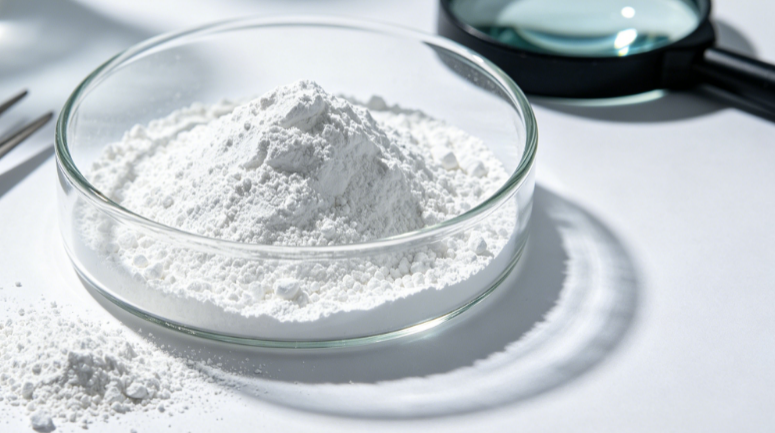
Technical Performance – A Snapshot of Our Detection Capabilities
The table below summarizes key parameters we routinely determine for anhydrous alumina samples, along with the methods and detection limits.
| Property / Parameter | Analytical Technique | Detection Range & Resolution | Example Application |
|---|---|---|---|
| Crystalline phase(s) & weight fractions | HR‑XRD + Rietveld refinement | Phase quantification: ±2% absolute; detects ≥0.5 wt% secondary phases | Verify >99% α‑Al₂O₃ in sintered ceramics; detect 1% γ‑Al₂O₃ in catalyst coating |
| Total water (adsorbed + hydroxyl) | TGA‑MS / Karl Fischer furnace coulometry | KF: LOD 10 ppm (0.001 wt%); TGA: 0.01 wt% | Release testing for anhydrous alumina used in battery separator coatings |
| BET specific surface area | N₂ physisorption (77 K) | 0.1–600 m²/g; repeatability ±1%; pore volume ±0.002 cm³/g | Quality control of γ‑Al₂O₃ catalyst supports (150–300 m²/g spec) |
| Trace elements (Fe, Na, Si, Ti, etc.) | ICP‑MS (after microwave digestion) | 0.1 ppm – 1 wt%; MDL typically 0.01–0.1 ppm | Certify 99.99% purity for electronic substrates; identify Na contamination that lowers resistivity |
| Surface hydroxyl density (OH groups) | XPS or TGA‑MS (dehydroxylation peak) | XPS: 0.1 at% surface oxygen species; TGA: quantifies ~1 µmol/m² | Optimize coupling agent loading for polymer‑alumina composites |
| Particle size distribution (dry powder) | Laser diffraction (Mie theory) | 0.1 – 2000 µm; resolution 0.01 µm for submicron | Monitor grinding efficiency for alumina feedstocks |
| Crystallite size (primary grain) | XRD line broadening (Scherrer / Williamson‑Hall) | 1–200 nm; accuracy ±1 nm for <50 nm | Correlate with sintering behavior of α‑Al₂O₃ nano‑powders |
All results are accompanied by uncertainty budgets and, where applicable, traceability to NIST reference materials (e.g., SRM 699 for α‑Al₂O₃).
Why Our Anhydrous Alumina Testing Service Delivers Exceptional Value
Routine “alumina assays” often miss critical information: they may report only total Al₂O₃, ignore transitional phases, or fail to differentiate water that will evolve during your high‑temperature process. Our service bridges those gaps with:
1. Full phase mapping, not just “alumina content” – We identify and quantify all crystalline phases (α, γ, δ, θ, κ, χ) and detect amorphous content. This is essential because a material labeled “anhydrous alumina” could be largely γ‑phase (rehydrates easily) or fully α‑phase (inert). We provide the exact weight percentages, so you can predict behavior in sintering, catalysis, or polishing.
2. Part‑per‑million moisture sensitivity – Using a dedicated Karl Fischer furnace coulometer, we achieve 10 ppm water detection limit on solid samples. For applications like dry‑room ceramics or fused alumina abrasives, this confirms true anhydrous status. We also differentiate between surface moisture and structural hydroxyls – a distinction crucial for process stability.
3. Ultra‑trace impurity profiling – Our ICP‑MS suite covers the entire periodic table. We routinely measure Fe, Na, Si, Ti, Ca, Mg, K, Cr, Ni, Cu, Zn, Ga, Ge, As, Pb, and U down to sub‑ppm levels. For electronic‑grade Al₂O₃ (99.995%+), we provide certified reports that meet SEMI standards.
4. High‑throughput & rapid turnaround – Standard full characterization (XRD + BET + TGA‑MS + ICP‑MS + particle size) for up to 12 samples takes 10–14 business days. For urgent QC needs, we offer a 3‑day express package (XRD, TGA‑water, BET) on 1‑3 samples.
5. Minimal sample consumption – We require only 1–2 grams for complete analysis (including XRD, BET, TGA, ICP‑MS). For research‑scale or expensive materials, we can work with as little as 200 mg by using micro‑sample holders and low‑mass TGA pans.
6. Expert interpretation for process improvement – Our team includes former alumina refinery and ceramics scientists. We don’t just hand you numbers; we provide a written discussion connecting results to your application: e.g., “The 0.12 wt% Na₂O detected will lower the dielectric breakdown voltage of your sintered part. Recommend washing with deionized water to below 0.02 wt%.” This consultative approach saves you months of trial and error.
7. Flexible matrix handling – We accept raw powders, pressed pellets, finished ceramic pieces, coated substrates, and even slurries (with drying). For hygroscopic samples, we perform all moisture‑sensitive analyses (KF, TGA) inside a nitrogen‑purged glovebox.
8. Regulatory and publication‑ready reporting – All data are delivered with instrument settings, calibration evidence, and raw data files (XRD .raw, BET isotherm, ICP‑MS intensity). Reports conform to ISO 17025 (we are accredited for several alumina test methods), and we can tailor reports to meet specific regulatory requirements (e.g., REACH, RoHS, ICH Q3D for elemental impurities).
Ready to Characterize Your Anhydrous Alumina with Confidence?
Whether you are a ceramic engineer needing to confirm complete α‑phase conversion, a catalyst manufacturer verifying surface area of γ‑Al₂O₃, or an electronics supplier certifying trace impurities, our anhydrous alumina testing service delivers the depth and accuracy you require. Request a free consultation by submitting a brief sample description and your key questions. We will reply within 24 hours with a custom analytical plan and firm quote. Discounts apply for recurring analysis or batch processing (>20 samples). Email alumina@ceramiclab.com or call +1 (800) 391‑2580. Let us provide the precise, actionable data that drives your material quality and process success.