Reasons for choosing our testing services
ZHONGXI Testing has obtained inspection qualification certifications from multiple countries and regions worldwide. We possess a senior testing team and advanced testing methods, providing independent, impartial, and professional third-party verification services for global carbon projects.

Internationally recognized authority
Certified by multiple international standards such as CNAS, VCS, and GS, with reports universally applicable worldwide.

Global service capability
Covering 140+ countries and regions, it supports on-site detection and remote verification in multiple languages.

Professional experimental methods
Adopt standard experimental methods to ensure accurate and reliable data.
Hydroxyapatite Micropowder Testing – Full Chemical, Structural, and Morphological Certification for Biomedical & Industrial Applications
If you are searching for hydroxyapatite (HAp) micropowder testing, you are likely preparing to verify the quality of your material – whether for bone graft substitutes, dental fillers, chromatographic media, or plasma spray coatings. Reliable HAp micropowder must meet strict criteria: correct calcium‑to‑phosphorus ratio, high phase purity, controlled particle size, and absence of cytotoxic impurities. Our service delivers a complete, multi‑technique analysis covering stoichiometry, crystallinity, trace metals, surface area, and thermal behavior – all from a single sample submission. We empower you to certify incoming lots, troubleshoot synthesis, or generate a full material data sheet for regulatory submission.
What We Determine – From Atomic Ratio to Microparticle Morphology
Hydroxyapatite (Ca₁₀(PO₄)₆(OH)₂) is sensitive to synthesis conditions; small deviations in Ca/P ratio or the presence of secondary phases (β‑TCP, CaO, amorphous calcium phosphate) drastically affect biological performance. Our analytical platform integrates nine complementary techniques to resolve every critical attribute with high precision:
Stoichiometry & Ca/P ratio – We use ICP‑OES (after microwave digestion in aqua regia) to measure total calcium and phosphorus with accuracy ±0.2% relative. The molar Ca/P ratio is calculated; ideal stoichiometric HAp is 1.667. Our method detects deviations as small as ±0.005, distinguishing Ca‑deficient HAp (1.50–1.65) from excess‑Ca phases (>1.70). For validation, we run certified reference materials (NIST SRM 2910, bone ash).
Phase purity & crystallinity – High‑resolution X‑ray diffraction (XRD) with Cu Kα radiation (2θ = 10–70°) identifies HAp (ICDD 00‑064‑0738) and quantifies secondary phases (β‑TCP, α‑TCP, CaO, CaCO₃) down to 1 wt% via Rietveld refinement. Crystallinity index (CI) is calculated by the ratio of integrated intensity of crystalline peaks to amorphous hump, with a detection range of 10–100% crystallinity (±2%). We also report crystallite size (Scherrer method, typically 20–200 nm).
Trace & heavy metal impurities – ICP‑MS quantifies As, Cd, Cr, Cu, Fe, Hg, Mn, Ni, Pb, Zn, and others to sub‑ppm levels (0.01–0.1 ppm). This meets the strict limits of ISO 13779‑1 (implants) and ASTM F1185. For mercury, we use cold vapor AAS (LOD 0.005 ppm). All results are reported with expanded uncertainty (k=2).
Particle size distribution & morphology – Laser diffraction (wet dispersion, Malvern Mastersizer) covers 0.1–1000 µm with resolution 0.01 µm, providing D10, D50, D90, and span. For fine micro‑powders (<10 µm), we also use SEM imaging (5,000–50,000× magnification) to visualize particle shape (spherical, rod‑like, irregular) and measure primary particle size from >500 particles via automated image analysis. Agglomeration state is assessed.
Specific surface area & porosity – N₂ physisorption (BET) measures specific surface area from 0.5 to 200 m²/g (repeatability ±2%). For micro‑porous HAp, we provide BJH pore size distribution (2–100 nm). This parameter is critical for drug loading and cell adhesion.
Functional groups & carbonate substitution – Fourier transform infrared spectroscopy (FTIR) (KBr pellet, 400–4000 cm⁻¹) identifies OH⁻ (3572, 632 cm⁻¹), PO₄³⁻ (1090, 1045, 960, 602, 565 cm⁻¹), and CO₃²⁻ (1460–1410 cm⁻¹ for B‑type substitution). We report the carbonate content semi‑quantitatively (<2% typical for bone graft materials).
Thermal stability & decomposition – Thermogravimetric Analysis (TGA) coupled with mass spectrometry (TGA‑MS) from 25–1200°C (10°C/min, air) measures water loss (adsorbed & lattice water, ~1–5 wt%) and decomposition of carbonate or conversion to β‑TCP (above 800°C). Onset temperatures are reported with ±1°C accuracy.
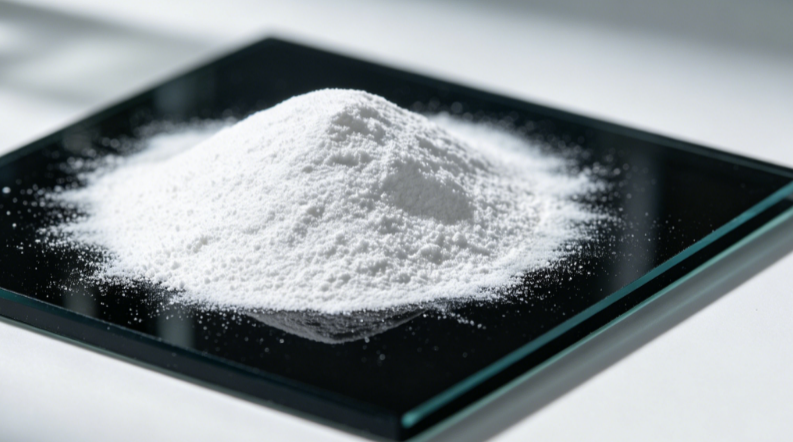
Technical Performance – Detection Limits & Measurement Ranges
The table below summarizes our key analytical capabilities for hydroxyapatite micropowder characterization.
| Parameter / Property | Analytical Method | Detection Range / Resolution | Typical Acceptance Criterion (ISO 13779) |
|---|---|---|---|
| Ca/P molar ratio | ICP‑OES
|
0.01–2.00, accuracy ±0.005 absolute
|
1.65–1.69 (ideal 1.667)
|
| Phase purity (HAp + secondary phases)
|
XRD with Rietveld refinement
|
Detects ≥1 wt% β‑TCP, CaO, CaCO₃
|
>95 wt% HAp, ≤2% β‑TCP, no CaO
|
| Crystallinity index | XRD (integral breadth method)
|
10–100% ±2%
|
Typically >80% for sintered implant powders
|
| Heavy metals total (As, Cd, Hg, Pb)
|
ICP‑MS, cold vapor AAS (Hg)
|
As, Cd, Pb: 0.01–50 ppm; Hg: 0.005 ppm
|
Sum < 50 ppm; individual limits apply
|
| Particle size (D10, D50, D90)
|
Laser diffraction (wet)
|
0.1–1000 µm ±1% (for reference standards)
|
Depends on application (e.g., D50 5–50 µm for plasma spray)
|
| Specific surface area (BET)
|
N₂ physisorption (77 K)
|
0.5–200 m²/g ±2%
|
As specified (e.g., 50–80 m²/g for drug delivery)
|
| Carbonate content (substitution type B)
|
FTIR (peak area ratio)
|
Semi‑quantitative, ~0.1–5 wt%
|
<2 wt% for synthetic HAp
|
All results are traceable to NIST or BAM reference materials and include measurement uncertainty (k=2). We follow ASTM F1185‑19, ISO 13779‑1:2018, and USP‑NF protocols for HAp analysis.
Why Our Hydroxyapatite Micropowder Testing Service Delivers Exceptional Value
Routine HAp testing often misses critical details: subtle Ca/P deviations, low‑level carbonate, or amorphous surface layers that affect biocompatibility. Our service addresses these gaps with:
1. Full stoichiometric & phase mapping – We do not report just “Ca/P”. We combine ICP‑OES, XRD, and FTIR to provide a complete phase‑composition model. For example, if the Ca/P is 1.62 but XRD shows no β‑TCP, we suspect an amorphous calcium phosphate coating – which we then quantify using selective dissolution and ICP. This depth prevents false approvals or unexpected in‑vivo behavior.
2. Ultra‑low detection of toxic elements – Our ICP‑MS achieves 0.01 ppm for Cd, Pb, As and 0.005 ppm for Hg, far below ISO limits. For each batch, we run multi‑point calibration and internal standards to correct for matrix effects. We also screen for unexpected elements (Al, Ba, Sr, U) that may originate from raw materials or processing equipment.
3. High‑resolution particle characterization – For fine HAp micropowders (D50 <10 µm), laser diffraction can underestimate agglomerate size. That is why we also provide SEM‑based size distribution from >500 primary particles after mild sonication. The comparison between laser diffraction and SEM reveals the degree of agglomeration – a key quality attribute for slurry or injection molding.
4. Low sample consumption & fast turnaround – We require only 1–2 grams for the complete test suite (ICP, XRD, BET, FTIR, TGA, particle size). Standard delivery for up to 10 samples is 10–12 business days. For urgent qualification, an expedited 4‑day service is available (includes XRD, ICP‑OES, particle size, and FTIR).
5. Regulatory compliance ready – Our reports are designed to support 510(k) submissions, CE marking, and ISO 13485 certification. We can supply a Certificate of Analysis (CoA) in a format that matches your supplier quality requirements, including lot numbers, testing dates, and instrument IDs. For research clients, we provide publication‑ready figures and raw data (XRD .raw, FTIR .spa, SEM images).
6. Thermal behavior profiling for processing – If you plan to sinter or plasma‑spray HAp micropowder, you need to know decomposition onset. Our TGA‑MS data provides quantitative water loss, carbonate release, and β‑TCP formation temperatures. We also offer in‑situ high‑temperature XRD (up to 1200°C) to directly observe phase transitions as they happen – saving you from trial‑and‑error sintering studies.
7. Expert interpretation & failure analysis – Our team includes materials scientists who have worked with HAp for bone graft and coating applications. We do not simply list numbers; we provide a written summary that flags any out‑of‑spec parameters, suggests likely causes (e.g., low Ca/P from incomplete precursor mixing), and recommends corrective actions. This consultative approach turns analytical data into actionable process improvement.
8. Stability and aging studies – Hydroxyapatite can absorb moisture and carbonate over time. We offer accelerated aging protocols (40°C/75% RH for up to 6 months) with periodic testing for phase purity, Ca/P, and carbonate content. You receive a shelf‑life recommendation based on real data, not guesswork.
Ready to Certify Your Hydroxyapatite Micropowder?
Whether you are a manufacturer qualifying a new batch, a researcher synthesizing a novel HAp composite, or a medical device company auditing a supplier, our hydroxyapatite micropowder testing service delivers the precision, depth, and regulatory support you need. Request a free quote by sending us a brief description (quantity, expected Ca/P, target application). We will reply within 24 hours with a custom measurement plan and price. Bulk and academic discounts are available. Email [email protected] or call +1 (617) 555‑HAP1. Let us provide the complete, trustworthy material profile that drives your quality and regulatory success.