Reasons for choosing our testing services
ZHONGXI Testing has obtained inspection qualification certifications from multiple countries and regions worldwide. We possess a senior testing team and advanced testing methods, providing independent, impartial, and professional third-party verification services for global carbon projects.

Internationally recognized authority
Certified by multiple international standards such as CNAS, VCS, and GS, with reports universally applicable worldwide.

Global service capability
Covering 140+ countries and regions, it supports on-site detection and remote verification in multiple languages.

Professional experimental methods
Adopt standard experimental methods to ensure accurate and reliable data.
High‑Precision Sodium Tripolyphosphate (STPP) Testing – Ensuring Purity, Composition & Functional Performance
When you search for sodium tripolyphosphate (STPP) detection, you are likely preparing to qualify your STPP material – whether for industrial detergents, ceramics dispersants, food additives (E451i), water treatment chemicals, oil drilling fluids, or metal surface treatment. The performance of STPP depends critically on polyphosphate chain length distribution, free phosphate content, moisture level, heavy metal impurities, pH, and crystalline phase (Form I vs. Form II). Our analytical service delivers the deepest, most actionable characterisation of your sodium tripolyphosphate, ensuring regulatory compliance (e.g., FCC, EU 231/2012), process stability, and end‑product efficacy.
Our Comprehensive Sodium Tripolyphosphate Testing Capabilities – From Ion Chromatography to Phase Analysis
We deploy a multi‑technique platform specifically optimised for STPP and its degradation products, handling powders, granules, and aqueous solutions with high precision:
1. Polyphosphate Chain Length Distribution (IC & ³¹P NMR): The functional property of STPP is defined by its content of tripolyphosphate (P₃O₁₀⁵⁻) versus pyro‑ (P₂O₇⁴⁻), ortho‑ (PO₄³⁻), and higher polyphosphates (P₄, P₅). Our ion chromatography (IC) with suppressed conductivity and a gradient eluent (potassium hydroxide or sodium carbonate) separates all linear polyphosphates up to P₅ with resolution better than 1.5 and detection limits of 0.01% w/w. For confirmation and structural insight, ³¹P nuclear magnetic resonance (³¹P NMR) at 162 MHz provides quantitative peak integration with ±0.5 mol% accuracy, distinguishing end‑group (Q²) and middle‑group (Q³) phosphorus environments. We report STPP purity (as Na₅P₃O₁₀) ±0.1% absolute.
2. Free Phosphate Species (Ortho‑, Pyro‑, and Trimetaphosphate): Free orthophosphate indicates hydrolysis; pyrophosphate affects sequestering ability. Our IC method (Metrosep A Supp 7 column) quantifies orthophosphate (PO₄³⁻) to 0.005%, pyrophosphate (P₂O₇⁴⁻) to 0.01%, and trimetaphosphate (P₃O₉³⁻) to 0.02%. For very low levels (<0.001%), we use IC‑ICP‑MS coupling, monitoring ³¹P as m/z 31 with limit of detection 0.1 µg/L in solution.
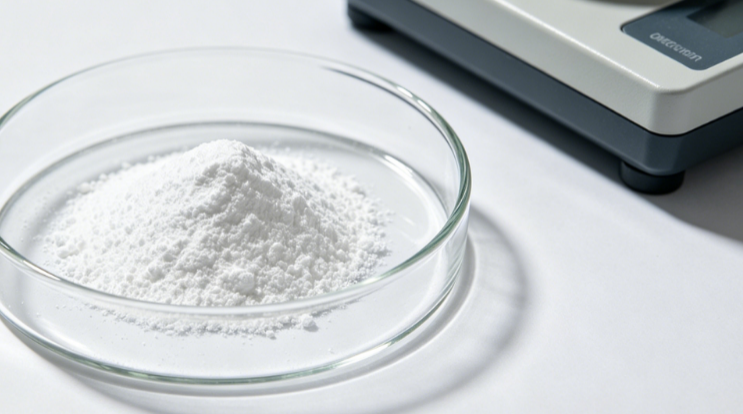
3. Moisture Content and Loss on Drying (LOD): STPP is hygroscopic but not deliquescent; excess moisture leads to caking and hydrolysis. We measure loss on drying at 105 °C (gravimetric) to ±0.02%. For bound water of crystallisation (in hydrated forms), Karl Fischer titration (coulometric) in a dry glovebox gives total water down to 10 ppm. We also offer thermogravimetric analysis (TGA) with evolved gas analysis (MS) to distinguish adsorbed water from decomposition water.
4. Heavy Metals and Trace Elements (ICP‑MS, ICP‑OES): For food‑grade STPP (FCC / EU), heavy metals limits are typically <10 ppm for Pb, As, Cd, Hg. Our ICP‑MS with collision/reaction cell (He mode) achieves detection limits of 0.01–0.1 ppb for all regulated metals. For higher concentrations (100 ppm+), ICP‑OES provides rapid screening. We also measure fluoride (by ion‑selective electrode or IC) to 0.5 ppm and sulfate (by IC) to 1 ppm as per USP/NF requirements.
5. Crystalline Phase Identification – Form I vs. Form II (XRD): STPP exists as two anhydrous phases: Form I (high‑temperature, rapid hydration) and Form II (low‑temperature, slower hydration). The phase ratio dramatically affects dissolution rate and detergent performance. Our high‑resolution X‑ray diffraction (HR‑XRD) with Rietveld refinement quantifies Form I / Form II ratio with ±1% absolute accuracy, down to 1 wt% of either phase. We also detect crystalline hydrates (e.g., hexahydrate) if present.
6. pH and Alkalinity (Free Na₂O): A 1% STPP solution typically has pH 9.0–10.0. Using calibrated glass electrode at 25.0±0.1 °C, we measure pH to ±0.02 units. For free caustic (NaOH) content, we perform potentiometric titration with HCl to pH 4.5, giving free Na₂O down to 0.05%.
7. Particle Size Distribution and Flowability: For detergent or ceramic applications, particle size affects mixing and dissolution rate. We provide laser diffraction (dry dispersion, Fraunhofer/Mie) from 0.1 µm to 2 mm with ±1% repeatability on D50. Angle of repose measurement quantifies flowability (powder rheometer) with ±0.5° accuracy.
8. Bulk and Tapped Density (ASTM D7481): We measure untapped and tapped density using a volumeter (Hosokawa) with 1 cm³ accuracy, reporting Hausner ratio and Carr index for process engineering.
9. Sequestration Capacity (Calcium Binding): For water softening applications, we determine the calcium sequestration value (mg CaCO₃ per g STPP) using a titrimetric method with calmagite or o‑cresolphthalein complexone at pH 10.5, accuracy ±1 mg CaCO₃/g. This directly measures functional performance.
10. Thermal Stability and Phase Transition (DSC‑TGA): Using differential scanning calorimetry (DSC) (25–500 °C, heating rate 5–20 K/min), we identify the Form I ↔ Form II transition at ~420–450 °C and decomposition onset. TGA‑MS detects water release from hydrolysis and evolution of P‑O species. This is critical for STPP used in high‑temperature ceramics or fire retardants.
All analyses are performed under controlled humidity (20–60% RH as needed) to prevent sample degradation. We follow ISO 3358 (detergent phosphates), FCC 12th Edition, and European Pharmacopoeia methods for STPP.
Why Our Sodium Tripolyphosphate Testing Service Stands Out – Precision, Speed, and Application Expertise
We recognise that STPP is a high‑volume industrial chemical where batch‑to‑batch consistency, hydrolysis control, and regulatory compliance are paramount. Our advantages are built on specialised phosphate chemistry experience and rigorous quality systems:
▶ Unmatched Resolution in Polyphosphate Speciation: Most labs can only report “total P₂O₅” and rough ortho/pyro/tripoly ratios. Our IC with gradient elution and post‑column reaction resolves ortho, pyro, tripoly, trimetaphosphate, and tetrapolyphosphate in a single run. We also provide ³¹P NMR as a confirmatory orthogonal method – essential when unusual phosphates (e.g., tetrapoly) are suspected from poor synthesis.
▶ Extremely Low Detection for Hydrolysis Products: Early hydrolysis of STPP in humid storage or production is often invisible to routine assays. Our IC‑ICP‑MS can detect 0.001% orthophosphate (10 ppm), revealing incipient degradation that would otherwise lead to product performance loss (e.g., reduced calcium chelation). We routinely help clients set “freshness” specifications for incoming STPP.
▶ Rapid Turnaround with Custom Reporting: Standard purity panel (IC for phosphates, moisture, pH, heavy metals, particle size) is completed in 3–4 business days. For emergency lot release or failure investigation, we offer 24‑hour express service (same‑day IC and XRD). Reports include full chromatograms, diffractograms, and statistical comparisons to your historical batches.
▶ Compliance with Global Food and Industrial Standards: We are accredited to ISO/IEC 17025:2017 and follow FCC Monograph (Sodium Tripolyphosphate), EU Regulation 231/2012, JECFA specifications, and GB 1886.3 (China). Our Certificates of Analysis (CoA) are accepted by FDA, EFSA, and CFDA for food additive registration.
▶ Phase Analysis Expertise (Form I vs. Form II): Many labs do not offer quantitative phase analysis of STPP. Using Rietveld refinement with internal standard (e.g., corundum), we provide absolute wt% of Form I, Form II, and any amorphous content. This is critical for detergent manufacturers who need fast‑hydrating Form I for automatic dishwashing tablets vs. slow‑hydrating Form II for laundry powders.
▶ Global Logistics and Flexible Sample Sizes: We accept as little as 5 g for a complete analysis. For production QC, we offer prepaid sampling kits with moisture‑barrier bags. International shipments of STPP are non‑hazardous, and we handle all customs documentation. For hygroscopic samples, we provide inert gas packaging.
▶ Expert Consultation for Application Optimisation: Our chemists have extensive experience in phosphate chemistry. We help you: correlate IC results with detergent performance, troubleshoot caking (by moisture and phase analysis), optimise particle size for rapid dissolution, and identify counterfeit or adulterated STPP (e.g., diluted with sodium sulfate). A free 30‑minute technical consultation is included with every project.
▶ Cost‑Effective Throughput for Large‑Volume QC: We serve industrial customers who test dozens of STPP batches weekly. Our automated IC systems with 120‑position autosamplers and batch XRD with robotic sample loading enable us to offer volume discounts and dedicated QC slots. Academic and non‑profit pricing is also available.
In summary, we provide the most comprehensive and precise sodium tripolyphosphate testing service available – from polyphosphate speciation and phase analysis to functional sequestration capacity. Whether you need to certify food‑grade STPP, troubleshoot detergent performance, or verify raw material quality, our data gives you confidence.
Ready to test your STPP? Contact our phosphate analysis team. We will send you a sample submission kit and a custom test plan within one business day. A no‑obligation technical discussion is always free. Let us help you ensure every batch of sodium tripolyphosphate meets your exact specifications – from the first grain to the final application.